 Ferndale Exterior
 Why Birch Bay's Shoreline Climate Is Hard on Siding
Birch Bay sits right on the water along the Salish Sea in Whatcom County, and that location comes with a specific set of exterior problems most inland siding never has to deal with. Salt-laden air moves off the water and settles on everything facing the shoreline, including the siding, trim, and fasteners on a home. Add in wind-driven rain that gets pushed sideways into walls rather than falling straight down, and siding here is under more sustained moisture load than a comparable home twenty minutes inland in Ferndale.
Then there's the moss and algae season, which in this part of Whatcom County can run a good chunk of the year on north-facing walls, shaded elevations, and anywhere siding stays damp longer than it should. Moss holds moisture against the wall, and once it's established it's not just cosmetic — it can trap water at seams, fasteners, and butt joints if the siding underneath isn't built to handle it. Any siding product installed on a Birch Bay home has to be judged against these three things at once: salt exposure, driving rain, and prolonged dampness. That's the lens we use for every material decision, and it's why board and batten specifically has to be done a certain way here to hold up.
What Board & Batten Brings to a Birch Bay Home
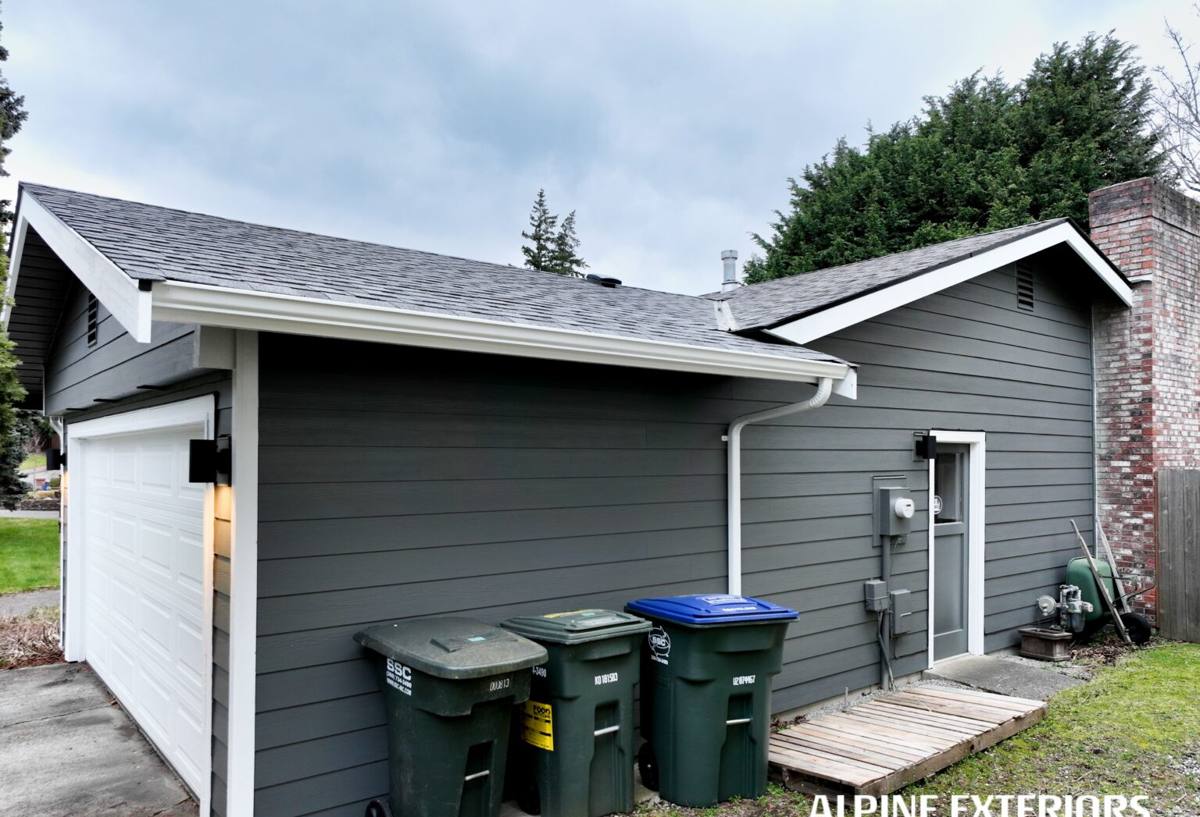
Board and batten is a vertical siding pattern: wide flat boards installed side by side, with narrower battens covering the seams between them. It's a look that's been used on coastal and farm buildings for a long time because the vertical lines shed water cleanly and the pattern reads well against gable roofs, dormers, and simple massing — which describes a lot of the housing stock around Birch Bay and Ferndale. Homeowners choose it for the clean, modern-farmhouse or classic Pacific Northwest coastal look, often mixed with horizontal lap siding as an accent on gables, entries, or a second story.
The pattern itself doesn't determine how well it holds up — the material behind it does. Board and batten has more linear seams per square foot than lap siding, and every one of those seams is a place water can find its way in if the board underneath swells, cups, or rots. That makes material choice more consequential for board and batten than it is for some other siding styles, especially in a climate like this one.
Where Board & Batten Works Best on a Home
Board and batten performs well as full exterior coverage or as an accent on specific elevations — gable ends, dormers, porch surrounds, and garage faces are common choices. On a home exposed to direct wind off the water, we pay close attention to which walls take the worst of the driving rain and make sure those elevations get the same attention to flashing and drainage as the rest of the house, regardless of whether board and batten is used there or not.
Why We Only Install Board & Batten in James Hardie Fiber Cement
We get asked why we don't offer board and batten in cedar, primed spruce, LP SmartSide, or vinyl — all of which are sold as board and batten options elsewhere. Here's the honest reasoning, not a sales pitch against those products.
Cedar is a genuinely good-looking natural material, and it's been used on this coast for generations. The trade-off is that it's organic — it absorbs moisture, and in a climate with this much sustained dampness and moss pressure, that means ongoing refinishing, sealing, and a real risk of rot at the seams and battens if maintenance slips even one season.
Primed spruce board and batten is a budget option, but the wood underneath the primer is still susceptible to swelling and moisture intrusion at cut edges and joints, which are exactly the areas board and batten has the most of.
LP SmartSide is an engineered wood product with a resin-treated strand substrate, and it performs reasonably well when the factory finish and edge seals stay intact. The catch is that if a seam, cut edge, or fastener point gets compromised — which happens over years of salt exposure and wind — moisture can wick into the substrate and cause swelling at exactly the joints board and batten depends on staying tight.
Vinyl board and batten is low-cost and low-maintenance in the sense that it doesn't rot, but it's a poor match for this look — vinyl expands and contracts significantly with temperature swings, which telegraphs through crisp vertical lines as waviness over time, and it doesn't hold paint or color the way fiber cement does if a homeowner ever wants to change the look.
James Hardie fiber cement is cement, sand, and cellulose fiber — it doesn't rot, it isn't a food source for insects, and it doesn't expand and contract with moisture the way wood-based products do. Hardie also builds specific product lines engineered for different climate zones; the HZ5 line is built for regions with the kind of freeze-thaw and moisture cycling the Pacific Northwest coast sees. Combined with the ColorPlus factory finish — baked on rather than field-applied — it holds color and resists the salt-air fading and chalking that painted wood and some engineered products struggle with. That's the whole reason we standardized on it: it's the one material we can put on a Birch Bay wall and stand behind for the long haul.
Material Comparison for Coastal Board & Batten
| Material | Salt Air & Driving Rain | Maintenance Needed | Long-Term Outlook |
|---|---|---|---|
| James Hardie Fiber Cement (HZ5) | Non-combustible, dimensionally stable, engineered for wet climates | Occasional wash; no repainting with ColorPlus finish | Strong transferable warranty, proven in coastal PNW use |
| Cedar | Absorbs moisture; needs sealing to resist salt and rot | Refinish/reseal every few years | Rot and insect risk rises without upkeep |
| Primed Spruce | Swells at joints and cut edges if moisture gets in | Repaint and caulk regularly | Shorter service life in wet coastal exposure |
| LP SmartSide | Holds up if finish and seals stay intact | Monitor edge seals and touch up finish | Vulnerable at seams if finish is compromised over time |
| Vinyl | Won't rot, but expands/contracts with temperature | Low maintenance | Lines can warp/wave; limited color-change options |
What a Correct Board & Batten Installation Actually Involves
Board and batten looks simple, but a correct install is more demanding than lap siding because of how many seams and fastening points are involved. A few things we treat as non-negotiable:
- A rainscreen gap or furring strip system behind the siding, so any moisture that does get past the surface has a path to drain and the wall assembly can dry out instead of staying damp against the sheathing
- Fastening per Hardie's published pattern — correct nail spacing, depth, and location so boards aren't over-driven or under-secured, both of which cause problems over time
- Proper flashing at every window, door, and roof-to-wall transition, since these are the points where wind-driven rain finds its way behind siding if they're rushed
- Correct gapping and sealing at butt joints and board ends, using sealants compatible with fiber cement rather than whatever's on hand
- Kickout flashing at roof-wall intersections so runoff is directed away from the wall instead of behind the siding
- Factory-finished cut edges sealed in the field wherever boards are trimmed on site, preserving the ColorPlus warranty coverage
Skipping any one of these doesn't usually show up as a problem in year one. It shows up in year five or seven, as staining, soft spots, or paint failure at the seams — which is exactly the kind of slow failure that's expensive to diagnose and fix after the fact, versus building it right the first time.
Our Process for Birch Bay Board & Batten Projects
We start with an on-site assessment specific to the home's exposure — which walls take the worst of the wind and driving rain off the water, where moss and shade are already a problem, and what condition the existing sheathing and wall assembly are in once old siding comes off. That exposure assessment shapes decisions about flashing detail and drainage plane, not just which product line we use.
- Walkthrough and exposure assessment, including a look at existing moisture damage or moss buildup
- Removal of old siding and inspection of the sheathing and framing underneath before anything new goes up
- Installation of the rainscreen/drainage system and correct flashing at every penetration and transition
- Board and batten installation to Hardie's HZ5 specifications, with attention to fastening and joint sealing
- Final walkthrough covering caulking, touch-up, and cleanup before we consider the job done
We don't shortcut the assessment step. A home on an exposed western elevation facing the water needs a different level of flashing attention than a more sheltered wall on the same house, and treating every wall identically is how coastal siding jobs end up failing early.
Keeping Board & Batten Looking Right Through the Wet Season
Fiber cement with a factory finish is genuinely low-maintenance, but "low-maintenance" isn't "no-maintenance," especially this close to the water. A little seasonal attention keeps a board and batten job looking and performing the way it should for decades:
- Rinse salt film off wind-exposed elevations a couple of times a year, especially after storms that push spray directly onto the walls
- Keep gutters and downspouts clear so water sheets off the roof correctly instead of running down the wall face
- Trim back vegetation near shaded or north-facing walls to improve airflow and cut down on moss and algae buildup
- Do a quick annual check of caulking at trim, windows, and penetrations, since sealant is the first thing to wear out, not the siding itself
- Touch up any chips or scrapes at impact points promptly, so the substrate underneath never sits exposed
Why Hiring a Crew That Already Works Birch Bay Matters
Board and batten done wrong doesn't fail everywhere on a house evenly — it fails first on the elevations that take the worst weather, and those elevations are different on a shoreline lot than they are twenty minutes inland. A crew that already works homes in Birch Bay knows which walls typically take the brunt of the wind and salt spray, understands the moss patterns specific to shaded coastal lots, and isn't guessing about how much flashing and drainage detail a given elevation actually needs.
Familiarity with Whatcom County permitting and inspection expectations also keeps projects moving instead of stalling on paperwork. And practically, a crew based nearby in Ferndale can respond quickly if weather windows shift — which they do often enough on this coastline that scheduling flexibility matters as much as installation skill.
If you're weighing board and batten for a home in Birch Bay, we're glad to walk the property, talk through what your specific elevations need, and give you a straightforward, no-pressure estimate — just fill out the form below.