 Ferndale Exterior
 Vinyl siding and fiber cement siding get compared constantly, and most of what's written about it online comes from manufacturers of one product or the other. We install exclusively James Hardie fiber cement, so we'll say upfront that we have a position here. But we also think Ferndale homeowners deserve a straight answer about what each product actually does on a house, not a sales pitch. This page lays out where vinyl genuinely earns its reputation, where it falls short in our climate, and why we stopped installing it years ago.
What Vinyl Siding Actually Gets Right
Vinyl isn't a bad product — it's a compromise product, and for a lot of homeowners that compromise makes sense. It's the least expensive siding material on the market, it goes up fast, and it never needs painting. For a rental property, a quick flip, or a tight budget where siding is one of ten competing expenses, vinyl solves a real problem.
It's also genuinely low-maintenance in the sense that it won't rot and it doesn't need refinishing. A homeowner who wants to spend zero weekends on siding upkeep will get that from vinyl, at least for a while.
Where It Starts to Show Its Age
The trade-offs show up over time, and they show up faster in this part of Washington than they would in a drier, calmer climate. Vinyl is a thin plastic product — typically .040" to .046" thick — installed with a "hanging" method that allows it to expand and contract with temperature. That flexibility is by design, but it also means vinyl can rattle, oil-can (that visible waviness in sunlight), and crack in cold snaps once it's a decade or more old.
Color is baked into the plastic itself, which sounds durable until you consider that dark colors fade and chalk under UV exposure, and there's no refinishing option — once it fades unevenly, replacement is the only fix. Impact resistance is also a real concern: a stray branch, a ladder bump, or a thrown rock can crack a panel, and matching an old, sun-faded panel with a new one is rarely seamless.
Why the Northwest Coast Is a Tougher Test
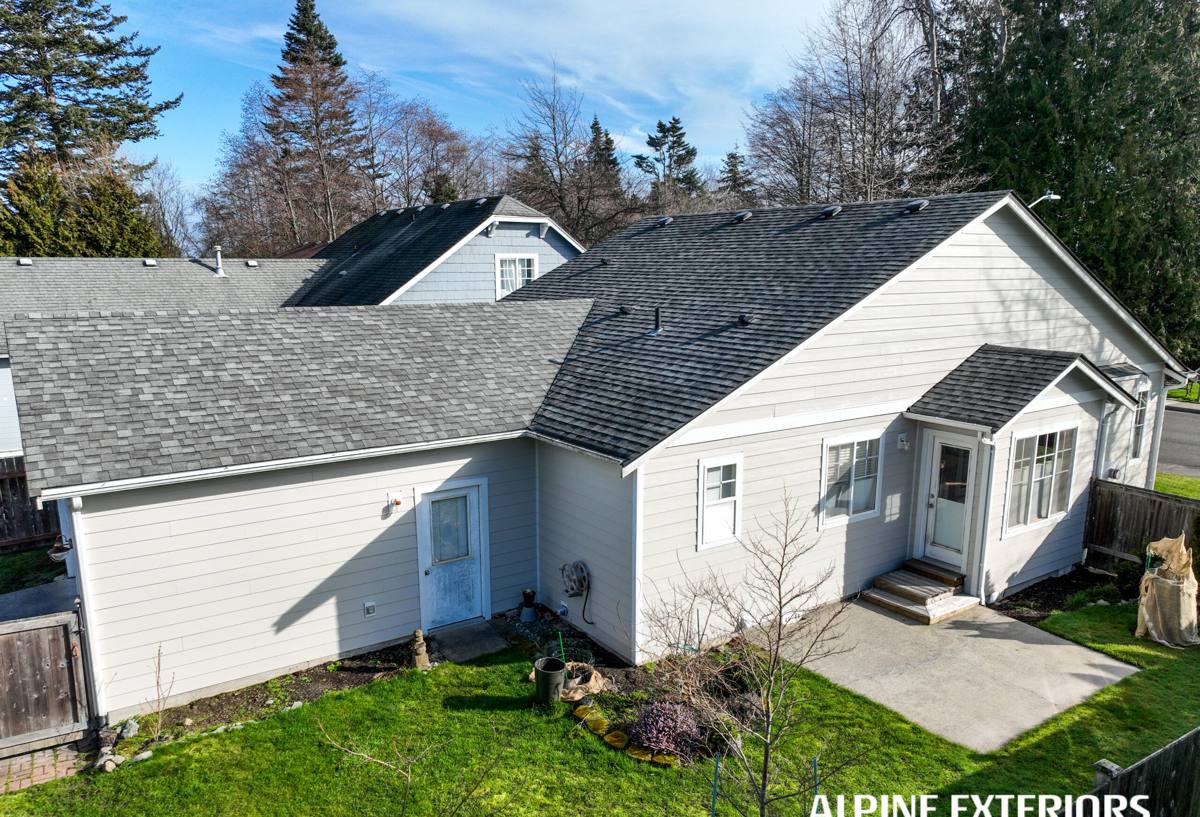
Ferndale and the rest of Whatcom County sit in a climate that's genuinely harder on exterior materials than most of the country realizes. We're close enough to the water to deal with salt-laden air, we get long stretches of driving rain off the Strait of Georgia, and our winters run cool and damp enough to support a moss and algae season that can stretch for months. That combination — moisture, salt, and shade from mature Pacific Northwest tree cover — is exactly the environment where cheaper siding systems get exposed.
Vinyl itself doesn't rot or absorb water the way wood does, which is a fair point in its favor. But vinyl siding is a rain-screen system that depends heavily on correct lapping, flashing, and a functioning weather-resistant barrier behind it. Panels are not sealed to each other — they're designed to let water get behind them and drain out the bottom. When that system is installed even slightly wrong, or when trim and J-channel details are cut short to save labor, water finds its way to the sheathing behind the panels. In a climate with this much sustained rain, that's not a hypothetical — it's a maintenance issue we've seen play out on homes across the county.
Moss, Algae, and Cleaning
Vinyl's textured, low-gloss finish is comfortable ground for algae and moss growth in shaded, damp areas — the north sides of homes tucked under trees, the kind of siting common throughout Ferndale's older neighborhoods. Keeping it looking clean typically means periodic soft-washing, and homeowners need to be careful with pressure washers, since too much force can drive water behind the panels or crack aged, brittle vinyl.
Fiber Cement: The System We Chose
James Hardie fiber cement is a cement, sand, and cellulose fiber composite — it's rigid, heavy, and dimensionally stable in a way plastic siding simply isn't. It doesn't expand and contract with temperature swings the way vinyl does, so there's no oil-canning, no rattling in wind, and it holds its shape and its fastening pattern for decades.
It's also non-combustible, which matters more every year as wildfire smoke seasons touch this region even when the fire itself doesn't. And it's engineered specifically for climate: Hardie's HZ5 product line is formulated for the Pacific Northwest's wet, humidity-heavy conditions, which is the version we install here rather than a generic national product.
ColorPlus Finish vs. Painted or Baked-On Color
Where vinyl bakes color into the plastic and offers no way to refresh it, Hardie's ColorPlus finish is a factory-applied, baked-on finish engineered specifically to resist the fading vinyl is prone to, and it can be repainted down the road when a homeowner wants a new look — something vinyl simply can't offer. It's a meaningfully different proposition: instead of a material that degrades visually with no recourse, you get a finish designed to last and an option to change color later without replacing the siding.
Side-by-Side Comparison
| Factor | Vinyl Siding | James Hardie Fiber Cement |
|---|---|---|
| Material | PVC plastic panels | Cement, sand, cellulose fiber composite |
| Upfront cost | Lowest on the market | Higher upfront investment |
| Fire resistance | Combustible plastic | Non-combustible |
| Impact resistance | Can crack from impact, especially when cold or aged | Rigid and impact-resistant when installed correctly |
| Behavior in wind/heat | Can oil-can, rattle, warp | Dimensionally stable |
| Color longevity | Fades and chalks with UV, no refinish option | ColorPlus finish resists fading; repaintable |
| Moisture management | Rain-screen design; performance depends heavily on install quality | Rigid panel system with climate-specific HZ5 formulation |
| Typical lifespan | 15-25 years before visible degradation | 30+ years with correct installation and upkeep |
| Warranty structure | Varies widely by manufacturer, often prorated | Long-term, transferable non-prorated coverage from Hardie |
The Installation Sensitivity Problem
Both products can fail early — but they fail for different reasons, and vinyl's failure mode is more forgiving of shortcuts in some ways and less forgiving of climate in others. Vinyl is fast and inexpensive to install, which unfortunately means it attracts crews working on volume rather than precision. Loose nailing, missing weep holes, poor J-channel work, and skipped flashing details are common corner-cutting because vinyl's flexibility hides sloppy work — for a while.
Fiber cement is less forgiving of shortcuts in a different way: it requires correct fastener placement, proper clearances, and manufacturer-specified flashing and caulking details, or you lose the performance and warranty protection the product is built for. That's exactly why installation quality — not just product choice — is the deciding factor in how either siding performs over 20 years in this climate.
What to Ask Any Contractor, Regardless of Product
- Are you following the manufacturer's written installation instructions, including fastener spacing and clearances?
- How are you flashing windows, doors, and roof lines to keep water out from behind the siding?
- What weather-resistant barrier is going behind the panels, and how is it lapped?
- What's your plan for ground clearance and drainage at the base of the wall?
- Is the warranty from the manufacturer, and does it transfer to a future homeowner if the house sells?
- Can you show examples of the specific product line you're proposing, not just a generic sample?
Cost Over Time, Not Just Cost Upfront
Vinyl wins on day-one price every time. But the honest comparison has to account for what happens over 20-30 years: vinyl siding that fades, cracks, or gets damaged by impact typically gets replaced rather than repaired, because discontinued colors and sun-fading make patch repairs visibly obvious. Fiber cement costs more to install but holds its finish, its shape, and its structure long enough that most homeowners who choose it are not thinking about siding again for decades.
Neither product is "maintenance-free" in a climate like ours — gutters need cleaning, moss needs washing off in shaded areas, and caulking needs periodic inspection regardless of what's on the wall. The difference is what happens if maintenance gets deferred: vinyl's forgiveness runs out when panels crack or fade unevenly with no fix available; fiber cement installed to spec tends to hold up through the kind of neglect that would leave other products looking rough.
Why We Only Install James Hardie
We made the decision years ago to install one siding system and install it correctly, rather than offer a menu of products at different price points. James Hardie's fiber cement, factory-applied ColorPlus finish, climate-specific HZ5 formulation, and transferable warranty line up with what actually holds up against Whatcom County's salt air, driving rain, and moss season. Vinyl has a place in this market — we just don't think that place is on a home we're putting our name behind.
If you're weighing siding options for a home in Ferndale or anywhere in Whatcom County, we're happy to walk your property, look at your sun exposure and tree cover, and give you a straight assessment — no pressure, no sales script. Reach out for a free estimate using the form below.