 Ferndale Exterior
 Serving Bellingham Homes Across Four Trades
Bellingham sits at the heart of Whatcom County's exterior-punishing climate: salt-tinged air moving in off Bellingham Bay, wind that drives rain sideways into wall assemblies and window frames, and a moss season that can run most of the year on shaded roof slopes and north-facing siding. Homes here work harder than homes in drier parts of the state, and the exterior systems protecting them need to be built and maintained with that in mind. We're based just up the road in Ferndale, and Bellingham has long been part of our regular service area — we know what this specific stretch of coastline does to a house over ten, twenty, and thirty years, not just what a spec sheet says it should do.
We handle four exterior trades for Bellingham homeowners: siding, roofing, windows, and decks. Rather than treating each as a separate transaction, we look at the exterior as one connected system, because water and wind don't respect the boundaries between trades. A window flashed wrong feeds moisture into the wall behind the siding. A roof edge that sheds water poorly can undercut siding and trim below it. Getting each trade right on its own matters, but getting the connections between them right is what actually keeps a Bellingham home dry for the long haul.
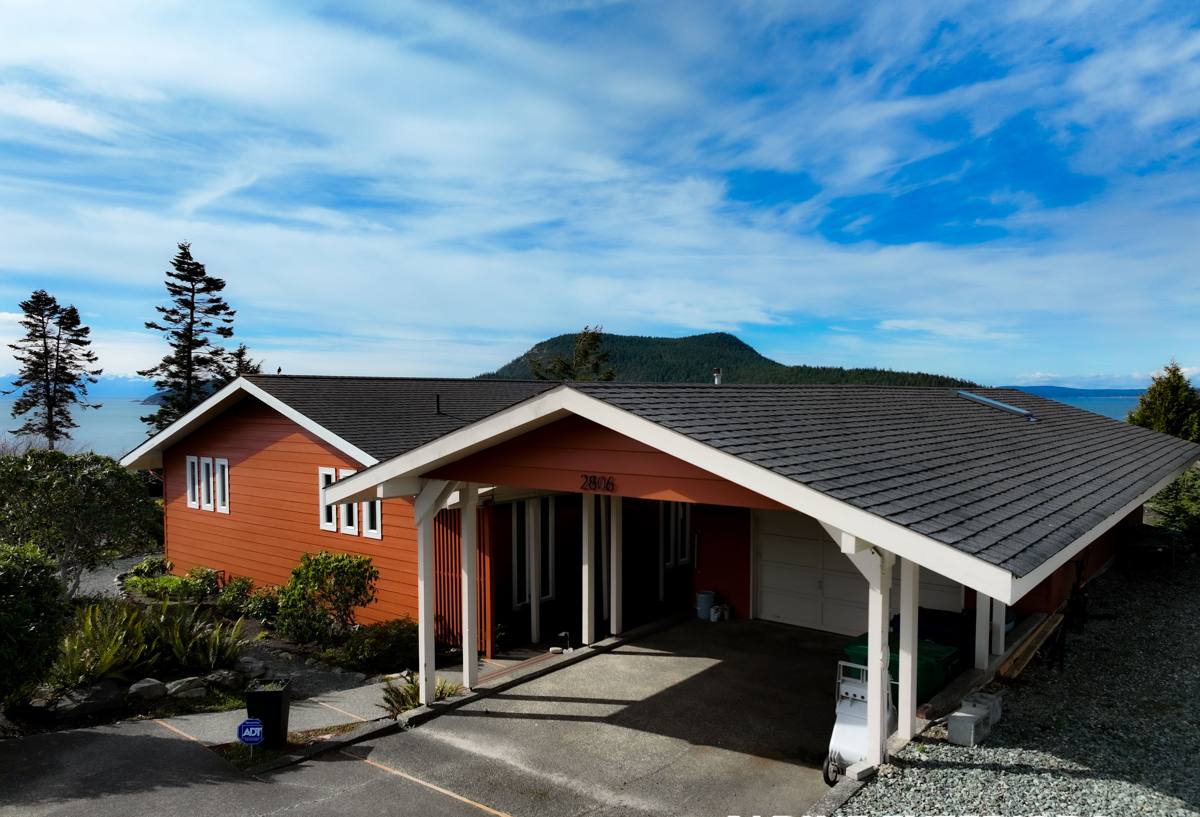
What Bellingham's Climate Does to a House
Salt Air and Marine Exposure
Being this close to Bellingham Bay and the Salish Sea means a steady dose of salt-laden air moving across roofs, siding, and exposed hardware. Salt speeds up corrosion in fasteners, flashing, and metal trim, and it wears down lower-grade finishes faster than you'd see further inland. Material and hardware choices that ignore that exposure tend to show their age early — chalking paint, rusting fasteners, and trim that fails years ahead of schedule.
Wind-Driven Rain
Rain off the water rarely falls straight down here. Wind pushes it sideways into siding laps, window frames, and roof-to-wall transitions, which is a tougher test than a simple rainfall total suggests. Products and installation details that would perform fine in a calmer climate can still let water in around Bellingham specifically because the rain is coming from the side, not just from above.
A Long Moss and Mildew Season
Mild temperatures, plenty of shade from mature trees, and near-constant moisture add up to a moss and algae season that runs long across Whatcom County, and Bellingham's tree-heavy neighborhoods see it as much as anywhere. Roofs lose granule protection faster under sustained moss growth, and porous or moisture-retentive siding becomes a growth surface over time — usually on north-facing walls and shaded rooflines well before it's visible from the street.
Siding: James Hardie Only
We install James Hardie fiber cement siding exclusively — in Bellingham, in Ferndale, and everywhere else we work in Whatcom County. We don't install LP SmartSide, vinyl siding, Cemplank, Allura, primed spruce, or cedar. That's not a brand preference pulled off a supplier list; it's a standard we settled on after seeing which products actually hold up against this specific mix of salt air, wind-driven rain, and sustained moisture, and which ones quietly shift maintenance burden onto the homeowner a few years down the road.
- Non-combustible core: fiber cement doesn't feed a fire the way wood-based siding products can.
- Factory-applied ColorPlus finish: baked on under controlled conditions rather than field-painted, so it resists fading and moisture intrusion far longer.
- Climate-engineered HZ product lines: Hardie's HZ5 formulation is built for regions with heavy moisture exposure and freeze-thaw cycling, which describes coastal Whatcom County well.
- Dimensional stability: fiber cement doesn't swell, cup, or warp the way engineered wood siding can after repeated wet-season cycles.
- Strong transferable warranty: backed by one of the more robust warranty structures in the industry when installation follows spec.
Each of the products we don't install has a legitimate place in the market, and plenty of homeowners are satisfied with them. We made a professional call that in a climate this demanding, standing fully behind one system beats offering a menu of options with different risk profiles attached.
Roofing Built for Moss Season
A roof in Bellingham does more work than a roof in a dry inland climate. Beyond shedding rain, it has to resist sustained moss and algae growth, hold up to salt-laden wind, and keep water moving correctly at every valley, penetration, and edge. We install and repair roofing with attention to the details that matter most here: proper underlayment for wind-driven rain, ventilation that keeps moisture from condensing in the attic, and flashing details at chimneys, skylights, and wall transitions that are the single most common source of roof leaks we find on service calls.
Moss Isn't Just Cosmetic
Moss on a roof holds moisture against shingles and granules, and over time it accelerates wear well beyond what the shingle's rated lifespan assumes. Left unaddressed, it can work its way under shingle edges and into fastener penetrations. Regular moss treatment and gutter maintenance extend a roof's useful life meaningfully in this climate — it's one of the cheaper things a homeowner can do to protect a bigger investment.
Windows: Sealing Out Wind-Driven Rain
Windows are one of the more common places we find moisture intrusion on Bellingham homes, and it's rarely the glass itself that's the problem — it's the flashing and sealing around the frame. Wind-driven rain finds any gap in the flashing sequence and tracks behind the siding or into the wall cavity, sometimes for years before it becomes visible as staining, soft trim, or a musty smell. When we replace windows, we treat the flashing and integration with the surrounding siding as seriously as the window unit itself, because a well-made window installed with a broken water path will still fail.
Energy Performance Matters Here Too
Bellingham's marine climate keeps temperature swings moderate compared to inland Washington, but drafty or poorly sealed windows still cost homeowners on heating bills through the damp winter months. Modern window units with good seals and appropriate glazing pay that difference back over time, on top of stopping the moisture problems that older, failing windows tend to invite.
Decks: Built to Handle Standing Moisture
Decks in Bellingham face a slower but steady version of the same moisture problem as siding and roofing: rain that doesn't dry out quickly given the region's humidity and shade, ground contact and fastener corrosion accelerated by salt air, and moss or algae buildup on horizontal surfaces that don't get much direct sun. We build and repair decks with attention to drainage, fastener selection, and ledger flashing — the detail most likely to cause structural problems if it's done wrong, since a poorly flashed ledger board lets water track directly into the house framing.
Why a Local Crew Matters in Bellingham
Exterior work here isn't generic. A crew that mainly works drier inland climates can install a technically correct product using a detail sequence that simply isn't built for this much sustained wind-driven rain and salt exposure, and the failure shows up years later as a callback nobody wants. We're a Whatcom County crew, based in Ferndale, and Bellingham is core to our regular service area — we've seen what holds up here and what doesn't, on siding, roofs, windows, and decks alike, and we build accordingly.
Cost Factors for Bellingham Exterior Projects
| Factor | What It Affects | Why It Matters Here |
|---|---|---|
| Home size and exterior complexity | Total material and labor across trades | More trim, valleys, and joints mean more places for wind-driven rain to intrude |
| Tear-off vs. overlay (siding and roofing) | Labor scope and substrate access | Tear-off reveals hidden moisture damage common under older materials in this climate |
| Substrate and framing condition | Repair costs before new material goes on | Years of trapped moisture can rot sheathing, decking joists, or roof framing |
| Flashing and detail work | Long-term water resistance | Salt air and sideways rain punish weak flashing details faster than a calmer climate would |
| Material selection | Upfront cost and maintenance burden | Climate-matched products cost more upfront but avoid the repeat maintenance cycle common with lesser materials here |
A Practical Checklist for Bellingham Homeowners
- Check north-facing siding and shaded roof slopes for moss buildup each spring and fall
- Look for rust streaking at fasteners and metal trim, a sign of salt-air corrosion
- Inspect window frames and interior sills after heavy wind-driven rain events for signs of intrusion
- Keep gutters and downspouts clear so roof runoff doesn't back up under shingles or siding
- Check deck ledger boards and fasteners annually for corrosion or softening wood
- Address small moisture issues promptly — in this climate, they rarely stay small
If you're weighing a siding, roofing, window, or deck project in Bellingham, we're happy to take a look and give you a straightforward, no-pressure estimate — just fill out the form below.