 Ferndale Exterior
 The Question We Get Asked Most
Almost every homeowner who calls us about a siding project asks about vinyl at some point. It's the most common siding material sold in the United States, it's inexpensive, and most people have seen it on countless homes around Whatcom County. So when we tell a homeowner in Ferndale that we don't install it, we owe them a straight answer about why — not a sales pitch, an honest one.
This page is that answer. We're not going to tell you vinyl siding is a scam or that everyone who has it made a mistake. Millions of homes wear it just fine. What we will tell you is why, after years of doing exterior work in this specific corner of the Pacific Northwest, we made the decision to stop installing it and to standardize on James Hardie fiber cement instead.
What Vinyl Siding Actually Gets Right
Fair is fair. Vinyl earned its market share for real reasons:
- Low upfront cost. It's usually the cheapest siding option on a bid sheet.
- No paint required. The color is molded through the material, so there's nothing to repaint under normal conditions.
- Lightweight and fast to install. Crews can cover a house quickly, which keeps labor costs down.
- Low-maintenance in mild, dry climates. In parts of the country with hot, dry summers and light rainfall, vinyl can perform reasonably well for a long time.
If you live somewhere with a dry climate and a tight budget, we understand the appeal. Whatcom County isn't that place, and that's the whole issue.
Why Our Climate Changes the Math
Salt Air and Moisture
Ferndale sits close enough to Bellingham Bay and the Salish Sea that salt-laden air is a real factor on exterior materials here, not a theoretical one. Combine that with our long, wet winters and the near-constant damp of a Pacific Northwest fall, and you have conditions that stress-test any cladding system's weak points — especially at seams, corners, and fastener penetrations.
Driving Rain
Storms coming off the water don't just fall straight down — wind-driven rain pushes moisture sideways, into laps, J-channels, and utility penetrations. Vinyl siding is designed as a "rain screen" that relies on gaps and drainage planes rather than a fully sealed surface. That's a reasonable design in light-rain regions. In a place where driving rain is a seasonal reality, it puts more pressure on correct flashing and installation detail than the product's low cost usually buys.
The Long Moss Season
Whatcom County's mild, wet winters are exactly the conditions moss and algae need to establish themselves on north-facing walls, shaded elevations, and anywhere siding stays damp for extended stretches. Vinyl's textured surface and overlapping panels give organic growth plenty of places to take hold, and because the color is baked into a thin, flexible material, aggressive cleaning to remove moss can dull the finish or crack panels over time.
The Real-World Trade-Offs
Heat and Cold Movement
Vinyl expands and contracts more than fiber cement with temperature swings. Installers have to leave room for that movement at every nail and every panel end. Nail it too tight and panels can buckle or warp; nail it too loose and panels can rattle in wind or blow off in a storm. Our winds off the water and temperature swings between summer afternoons and winter nights make correct installation tolerance more important, not less.
Impact Damage
Vinyl is a thin, flexible plastic. It resists denting reasonably well but cracks under sharp impact — a thrown rock, a ladder bump, hail, or debris in a windstorm — especially once it's had a few cold winters to become more brittle. A cracked panel usually means a full section replacement, and if that exact color and profile has faded from a decade of sun exposure, matching it can be difficult.
Seams and Fading
Vinyl panels are installed in overlapping horizontal runs, and on longer wall sections you'll often see vertical seams where panels join. Over years of UV exposure, vinyl can fade unevenly, making seams and patched sections more visible than they were at installation. Because color is molded through the material rather than applied as a finish, there's no practical way to refresh the color short of replacement.
Installation Sensitivity
Vinyl is genuinely easy to install badly and still have it look fine on installation day. Problems — nailed too tight, flashing details skipped, insufficient overlap at corners — often don't show up until the first hard winter or the first big windstorm, well after the crew has moved to the next job. That gap between "installed" and "problem visible" is part of why we didn't want to build our name on it.
Vinyl vs. James Hardie: A Side-by-Side Look
| Factor | Vinyl Siding | James Hardie Fiber Cement |
|---|---|---|
| Core material | PVC plastic | Cement, sand, and cellulose fiber |
| Fire behavior | Combustible plastic | Non-combustible |
| Moisture response | Doesn't absorb water, but relies on drainage gaps at seams | Engineered HZ formulations for Pacific Northwest moisture exposure |
| Impact resistance | Cracks under sharp impact, more brittle with age | Dense, rigid board resists denting and cracking |
| Color/finish | Color molded through material, fades unevenly, no repainting option | Factory-baked ColorPlus finish, warrantied against fading and peeling |
| Expansion/contraction | Significant; installation tolerance is critical | Minimal; more forgiving over temperature swings |
| Typical lifespan (installed to spec) | 20-30 years, condition-dependent | 30-50+ years, backed by transferable warranty |
| Upfront cost | Lowest of common siding options | Mid-to-higher upfront cost |
Why We Standardized on James Hardie
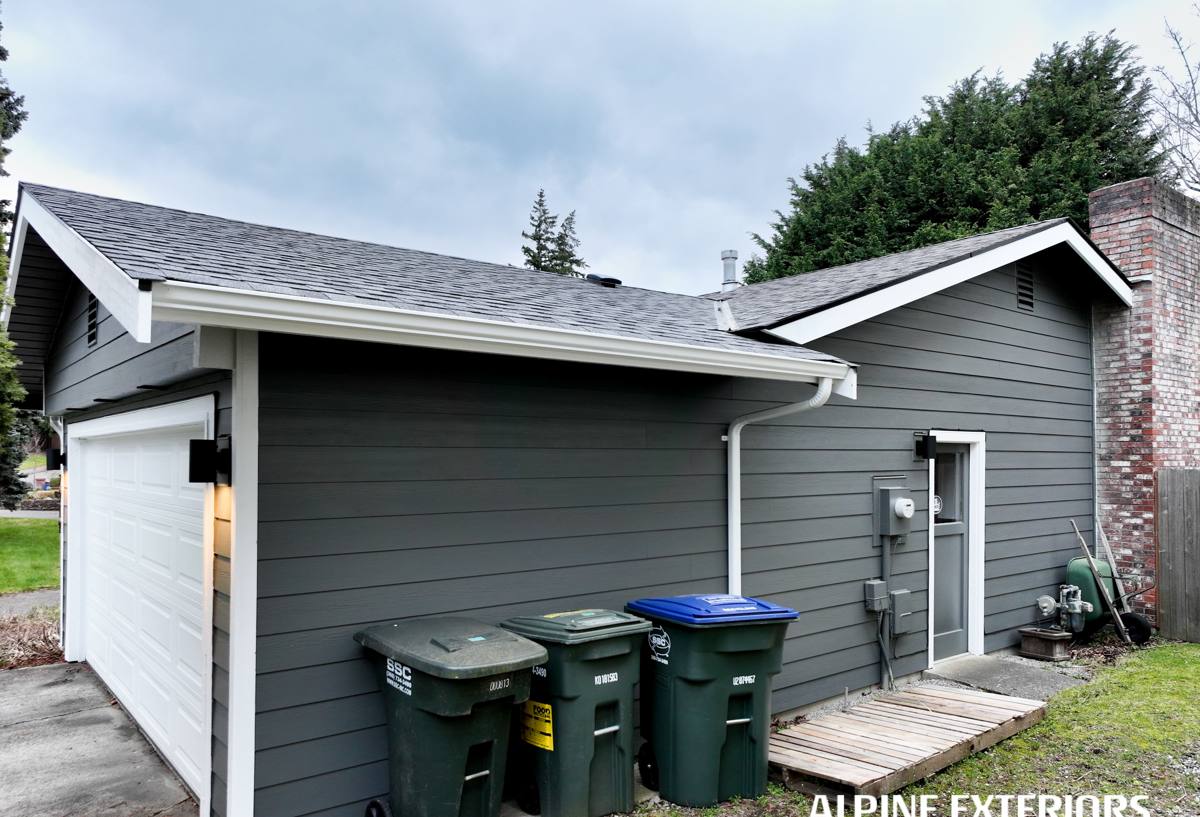
After years of tearing off old siding and seeing firsthand how different materials hold up in Whatcom County conditions, we made a decision: we would install one product line, do it correctly every time, and stand behind it. That product is James Hardie fiber cement.
Non-Combustible Core
Hardie board is made primarily of cement, sand, and cellulose fiber. It doesn't burn. In a region where wildfire smoke and dry late-summer stretches have become a more regular concern even west of the Cascades, that's a real difference in what's on your walls, not a marketing point.
Built for This Climate
Hardie's HZ5 product line is engineered specifically for regions like ours — freeze-thaw cycles, sustained damp, and coastal moisture exposure. That's not a generic siding designed for the whole country and sold everywhere; it's a formulation with our kind of weather in mind.
ColorPlus Factory Finish
Instead of color baked into a flexible plastic, Hardie's ColorPlus finish is a factory-applied, baked-on finish designed to resist fading, chipping, and cracking better than field-applied paint — and it comes with its own finish warranty separate from the product warranty.
Real Weight and Rigidity
Fiber cement is dense and rigid compared to vinyl. It holds paint or factory finish differently, resists impact better, and doesn't telegraph the wavy, "not quite flat" look that vinyl can develop over time as panels expand, contract, and settle against the wall.
A Warranty Worth Something
Hardie backs its products with a strong, transferable limited warranty. That matters twice: once for you, and again down the road if you sell the house — a documented, transferable warranty on the siding is a real selling point for the next owner.
What Correct Hardie Installation Requires
None of these benefits show up automatically — fiber cement only performs the way it's designed to when it's installed to spec. That means:
- Correct fastener type, spacing, and depth (Hardie is unforgiving of both overdriven and underdriven nails)
- Proper clearances at grade, decks, and roof lines to keep the board out of standing moisture
- Correctly lapped and flashed penetrations, corners, and butt joints
- Factory-cut edges sealed or primed per manufacturer specification
- Use of Hardie-approved trim and accessory products, not mismatched substitutes
We install this way on every project, not just when someone is watching.
Making the Right Call for Your Home
If your budget genuinely can't stretch to fiber cement, we'll tell you that honestly rather than talk you into something we won't stand behind — and we'll tell you what corners not to cut with whatever you choose. But if you're weighing options for a home in Ferndale or anywhere in Whatcom County, our professional recommendation is fiber cement, specifically James Hardie, installed correctly. It's the product we'd choose for our own homes in this exact climate, and it's the only siding we put our name behind.
If you'd like to talk through your options, we're happy to take a look at your home and walk you through what makes sense for your budget and your walls. Reach out for a free, no-pressure estimate — there's a form right below this page.