 Ferndale Exterior
 What Lynden's Climate Does to a House
Lynden sits inland from Bellingham Bay in Whatcom County, but "inland" in this part of Washington doesn't mean dry. Homes here still deal with salt-tinged marine air moving in off the Strait of Georgia and Puget Sound, long stretches of driving rain through fall and winter, and a moss season that can run eight or nine months out of the year on shaded or north-facing walls and roof planes. None of that is unusual for this region. What matters is whether a home's exterior was built and installed to handle it, or just to look good on the day it went up.
Salt Air and the Whatcom County Coastline
Even homes several miles from open water pick up trace salt in the air during onshore weather patterns, especially in fall and winter storms. Salt-laden moisture accelerates corrosion on fasteners, flashing, and any exposed metal, and it speeds up the breakdown of paint films and lower-grade siding materials. It's a slow process, which is exactly why it gets overlooked — the damage shows up as premature caulk failure, rust streaking, and paint that needs redoing years ahead of schedule.
Driving Rain and Wind-Driven Moisture
Whatcom County storms don't just drop rain straight down — wind pushes it sideways into wall assemblies, around window and door openings, and up under lap siding and roof edges. A house exterior in Lynden needs to shed wind-driven rain, not just rain falling straight down. That comes down to flashing details, lap spacing, house wrap integration, and roof underlayment choices as much as it does the visible material on the outside.
Moss, Shade, and the Long Wet Season
Lynden's mix of open farmland and tree-lined residential streets means some homes get plenty of sun exposure while others sit in near-constant shade from mature trees. Shaded roofs and north-facing siding stay damp longer after every rain event, which is exactly the environment moss and algae need to take hold. Left unchecked, moss holds moisture against roofing and siding surfaces for extended periods, which shortens the life of both.
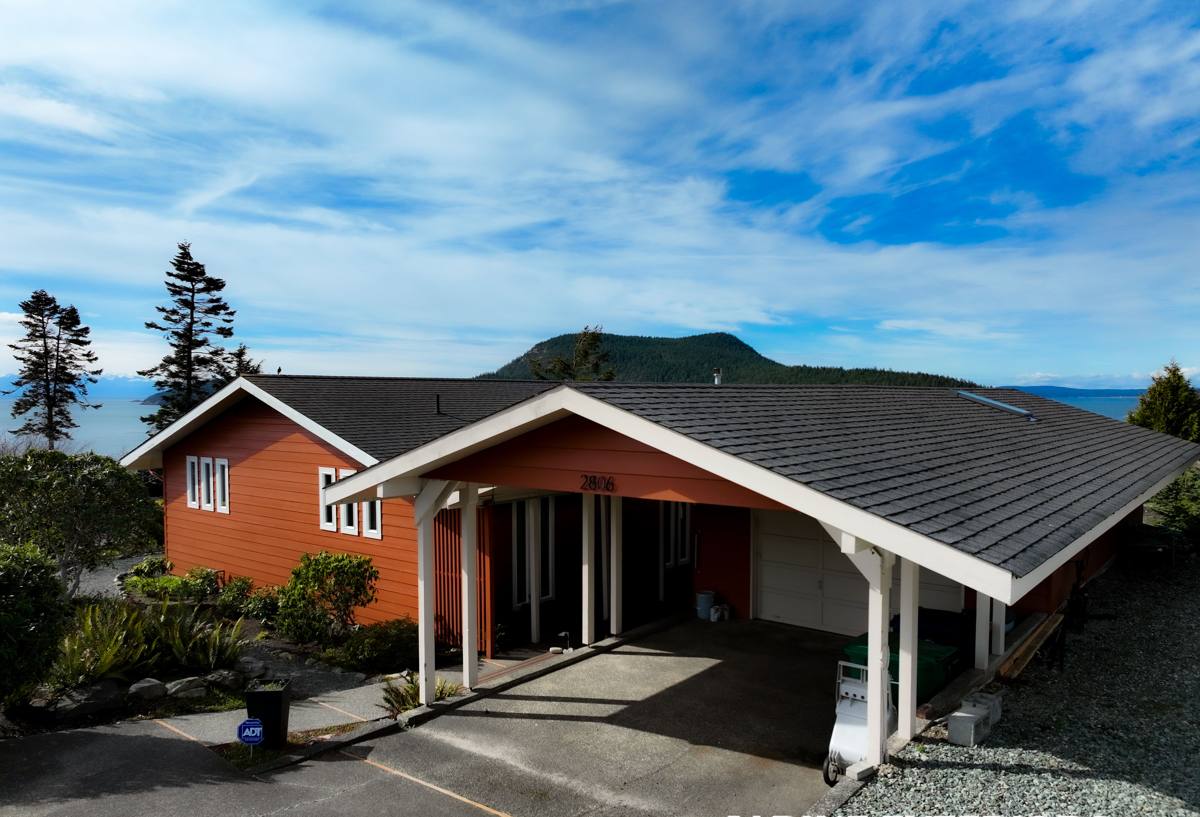
Siding: Why We Only Install James Hardie Fiber Cement
We install James Hardie fiber cement siding exclusively. We don't install vinyl, LP SmartSide, Cemplank, Allura, primed spruce, or cedar, and we're upfront about why. Each of those products has legitimate uses and reasonable people install them — but for the moisture load, salt exposure, and moss pressure a Lynden home sees over a 30-plus year ownership window, we've standardized on one material we can stand behind without caveats.
Vinyl siding is affordable and low-maintenance in the short term, but it expands and contracts with temperature swings, can distort or crack in impact events, and its long-term color retention depends heavily on the specific product line. Engineered wood products like LP SmartSide perform well when installation and maintenance are kept up perfectly, but they're wood-based, which means any breach in the water-resistive barrier or unsealed cut edge gives moisture a path into a material that can swell or deteriorate. Cedar and primed wood siding require an ongoing maintenance commitment — refinishing, caulking, and moisture monitoring — that most homeowners underestimate going in.
James Hardie fiber cement is cement, sand, and cellulose fiber — it doesn't absorb water the way wood-based products can, it won't warp or rot, and it's non-combustible, which matters given the wildfire smoke seasons the Pacific Northwest has seen in recent summers. Hardie's HZ5 climate-zone engineering is formulated for exactly the wet, moderate-temperature conditions Whatcom County sees, and the factory-applied ColorPlus finish is baked on under controlled conditions rather than field-painted, so it holds color and resists the moisture cycling this climate puts it through.
What Correct Installation Looks Like
Fiber cement siding only performs as well as its installation. That means correct nailing patterns and fastener spacing, proper caulking at butt joints and penetrations, house wrap and flashing integration behind the siding, and clearance from grade, roof lines, and decks so water has somewhere to go. We follow Hardie's published installation specifications because that's what keeps the manufacturer's warranty intact and what actually keeps water out of the wall assembly.
Roofing Built for This Weather
A roof in Lynden has to manage the same driving rain and moss pressure as the siding below it, plus wind uplift during winter storm systems. That means proper underlayment coverage (not just at the minimum code requirement), ice-and-water shield at eaves and valleys where wind-driven rain and ice dams are most likely to force water backward under shingles, and ventilation that keeps the attic from trapping moisture against the roof deck. Ventilation is easy to overlook because it's invisible from the ground, but poor attic ventilation is one of the most common reasons a roof underperforms its rated lifespan in this climate.
Moss management is part of a roofing plan here, not an afterthought. That includes material and color choices that don't trap moisture as readily, proper flashing at any roof-to-wall transitions where debris and moisture collect, and making sure valleys and gutters are sized and pitched to actually move water off the roof instead of holding it.
Windows: Sealing Out Moisture and Drafts
Windows fail from the outside in more often than homeowners expect. The glass and frame rarely give out first — it's the flashing and sealant integration between the window and the surrounding wall assembly that lets moisture in, usually years before anyone notices a soft spot or a musty smell. When we replace windows alongside siding, we integrate window flashing with the new house wrap and siding install as one continuous water management system, rather than treating windows as a separate, disconnected job. That's a meaningfully different result than caulking new windows into an old, unaddressed wall assembly.
Energy performance matters too. Whatcom County's temperature swings are moderate compared to much of the country, but consistent dampness and wind exposure mean drafts and condensation show up quickly on underperforming windows. Properly installed, well-sealed windows cut down on both.
Decks: Built for Wet-Dry Cycling
Decks in this climate go through repeated wet-dry cycles for most of the year, which is hard on fasteners, ledger connections, and any wood-to-wood contact point where water can sit. We build decks with attention to the same details that matter on the rest of the house: proper flashing at the ledger board where the deck meets the house, fasteners rated for exterior and coastal-adjacent exposure, and spacing and drainage that let the structure dry out between storms instead of staying saturated.
Comparing Siding Options
| Material | Moisture Behavior | Maintenance | Typical Warranty |
|---|---|---|---|
| Vinyl | Doesn't absorb water, but can warp/crack with temperature swings and impact | Low, but limited repair options if damaged | Varies widely by product line |
| LP SmartSide / engineered wood | Wood-based; vulnerable at unsealed cuts and breached barriers | Requires diligent caulk and paint upkeep | Typically prorated over time |
| Cedar / primed wood | Absorbs moisture; prone to swelling and rot without upkeep | High — refinishing and sealing on a recurring cycle | Often material-only, short term |
| James Hardie fiber cement | Non-combustible, dimensionally stable, engineered for wet climates (HZ5) | Low — factory ColorPlus finish resists fading | Long-term, transferable |
Why a Local Crew Matters
Anyone can read a manufacturer's spec sheet. What's harder to fake is knowing, from experience, which walls on a given lot stay wet longest after a storm, which roof valleys in this area tend to collect moss first, and how to sequence a job around the actual rain patterns Whatcom County sees rather than a generic install calendar. A crew that works this area regularly also knows the local permitting process and inspection expectations, which keeps a project moving instead of stalling on paperwork.
There's also accountability. A local company has a reputation in the community to protect and is easy to reach if a warranty question comes up five or ten years down the road — not a call center reading from a script.
What to Look For When Hiring
- Manufacturer certification or documented training on the specific siding or roofing product being installed
- A written scope that specifies flashing, house wrap, and fastener details — not just "siding replacement"
- Proof of current licensing and insurance for work in Washington State
- Clear warranty terms in writing, covering both materials and labor separately
- Willingness to explain why they recommend one product over another, including trade-offs
- References or completed work in the local area, not just stock photos
If you're weighing a siding, roofing, window, or deck project for a home in the Lynden area, we're happy to walk the property, talk through what your specific exposure looks like, and give you a straightforward, no-pressure estimate using the form below.