 Ferndale Exterior
 Two Materials, One Wall, Very Different Bets
When a homeowner in Ferndale asks us to compare fiber cement and engineered wood siding, they're usually really asking a simpler question: which one is going to hold up on my house? Both products are marketed as upgrades over vinyl and both are legitimate, widely used building materials. But they are built from different substances, they fail in different ways, and they demand different things from the crew installing them. We install James Hardie fiber cement exclusively. This page explains what engineered wood does well, where it struggles specifically in our climate, and why we made the call we did.
This isn't a takedown. Engineered wood siding, most commonly sold under the LP SmartSide brand, is a real improvement over the old primed-spruce and cedar lap siding it replaced. It has a place in the market. It's just not the place we chose to build our business around, and Whatcom County's weather is a big part of why.
What Engineered Wood Gets Right
LP SmartSide and similar engineered wood products are made from wood strands bonded with resin under heat and pressure, then coated with a resin-saturated overlay and factory primer. Compared to old-school solid wood siding, that construction solves several real problems:
- It resists splitting and warping better than solid-sawn cedar or spruce boards.
- It's treated with a zinc-borate additive that gives it real resistance to termites and fungal decay, which matters anywhere with sustained moisture.
- It's lighter and easier to cut and nail than fiber cement, which can shorten install time.
- It takes paint well and gives a wood-grain look that some homeowners prefer over the smoother finish of fiber cement.
- It's generally less expensive per square foot than fiber cement, both in material cost and labor.
For a drier climate, or a home that gets consistent maintenance attention, engineered wood can perform reasonably well for a couple of decades. The trouble starts when you put it somewhere like Whatcom County and expect the same result.
Where It Struggles in Our Climate Specifically
Ferndale sits close enough to Bellingham Bay and the Salish Sea that salt-laden air is a routine part of the weather, not an occasional event. Add in the driving rain that comes off the water in fall and winter storms, and a moss season that can run from October through May on a shaded north wall, and you've got a climate that tests the weak points of any wood-based product.
Engineered wood's core vulnerability is still what it's made of: wood fiber. The resin coating and zinc-borate treatment protect the factory-finished face and edges, but any cut end, nail penetration, or caulk joint that fails exposes raw wood-strand substrate to moisture. Once water gets past that protective layer, it wicks into the strand structure and doesn't dry out quickly, especially on a wall that doesn't get much direct sun. In a climate with occasional hard rain, that's a manageable risk. In a climate with near-constant damp and a long moss season that holds moisture against the wall surface, it's a much bigger one.
We also see it in how these products handle sustained humidity even without direct water intrusion. Wood-based siding swells and contracts with moisture cycling more than fiber cement does, which stresses paint film and caulk joints over time — exactly the joints that are protecting the vulnerable cut edges in the first place. It's not that the product is defective. It's that its failure mode lines up almost exactly with our weather pattern.
What Fiber Cement Is Made Of, and Why It Behaves Differently
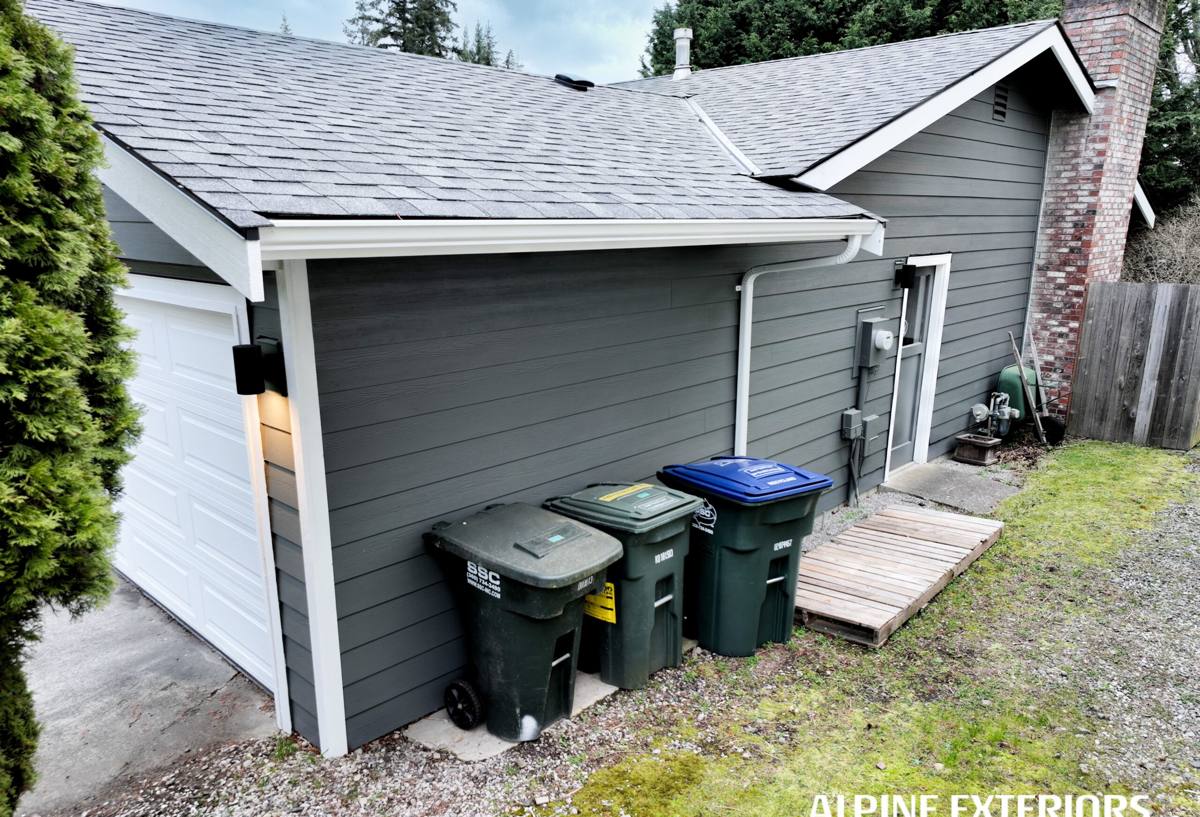
James Hardie siding is made from Portland cement, sand, and cellulose fiber, cured into a rigid board. There's no wood-strand core to absorb and hold water. It doesn't swell and shrink with humidity the way wood products do, it won't support fungal decay because there's no organic substrate for fungus to feed on, and it's non-combustible — a genuine advantage during wildfire smoke and ember seasons that have become a bigger regional concern in recent years.
Hardie also builds specifically for climate. Their HZ5 product line is engineered for regions like ours with freeze-thaw cycling and sustained moisture exposure, with a formulation and installation spec built around resisting moisture-related damage. That's not a marketing add-on — it's a different product designation with different testing behind it, and it's the line we spec for Ferndale and the rest of Whatcom County.
The factory finish matters too. ColorPlus is a baked-on, multi-coat finish applied under controlled conditions before the boards ever reach the jobsite, backed by its own finish warranty separate from the substrate warranty. Field-applied paint, which is how most engineered wood and all site-finished materials get their color, is far more dependent on weather conditions during application and on how well the crew back-primes cut edges. That's a variable we'd rather not be depending on to keep water out of a wall.
Side-by-Side: How the Two Materials Compare
| Factor | James Hardie Fiber Cement | Engineered Wood (LP SmartSide) |
|---|---|---|
| Core material | Cement, sand, cellulose fiber | Wood strands bonded with resin |
| Moisture behavior | Does not absorb and swell; dimensionally stable | Resists moisture at the treated face; vulnerable at cut edges and breaches |
| Fire rating | Non-combustible | Combustible, though treated |
| Pest/decay resistance | No organic substrate for fungus or insects | Zinc-borate treated; effective but not permanent if coating is compromised |
| Finish | Factory-applied ColorPlus, separate finish warranty | Factory primed or pre-finished; often needs field topcoat and re-caulking maintenance |
| Weight/handling | Heavier, requires specific tools and technique | Lighter, easier and faster to install |
| Typical material cost | Higher | Lower to moderate |
| Warranty structure | Long-term, transferable substrate warranty | Warranty terms vary by product line and finish |
Installation Sensitivity: The Material Is Only Half the Answer
Neither of these products performs to spec if it's installed wrong, and this is where a lot of siding failures actually originate, regardless of brand. Fiber cement has its own installation rules: correct nail placement and depth, proper clearance from grade and roof lines, sealed and back-primed cut edges, and correct fastener spacing to handle expansion and contraction. Get those wrong and you can create the exact moisture pathways fiber cement is otherwise resistant to.
Engineered wood is arguably even less forgiving, because its vulnerable point — the wood-strand core — is exposed the moment a board gets cut, drilled, or damaged on site. Every field cut has to be sealed correctly, every panel joint has to be flashed and caulked to spec, and that maintenance discipline has to continue for the life of the siding, not just at install. On a coastal, high-moisture site, that's a maintenance schedule that doesn't have much room for a missed year.
We standardized on one material in part because it lets our crews build deep expertise in one installation system rather than splitting attention across two very different product logics. That specialization is part of what keeps an installation matching the manufacturer's spec sheet instead of drifting from it over dozens of jobs.
Cost Over the Life of the Siding, Not Just at Install
Sticker price tells only part of the story. Engineered wood usually costs less installed than fiber cement, sometimes meaningfully so. But the honest comparison has to include what happens over the following 15 to 30 years: repainting cycles, caulk joint maintenance, and the risk of localized repair or replacement if moisture gets behind the material at a compromised edge or joint. Fiber cement with a factory finish generally pushes the first repaint decision out much further and carries a longer substrate warranty against the failure modes that matter most in our climate.
Neither of us can tell you the exact dollar difference over 20 years without knowing your specific house, elevation exposure, and maintenance habits — anyone who gives you a precise long-term number is guessing. What we can say is that lower upfront cost and lower lifetime cost aren't the same thing, and in a wet coastal climate the gap between them tends to widen rather than close.
Why We Standardized on James Hardie
We made the decision to install only James Hardie fiber cement because we'd rather build our reputation on a material whose failure modes are the ones we can control through good installation, not the ones baked into a wood-fiber core sitting a few hundred feet from salt water. HZ5's climate-specific engineering, the non-combustible core, the factory ColorPlus finish, and a transferable warranty structure all line up with what actually holds up on a Whatcom County exterior wall through a normal winter of driving rain and a long moss season. That's not a knock on every homeowner who chooses engineered wood elsewhere — it's a statement about what we're willing to put our name on here.
Questions Worth Asking Before You Choose a Siding Material
- How does this material handle a cut edge or field modification — does it need to be sealed, and how well does that hold up over time?
- What's the manufacturer's warranty on the substrate versus the finish, and is it transferable if you sell the house?
- Is the product rated or engineered for a specific climate zone, or is it a general-purpose formulation?
- What ongoing maintenance does the manufacturer actually require to keep the warranty valid?
- Has the contractor installed this specific product enough to know its quirks, or are they learning on your house?
- How does the material perform against fire exposure, given regional wildfire smoke and ember seasons?
What This Means for Your Ferndale Home
If you're weighing siding options for a home in Ferndale or anywhere else in Whatcom County, the material decision is really a decision about which risks you're comfortable managing over the next few decades. Engineered wood asks you to stay on top of caulking, edge sealing, and repainting to keep water out of a wood-fiber core. Fiber cement asks for a correct initial installation and, from there, is working with a material that doesn't care much about salt air, driving rain, or a wall that stays shaded and damp through moss season. We chose to build our business around the second bet, and we think it's the more honest one to make on homes exposed to this coastline.
If you'd like to talk through what that looks like for your specific house — elevation exposure, current siding condition, and what a correct Hardie installation would involve — we're happy to walk the property and put together a free, no-pressure estimate.