 Ferndale Exterior
 Siding Replacement for Bellingham Homes
Bellingham homes sit in a stretch of Whatcom County where Bellingham Bay's salt-tinged air, wind-driven rain off the water, and a moss season that can run most of the year all work on a wall at the same time. A siding replacement here isn't just a cosmetic swap. Done right, it's a chance to correct whatever let moisture in the first time and to put a material and installation system underneath that's actually built for this exposure. Done wrong, or done with the wrong product, a homeowner can end up re-doing the same work in ten or fifteen years instead of thirty or more.
We install James Hardie fiber cement siding exclusively on Bellingham replacement projects. This page walks through what full replacement actually involves, what Bellingham's climate demands of the work, and how to tell whether your home needs a full re-side or something less.
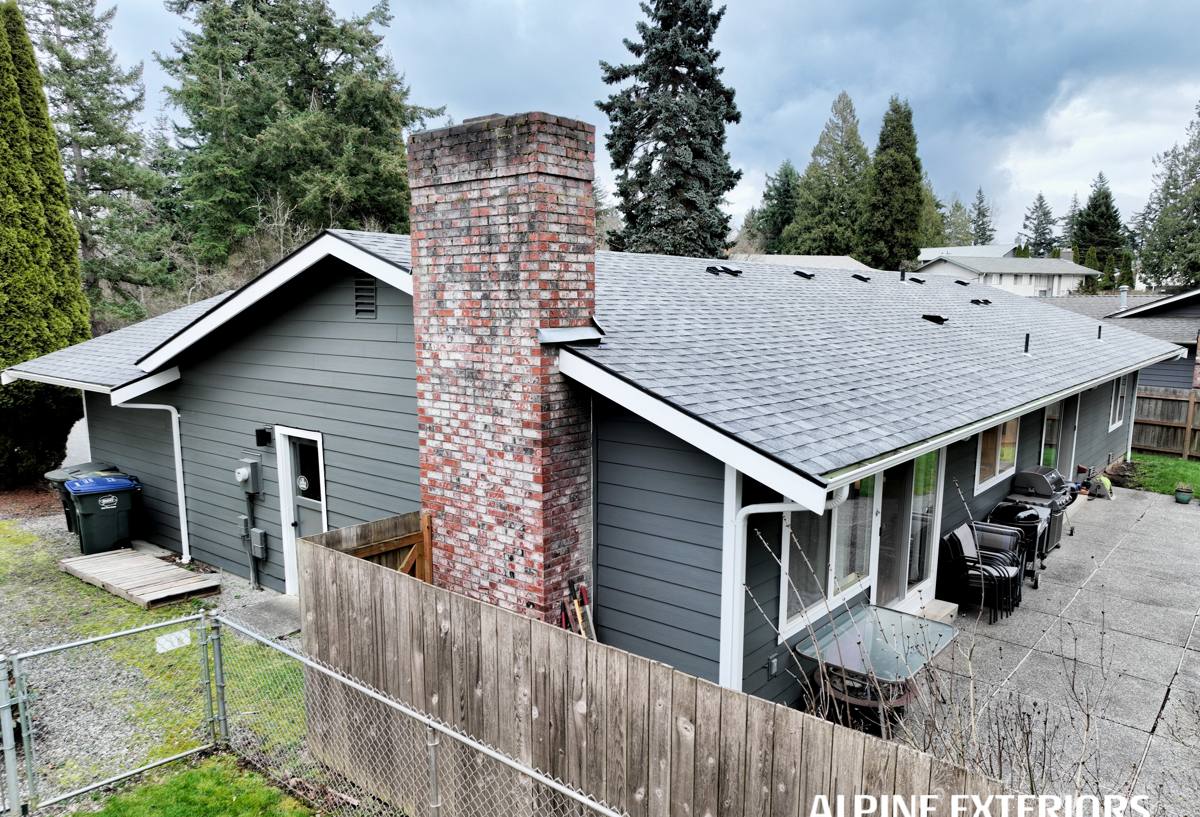
Signs a Bellingham Home Needs Full Replacement, Not a Repair
Not every siding problem calls for a complete tear-off. A cracked board here, a section that took storm damage there, can often be repaired and matched into the surrounding siding without touching the rest of the wall. Full replacement becomes the right call when the damage is systemic rather than isolated.
- Soft, spongy, or crumbling siding across multiple walls, not just one damaged spot
- Moss and dark staining that comes back within weeks of cleaning, especially on shaded or north-facing sides
- Paint that's peeling or bubbling across large sections rather than a single weathered board
- Visible warping, cupping, or delamination in the siding material itself
- A musty smell or soft drywall on interior walls that share an exterior wall with damaged siding
- Siding that's original to a home built more than 25-30 years ago, especially if it's an engineered wood or lower-grade product
When we walk a property, we're checking for these signs specifically, and we'll tell a homeowner honestly if a repair or partial re-side would do the job. There's no reason to sell a full replacement to someone who doesn't need one yet.
What Bellingham's Climate Does to a Wall Over Time
Salt Air Off the Bay
Homes anywhere near Bellingham Bay pick up a steady dose of salt-laden air, and that salt works on fasteners, flashing, and lower-grade finishes faster than a drier inland climate would. It's a slow, cumulative process, which is exactly why it's easy to underestimate until a tear-off reveals corroded nails or degraded trim that's been quietly failing for years.
Wind-Driven Rain
Rain in this part of Whatcom County rarely falls straight down. Wind pushes it sideways into lap joints, trim edges, and wall penetrations, which is a very different load than a simple annual rainfall total suggests. A siding system that would perform fine somewhere calmer and drier can still fail here specifically because water is finding its way in from the side.
A Long Moss Season
Mild temperatures, consistent moisture, and plenty of shaded exposure add up to a moss and mildew season that runs long in Bellingham. Any siding material that's even a little porous, or that holds moisture against the substrate, becomes a growth surface over time. It typically shows up first on the sides of a house that get the least sun, well before it's obvious from the street.
Why We Only Install James Hardie for Replacement Work
We used to install a broader range of siding products. We narrowed that down, and the reasoning was practical rather than promotional: on tear-offs and service calls across this exact climate, one system consistently held up the way we needed it to, and the rest carried trade-offs we weren't willing to keep installing on Bellingham homes.
- Non-combustible core: Fiber cement doesn't feed a fire the way wood-based siding products can, which matters for both household safety and insurance underwriting.
- Factory-applied ColorPlus finish: Color is baked on under controlled factory conditions instead of brushed on in the field, so it resists fading, chalking, and moisture damage far longer than site-applied paint.
- Climate-engineered HZ product lines: Hardie's HZ5 formulation is built for regions with heavy moisture exposure and freeze-thaw cycling, which describes coastal Whatcom County well.
- Dimensional stability: Fiber cement doesn't swell, cup, or warp the way engineered wood siding can after repeated wet-season moisture cycles.
- Strong transferable warranty: Hardie backs its products with one of the more robust warranty structures in the industry, provided installation follows spec.
We won't install LP SmartSide, vinyl siding, Cemplank, Allura, primed spruce, or cedar. Each has a legitimate place in the market and plenty of satisfied owners elsewhere. But for a full replacement in a climate with this much sustained moisture and salt exposure, we made a professional call to stand behind one system completely rather than offer a cheaper option that quietly shifts maintenance risk onto the homeowner down the road.
Vinyl, Engineered Wood, and Fiber Cement Compared
| Factor | Vinyl | Engineered Wood | James Hardie Fiber Cement |
|---|---|---|---|
| Moisture behavior | Can trap moisture behind panels | Absorbs moisture at cut edges and seams | Resists moisture absorption when installed and sealed to spec |
| Salt air / coastal exposure | Finish can chalk and fade faster | Vulnerable at unsealed edges | Factory ColorPlus finish holds up well |
| Fire resistance | Can soften or melt under heat | Wood-based, combustible | Non-combustible core |
| Dimensional stability | Can warp or buckle with temperature swings | Can swell, cup, or delaminate with moisture cycling | Stable across wet-dry cycles when properly installed |
| Typical lifespan when correctly installed | 15-25 years | 15-25 years | 30+ years |
What a Correct Replacement Project Involves
Tear-Off and Substrate Inspection
The first step in any real replacement is removing the old siding entirely and inspecting what's underneath. This is where hidden problems surface: rotted sheathing, compromised house wrap, or framing that's been absorbing moisture for years without any visible sign from outside. Skipping this step, or covering over a compromised substrate with new siding, is one of the most common ways a replacement job fails early.
House Wrap and Flashing
New siding is only as good as the water management system behind it. Correct installation means house wrap that's lapped and taped properly, and flashing at every window, door, and penetration that directs water out and away from the wall rather than letting it track behind the new siding. In a climate with this much wind-driven rain, these details matter as much as the siding material itself.
Fastening and Clearances
James Hardie siding has a specific fastening pattern and minimum clearances from grade, roof lines, and other surfaces that are part of getting the warranty and the performance the product is designed for. Cutting corners here is one of the more common ways a good material ends up performing poorly, and it's why we treat installation detail with the same seriousness as the material spec.
Trim, Joints, and Sealing
Every lap joint, corner, and trim piece is a potential water entry point if it isn't detailed correctly. Proper overlap, correct sealant use where Hardie specifies it, and consistent attention to these small joints is what keeps a replacement project performing for decades rather than years.
What Drives Replacement Cost in Bellingham
| Factor | What It Affects | Why It Matters Here |
|---|---|---|
| Home size and wall complexity | Total material and labor | More trim, dormers, and corners mean more joints where wind-driven rain can intrude |
| Substrate condition after tear-off | Repair costs before new siding goes on | Years of trapped moisture behind failing siding commonly cause hidden sheathing or framing rot |
| House wrap and flashing scope | Labor and material for water management | Wind-driven rain off the bay demands correct detailing, not shortcuts |
| Siding profile and trim selection | Material cost | Different Hardie profiles and trim packages carry different price points |
| Color and finish selection | Material cost and long-term maintenance | ColorPlus factory finishes cost more upfront but resist salt air and UV far longer than field-applied paint |
| Site access and lot conditions | Labor time and equipment needs | Sloped lots or tree-shaded properties common around Bellingham can add setup and staging time |
Exact numbers depend on the specific home and what tear-off reveals, which is why we walk the property in person and give a real estimate rather than quoting off a generic price sheet.
Roofing, Windows, and Decks During a Re-Side
A siding replacement is also a natural point to check the rest of a home's exterior, since roofing, windows, and decks all interact with the same wall assembly. A poorly flashed window or a roof valley that's been shedding water onto a wall can be the actual root cause of siding damage that looks, at first glance, like a material failure. Because we handle roofing, windows, and decks in addition to siding, we look at a Bellingham home as one connected exterior system during a replacement rather than treating the wall in isolation.
What to Expect From Our Process
- An in-person walk of the property to assess current siding condition and identify likely trouble spots
- An honest read on whether the home needs full replacement, partial re-side, or repair
- A written estimate that accounts for the specific home, not a generic per-square-foot number
- Tear-off with a substrate inspection before anything new goes up
- Correct house wrap, flashing, fastening, and trim detailing to Hardie's installation spec
- A final walkthrough so the homeowner sees the finished work before we consider the job done
Why a Bellingham-Familiar Crew Matters
A crew that replaces siding across Whatcom County regularly sees how salt air, wind-driven rain, and moss actually behave on real homes over full seasons, not just how a product performs on a spec sheet. That shows up in practical decisions on a job site: where to spend extra time on flashing, which wall orientations tend to hide the most moisture damage, and which details are worth doing right the first time so a homeowner isn't back to square one in a few years. Bellingham's mix of bay-adjacent exposure and Whatcom County's overall wet climate means those calls aren't identical to every town nearby, and local, repeated experience is what makes them consistent.
If your Bellingham home is showing signs it needs new siding, or you just want an honest read on what's going on behind an aging wall, we're glad to take a look. Reach out using the form below to schedule a free, no-pressure estimate.