 Ferndale Exterior
 Siding in Cordata Has to Answer to the Weather, Not Just Look Good on Day One
Cordata sits close enough to the water and the tree line that its siding problems tend to be different from what you'd see further inland. Homes here deal with a steady mix of salt-laden air rolling off the Sound, driving rain that hits siding sideways during winter storms, and a moss season that can stretch from late fall through spring under the area's tree canopy and cloud cover. None of that is unusual for Whatcom County, but it adds up fast on a wall material that isn't built to handle it. Paint fails early, seams open up, and moisture finds its way behind panels that were never properly flashed in the first place.
That's the backdrop for every siding decision a Cordata homeowner makes. The question isn't just "what does this look like on the truck" — it's "what does this look like in year twelve, after a dozen wet winters and a few hundred freeze-thaw cycles." This page is about one product, installed in one way, for this one area: James Hardie fiber cement siding, done to spec, for homes in and around Cordata.
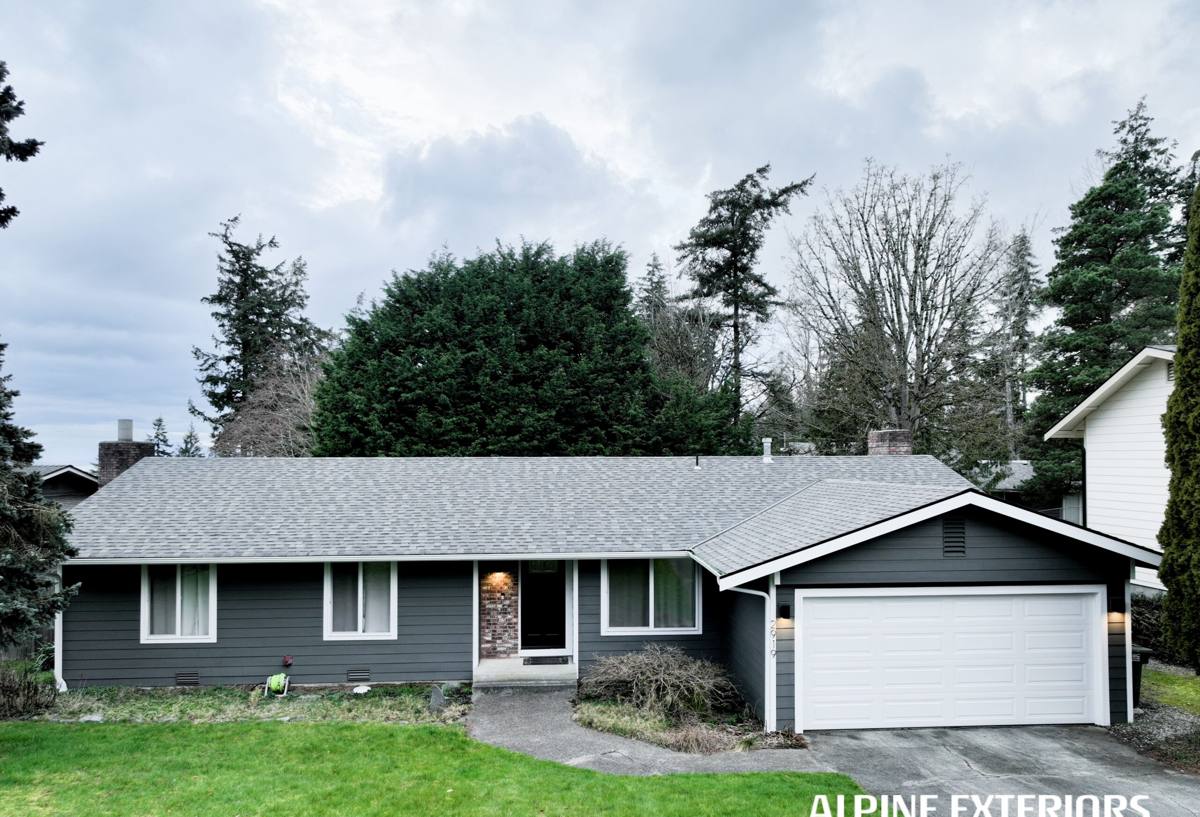
Why We Only Install James Hardie
We don't install vinyl, LP SmartSide, Cemplank, Allura, primed spruce, or cedar. That's not a marketing line — it's a standard we hold because we've seen how each of those products behaves once it's been through a few Pacific Northwest winters. Vinyl expands and contracts with temperature swings and can warp or crack in sustained wind-driven rain. Engineered wood products depend heavily on unbroken paint and caulk lines to keep moisture out of their wood-strand core; once that seal fails, the damage can spread underneath the surface before it's visible. Cedar is a beautiful, honest material, but it demands a maintenance schedule most homeowners don't keep up with, and it's combustible in a state that takes wildfire risk seriously.
James Hardie fiber cement is cement, sand, and cellulose fiber — it doesn't rot, it doesn't feed insects, and it isn't combustible. It holds a factory-applied ColorPlus finish that's baked on and warranted against fading and peeling, which matters in an area where UV exposure is inconsistent but salt and moisture exposure is constant. It's not the cheapest siding on the market, and we're upfront about that. It's the one we're willing to put our name behind.
What Salt Air Actually Does to Siding
Salt in the air accelerates corrosion on fasteners, trim flashing, and any exposed metal components, and it can degrade lower-quality paint finishes faster than inland weathering would. Hardie's ColorPlus finish is engineered to resist fading and chalking better than field-applied paint, and when we pair it with corrosion-resistant fastener systems and properly flashed trim, the whole assembly is built to handle salt exposure rather than just tolerate it for a few seasons.
The HZ5 Product Line: Built for This Exact Climate
James Hardie engineers its siding in different formulations for different climate zones, and Whatcom County falls into the HZ5 zone — the company's specification for regions with heavy moisture, freeze-thaw cycles, and sustained wet weather. HZ5 products are formulated to resist moisture absorption and hold dimensional stability better than a one-size-fits-all product would. This matters more than most homeowners realize: siding rated for a dry climate zone can perform noticeably worse here, even if it looks identical on a sample board. We install HZ5-rated Hardie products specifically because Cordata's weather doesn't leave much margin for a product that's a rough fit.
What a Correct Installation Actually Involves
Fiber cement siding is only as good as the installation behind it. Hardie's own warranty is conditioned on installation meeting their published specifications — this isn't a product you can install "close enough" and expect full performance from. A correct job involves several details that aren't visible once the siding is up, which is exactly why they matter.
Flashing and Moisture Management
Every window, door, and roofline intersection needs proper flashing and a drainage plane behind the siding, not just caulk covering a gap. Water that gets behind the cladding needs a path to get back out — a weather-resistive barrier and correctly lapped flashing give it one. Skipping this step is the single most common cause of hidden rot behind fiber cement siding, and it's invisible from the street.
Fastening, Clearances, and Gaps
Hardie specifies exact fastener spacing, minimum clearances from the ground, roofline, and adjoining surfaces, and gap allowances at butt joints to accommodate seasonal movement. Siding installed tight to grade or hard against a deck or patio surface will wick moisture no matter how good the product is. These clearances are simple to follow and easy to skip if a crew is moving fast.
Caulking and Paint Lines
Factory-primed cut edges need field paint or caulk before installation, not after. Left exposed, a cut edge absorbs moisture directly into the fiber cement core, which can lead to swelling and paint failure right at that seam years before the rest of the wall shows wear.
Where We See Installations Go Wrong in This Area
A lot of siding failures we get called out to inspect aren't product failures — they're installation shortcuts that took years to show up. In shaded, tree-covered lots like much of Cordata, we regularly see moss and algae holding moisture against siding that was installed without adequate clearance or ventilation, which keeps the wall assembly damp far longer after a storm than it should be. We also see caulk used as a substitute for flashing around windows, which works for a season or two and then fails once the caulk shrinks. Both problems are avoidable with correct technique — they're just not visible until something goes wrong behind the wall.
Our Process for a Cordata Siding Job
We run the same disciplined process on every home, adjusted for the specific exposure and tree cover of the lot.
- On-site assessment of existing siding, trim, and any moisture damage, plus a look at shade, drainage, and wind exposure specific to the lot.
- Full tear-off of old siding and inspection of the sheathing underneath for rot or damage before anything new goes up.
- Installation of a weather-resistive barrier and correctly lapped flashing at every penetration, window, and roofline transition.
- Hardie HZ5 panel or plank installation to manufacturer fastening, clearance, and gap specifications.
- Field caulking and painting of all cut edges and trim per Hardie's application guidelines.
- Final walkthrough and documentation for manufacturer warranty registration.
We don't skip the tear-off and inspection step even when it would be faster to side over existing material. What's underneath the old siding tells us whether the sheathing is sound, and that's not something we're willing to guess about.
Comparing the Options for This Climate
| Factor | James Hardie HZ5 Fiber Cement | Vinyl | Cedar |
|---|---|---|---|
| Moisture resistance | Engineered for wet, coastal climates | Moderate; seams can allow water intrusion | Requires ongoing sealing to resist rot |
| Salt air performance | ColorPlus finish resists fading and chalking | Can become brittle over time in coastal exposure | Weathers unevenly; needs frequent refinishing |
| Combustibility | Non-combustible | Can soften or deform under heat | Combustible |
| Maintenance | Occasional wash; repaint only if desired decades out | Low, but limited repair options if damaged | Regular staining or sealing required |
| Typical lifespan with correct install | Decades, backed by transferable warranty | Varies widely by grade | Shorter without diligent upkeep |
Why It Matters That We Already Work This Area
A crew that's already worked jobs around Cordata and greater Ferndale has a feel for how this specific stretch of Whatcom County behaves — which lots hold moisture longer because of tree cover, where wind-driven rain hits hardest, and what permitting and inspection expectations look like locally. That local familiarity shows up in small decisions on the job: where to add extra flashing attention, how much clearance to leave given a lot's drainage, which sides of a house need the most protection from prevailing weather. It's the difference between a crew executing a generic install and a crew building for the conditions that specific home will actually face.
It also matters for accountability. A local contractor is still around next year and the year after, which is relevant given that Hardie's product warranty and most workmanship warranties depend on correct installation being provable and standing behind it if something needs attention.
Signs Your Current Siding Is Telling You Something
- Persistent moss or algae growth that returns within weeks of cleaning, especially on shaded walls
- Soft or spongy spots when you press on siding near the ground or below windows
- Paint that's peeling, bubbling, or chalking heavily in patches rather than evenly across the wall
- Visible gaps, warping, or separation at seams and corners
- A musty smell near exterior walls inside the home, which can indicate moisture behind the siding
- Caulk that's cracked, shrunk, or missing around windows and trim
Any one of these on its own isn't necessarily an emergency, but they're worth having looked at before the next wet season, since fiber cement replacement done proactively is almost always simpler and less costly than replacement done after hidden rot has spread into the sheathing.
Get a Straight Answer for Your Home
If you're weighing a siding replacement in Cordata or anywhere around Ferndale, we're happy to take a look and give you an honest read on what your home actually needs — no pressure, no upsell to a product we don't stand behind. Request a free estimate below and we'll walk the property with you.