 Ferndale Exterior
 Why Sandy Point Is a Different Job Than Windows Inland
Sandy Point sits right on the water, and that changes what a window has to survive day to day. Homes just a few miles inland in Ferndale deal with normal Pacific Northwest weather — rain, humidity, mild winters. Homes on Sandy Point deal with all of that plus salt-laden air blowing straight off the water, wind-driven rain that hits window walls at an angle instead of falling straight down, and a moss and mildew season that runs longer than it does even a short drive east. None of that is dramatic on any single day. It's the cumulative effect over years that separates a window that lasts two decades from one that fails in eight.
We treat Sandy Point as its own category of job, not a smaller version of a standard Ferndale window replacement. The frame material, the flashing detail, the hardware, and even the caulk we use are chosen with that shoreline exposure in mind.
What "Custom" Actually Means on This Stretch of Coast
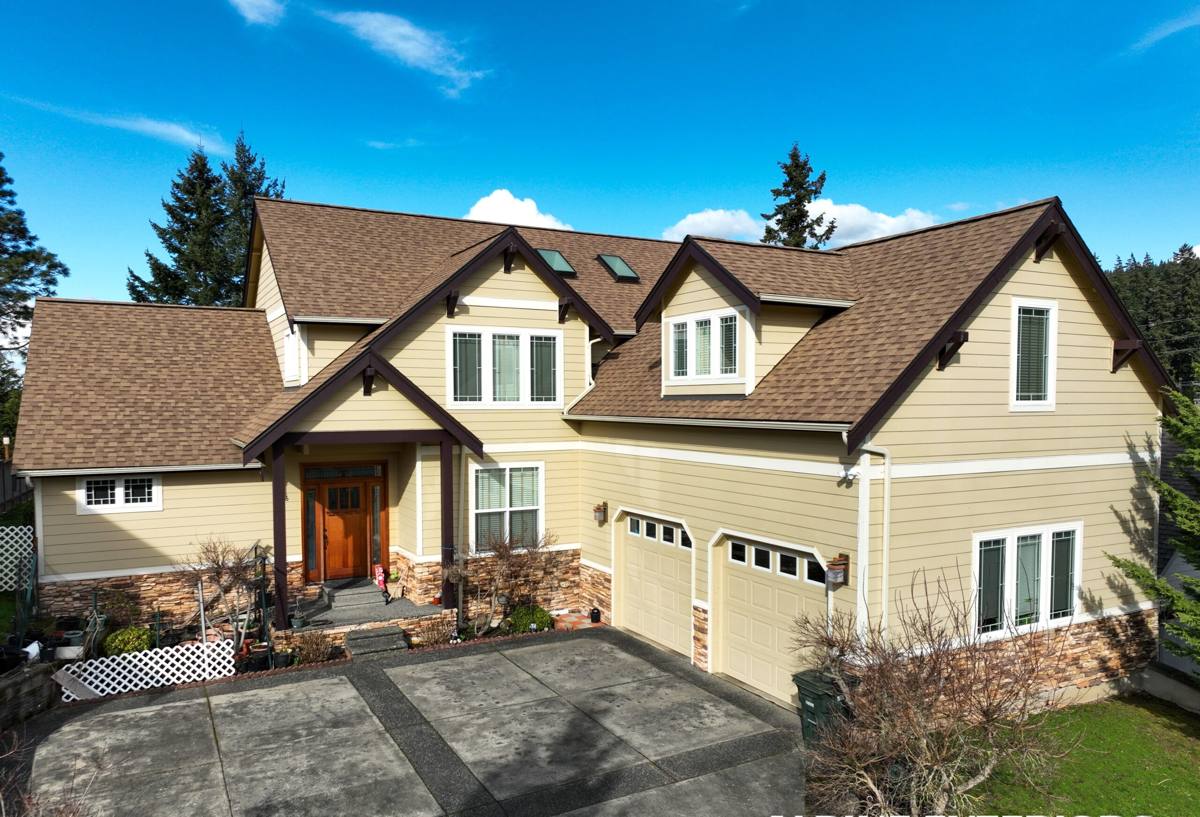
A lot of Sandy Point housing stock started as seasonal cabins and beach cottages, many of which have been added onto, insulated, and converted into year-round homes over the years. That history matters for window work. Openings are frequently non-standard sizes, framed by hand decades ago rather than built to a modern lumber grid. Additions often don't line up cleanly with the original structure. A stock window off a shelf rarely fits without either oversizing the rough opening (bad for a tight, weathertight seal) or forcing a mismatch that leaves gaps for wind-driven rain to find.
"Custom" here means we measure every opening individually, order units built to those exact dimensions, and treat each window as its own small project rather than assuming a whole house takes one uniform size. It also means matching sightlines and grid patterns across a home that may have been built and remodeled in more than one era, so the finished result looks like it belongs together instead of like a patchwork of replacement projects done at different times.
Common Situations We See at Sandy Point
- Original cabin-era window openings that are slightly out of square after decades of settling
- Additions with different wall thickness than the original structure, affecting how the window sits and gets trimmed
- Water-facing walls with heavier weathering than the landward side of the same house
- Older aluminum or single-pane wood windows original to a cabin conversion, never upgraded when the rest of the home was updated
- Homes used seasonally in the past, where deferred maintenance let moisture problems get further along before anyone noticed
Frame Material: What Actually Holds Up in Salt Air
Not every frame material ages the same way a few hundred yards from saltwater. Corrosion, UV exposure, and constant damp cycling all move faster here than they do further inland. This is one of the biggest decisions in a Sandy Point window project, and it's worth understanding the trade-offs rather than defaulting to whatever's cheapest or most familiar.
| Frame Material | Salt Air Performance | Maintenance | Typical Cost Tier |
|---|---|---|---|
| Vinyl | Good — won't corrode or rust; UV-stable formulations hold color | Low — occasional rinse to clear salt film | Lower to mid |
| Fiberglass | Very good — dimensionally stable, resists pitting and corrosion | Low | Mid to upper |
| Wood-clad (exterior clad) | Depends heavily on cladding integrity and joint sealing; interior wood is not designed for salt exposure | Moderate to high — cladding seams and sills need periodic inspection | Upper |
| Bare aluminum | Poor without marine-grade coatings — standard mill finish aluminum is prone to pitting and white corrosion near salt water | High | Lower to mid |
Our Standard for This Neighborhood
For most Sandy Point homes, we steer clients toward vinyl or fiberglass frames with corrosion-resistant hardware — stainless steel screws, hinges, and locks rather than standard-grade fasteners that can start showing rust streaks within a few seasons. We're not against wood-clad or aluminum units on principle; they have real advantages in appearance and structural rigidity. But we're upfront that they carry a higher maintenance burden this close to the water, and we'd rather a homeowner make that choice with full information than find out the hard way five years in.
Installation Details That Matter More Here Than Inland
A correctly installed window in Sandy Point isn't just about setting the unit level and square — the water management around it is what determines whether it lasts. Wind-driven rain doesn't behave like ordinary rainfall; it can push moisture sideways and upward against a wall, which means flashing details that would be adequate on a sheltered inland wall aren't always enough here.
What a Correct Installation Includes
- Sloped sill pan flashing under every unit, directing any water that gets past the frame back out rather than into the wall cavity
- Properly lapped weather-resistive barrier integrated with the flashing so water sheds down and out, following correct shingle-lap order
- Backer rod and high-quality, flexible sealant rated for exterior and coastal exposure at every joint, not just a bead of caulk around the trim
- Corrosion-resistant fasteners throughout, matched to the frame material
- Shimming and squaring that accounts for the actual condition of an older or settled opening, not just the theoretical rough opening size
Skipping or rushing any one of these is usually invisible on installation day and becomes obvious two or three winters later as staining, soft trim, or drafts. Salt air also affects how long sealants and finishes last, so we favor products with documented coastal or marine-exposure performance rather than standard residential-grade materials.
Glass, Condensation, and the Long Moss Season
Whatcom County's damp, gray stretches — the same conditions that keep moss thriving on roofs and north-facing siding for much of the year — also affect what happens on the inside of a window. Older single-pane or early double-pane units in Sandy Point homes often show heavy interior condensation during cold snaps, which over time contributes to sill rot and mildew on nearby trim and drywall.
Modern insulated glass units with a low-E coating and an appropriate U-factor cut down on that condensation by keeping the interior glass surface warmer. For most Sandy Point homes, a good double-pane low-E unit is sufficient; triple-pane makes sense mainly for water-facing rooms that get significant wind exposure or for homeowners prioritizing sound reduction from wind and surf. We size glass performance to each wall's actual exposure rather than specifying the same package for every elevation of the house.
A Few Basics Worth Knowing
U-factor measures how well a window resists heat loss — lower is better for our climate. SHGC (solar heat gain coefficient) matters less here than in sunnier climates, but still affects comfort in south- and west-facing rooms. Neither number tells the whole story on its own — installation quality and frame material affect real-world performance just as much as the glass spec on paper.
Our Process
- On-site visit and assessment — we look at every opening individually, note exposure differences between elevations, and check for existing moisture or rot issues before quoting anything
- Measuring and custom ordering — units are built to the actual opening, not a stock size
- Material and glass selection — walked through with the homeowner, including honest trade-offs by frame type and exposure
- Removal and opening inspection — old units come out carefully so we can check framing and sheathing condition before anything new goes in
- Flashing and installation — sill pans, weather barrier integration, squaring, and sealing done to the coastal standard described above
- Interior and exterior finish work — trim, caulking, and touch-up so the result looks finished, not just functional
- Final walkthrough and cleanup — operation checked on every window, site cleaned up, and warranty paperwork provided
Why a Crew That Already Works Sandy Point Matters
Window replacement isn't identical everywhere in Whatcom County, and a contractor who mostly works sheltered inland neighborhoods can miss things that are second nature to a crew that's been out on this shoreline repeatedly. Knowing which walls typically take the worst of the wind-driven rain, recognizing early signs of salt-related hardware corrosion, and understanding how older cabin-era framing in this specific area tends to be built all shorten the guesswork — and reduce the chance of a callback for a problem that should've been caught during installation.
It also matters for access and logistics. Waterfront and near-waterfront lots sometimes have tighter site access, seasonal neighbors, or road conditions that affect scheduling and staging materials. A crew familiar with the area plans around that instead of discovering it on the day of the job.
Signs Your Sandy Point Windows May Be Losing the Battle
- Visible corrosion or rust streaks around hardware, hinges, or fasteners
- Persistent interior condensation on the glass, especially during cold, wet weeks
- Soft, discolored, or moss-tinged trim and sills around the window
- Noticeable drafts or whistling during storms with wind off the water
- Difficulty opening, closing, or locking that wasn't there a few years ago
- Fogging or a permanent haze between panes of double-pane glass, indicating a failed seal
Any one of these on its own isn't necessarily urgent. Several together, especially on a water-facing wall, usually means the window's protective layers are wearing out faster than the rest of the house.
If you're noticing any of the above, or you're planning ahead for a Sandy Point home you know takes the brunt of the weather, we're happy to take a look and walk you through honest options. Fill out the form below for a free, no-pressure estimate.