 Ferndale Exterior
 Fiber Cement Siding Built for Lummi Island's Marine Climate
Lummi Island sits right in the path of Puget Sound's weather — salt-laden air off the water, wind-driven rain that hits siding sideways instead of straight down, and a long, damp moss season that can run from October clear through April. Homes here don't get a mild, forgiving climate the way some inland Whatcom County properties do. Siding on the island earns its keep every single day, and the material and installation quality matter more here than almost anywhere else we work.
Fiber cement siding, when it's the real thing installed correctly, holds up to this environment better than most alternatives available to island homeowners. But "fiber cement" isn't one product — installation quality, product line, and even which manufacturer made it can be the difference between siding that looks sharp at year fifteen and siding that's cupping, staining, or rotting at the seams by year eight.
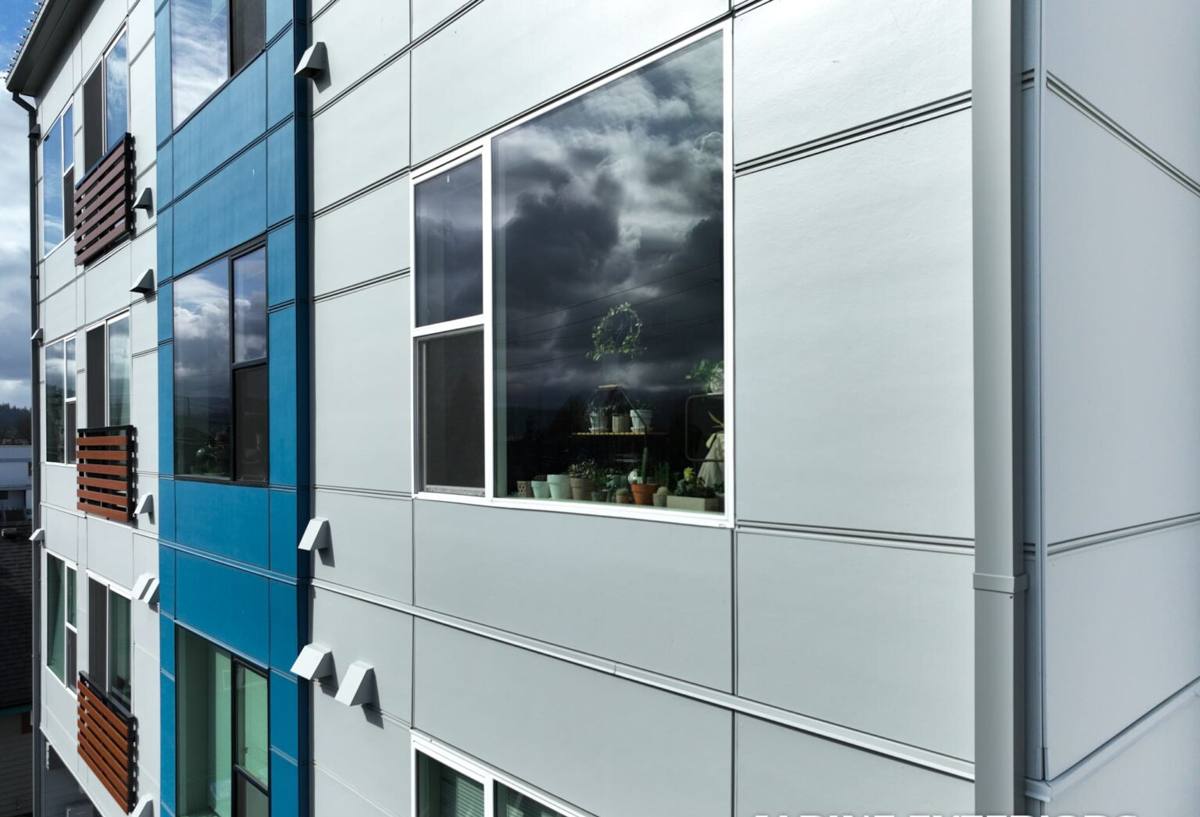
Why Salt Air and Driving Rain Change the Equation
Salt Air's Slow Damage
Airborne salt from the Sound doesn't just sit on the surface — it works into fasteners, trim joints, and any exposed or under-caulked seam. Over years, that accelerates corrosion in the wrong hardware and degrades finishes that weren't engineered for a marine environment. This is one of the clearest reasons factory-applied, baked-on finishes outperform field-applied paint on the island: a factory finish cures under controlled conditions and bonds more evenly than paint applied outdoors on a job site, which matters when salt exposure is a daily fact of life rather than an occasional coastal visit.
Driving Rain and Wind-Loading
Lummi Island catches wind off open water with little to break it up before it reaches a house. That means rain doesn't just fall on siding, it gets driven into laps, corners, and butt joints under pressure. Flashing details, house wrap integration, and proper lap spacing aren't cosmetic choices on the island — they're the difference between water shedding off the wall and water finding its way behind it.
Extended Moss and Moisture Season
North-facing walls and anything shaded by trees or a neighboring structure can stay damp for months at a stretch during Whatcom County's wet season. Moss and algae need sustained moisture to establish, and once they do, they hold even more water against the siding surface. Products and finishes that resist this buildup — and siding installed with enough drainage clearance to actually dry out between rains — matter enormously here.
What a Correct Installation Actually Involves
A lot of what determines whether siding survives Lummi Island's climate happens before the first plank goes up.
- Weather-resistive barrier and flashing first. House wrap, window and door flashing, and kick-out flashing at roof-to-wall intersections need to be correct and continuous before siding installation even starts.
- Rainscreen or drainage gap where conditions call for it. A small air gap behind the siding lets bulk water drain and lets the wall assembly dry, which matters more on a wind-exposed island lot than on a sheltered inland site.
- Correct fastener type and placement. Fasteners need to be corrosion-resistant and driven per manufacturer spec — not overdriven, not underdriven, and located where they won't split the board or void the warranty.
- Proper clearances. Siding needs to sit above grade, roof lines, decks, and hardscaping by the manufacturer's minimum clearance so it isn't sitting in standing water or splashback.
- Tight, sealed joints without overcaulking. Butt joints and trim transitions need the right combination of flashing and sealant — caulk alone isn't a substitute for correct flashing detail.
- Factory-cut edges primed and sealed. Any field-cut plank edge needs to be primed before installation so the cut edge isn't left absorbing moisture.
Skip any one of these steps and you can end up with siding that looks fine at handoff and starts showing problems within a few wet seasons — long after the crew that installed it is gone.
Why We Only Install James Hardie
We don't install every fiber cement product on the market, and on a site like Lummi Island that decision matters even more than usual. We install James Hardie exclusively, and it comes down to a few specific things:
- Non-combustible core. Hardie's fiber cement doesn't feed a fire the way wood-based or vinyl products can, which is a real consideration for island and rural properties with longer emergency response times.
- ColorPlus factory finish. A baked-on, factory-applied finish resists fading, chipping, and the kind of salt-air degradation that field-applied paint struggles with over time — and it holds its color more evenly across a marine environment than most site-applied coatings.
- HZ5 climate engineering. Hardie manufactures regional product formulations engineered for specific climate zones, including moisture-heavy Pacific Northwest conditions — this isn't a generic national product retrofitted for our weather.
- Transferable warranty backed by a large manufacturer. A warranty is only as good as the company standing behind it, and Hardie's track record and scale give island homeowners something real if a product issue does arise.
- Decades of proven performance in wet coastal climates. Fiber cement siding has been on Pacific Northwest homes long enough now that we can point to real-world longevity, not just manufacturer claims.
We get asked why we don't also offer LP SmartSide, vinyl, or lower-cost fiber cement alternatives like Cemplank or Allura. The honest answer is that we standardized on one product system so we can install it correctly every time, back it with a warranty we trust, and not have to caveat our own recommendation. On a site with Lummi Island's exposure, that consistency isn't a sales pitch — it's the whole reason the siding is still doing its job in twenty years.
Comparing Approaches for Island Exposure
| Factor | Why It Matters on Lummi Island | What We Do |
|---|---|---|
| Finish durability | Salt air and UV degrade field-applied paint faster than a factory finish | Factory-baked ColorPlus finish, not site-painted siding |
| Moisture drainage | Driving rain and long wet seasons need the wall assembly to dry out | Proper flashing, clearances, and drainage detailing at every install |
| Fastener corrosion | Salt-laden air accelerates corrosion in the wrong hardware | Corrosion-resistant fasteners installed to manufacturer spec |
| Fire resistance | Rural/island response times raise the stakes of combustible cladding | Non-combustible Hardie fiber cement, no wood-based alternatives |
| Long-term warranty | Repairs and replacements on the island cost more in time and access | Manufacturer-backed, transferable Hardie warranty |
Why a Crew That Already Works Lummi Island Matters
Lummi Island isn't a neighborhood you drive through on the way to somewhere else — getting a crew, materials, and equipment there takes planning around ferry schedules and limited daily crossings. A contractor who already works the island has that logistics figured out: material staging, crew timing, and realistic project scheduling that accounts for ferry availability rather than fighting it project by project.
More importantly, a crew with island experience has already seen how homes here actually weather — which elevations take the worst of the wind-driven rain, where moss establishes first, which older siding installations are failing and why. That's knowledge you can't get from a spec sheet. It shows up in small decisions on the job: extra attention to a west-facing wall, tighter flashing at a roofline that catches more wind than the plans would suggest, fastener choices that account for the salt exposure a standard spec sheet doesn't fully anticipate.
As a Ferndale-based crew, we're close enough to Lummi Island to be responsive — for the initial estimate, through the installation itself, and if anything ever needs a look afterward — without the project competing with a multi-hour drive from a contractor based somewhere else in the region.
Signs Your Current Siding Is Losing the Fight
- Persistent moss or algae staining that returns shortly after cleaning, especially on north-facing or shaded walls
- Soft spots, bubbling, or visible swelling near the bottom edge of boards or around trim
- Paint that's chalking, peeling, or fading unevenly across different wall exposures
- Visible gaps opening at butt joints or around window and door trim
- Rust streaking from fasteners or corroded trim hardware
- Boards that have visibly cupped, warped, or pulled away from the wall
Any of these on their own might just need attention. Several at once, especially on an older or non-Hardie installation, usually means the siding system itself is losing its battle with the island's climate rather than just needing a cleaning.
What to Expect From Our Process
We start with an on-site look at the home — not a generic estimate pulled from square footage alone. That means checking existing siding condition, trim and flashing details, drainage around the foundation, and which elevations are taking the most weather exposure. From there we walk through Hardie product line and color options that fit the home and the island's conditions, give a straightforward written estimate, and schedule the work around ferry logistics so there are no surprises mid-project. Once installation starts, our process follows manufacturer installation specs on flashing, clearances, fastening, and joint treatment — the details that determine whether the siding is still performing well a decade or two down the road, not just at the final walkthrough.
If your Lummi Island home's siding is showing its age or you're planning ahead for a replacement, we're happy to take a look and give you a straightforward, no-pressure estimate — just fill out the form below to get started.