 Ferndale Exterior
 Point Roberts Decks Face a Tougher Environment Than Most of Whatcom County
Point Roberts sits right on the water, and that changes how a deck ages. Salt-laden air off the Strait of Georgia and Boundary Bay works its way into every joint, fastener, and cut end of lumber. Combine that with the long, wet Pacific Northwest winter and the moss season that follows it, and you get decks that show wear faster than the same structure would inland in Ferndale or elsewhere in Whatcom County. Homeowners in Point Roberts often tell us their deck problems seem to show up "out of nowhere" — a soft spot near the stairs, a railing post that wiggles, dark streaking along the boards. It rarely happens overnight. It's the cumulative effect of salt corrosion on metal connectors, driving rain finding its way into end grain and fastener holes, and moss holding moisture against the wood surface for months at a time.
Salt Air's Real Target: The Metal, Not Just the Wood
People assume deck damage is mostly a wood problem. In a salt-air environment like Point Roberts, the metal fasteners, joist hangers, and structural screws often fail before the boards do. Standard hot-dip galvanized hardware can start showing rust bleed and pitting years ahead of schedule this close to salt water. Once a fastener corrodes, it loses grip strength long before it looks obviously "broken," which is why a deck can feel solid underfoot right up until it isn't.
Driving Rain and the Moss Problem
Point Roberts gets the same wind-driven winter storms as the rest of the coastal Northwest, and that rain doesn't just fall straight down — it gets pushed sideways into ledger boards, under railings, and into any gap where flashing or caulking has failed. Add a long moss season, and shaded or north-facing decks stay damp for weeks at a stretch. Moss and algae aren't just cosmetic; they hold water against the decking surface and accelerate rot in a way that dry weather never would.
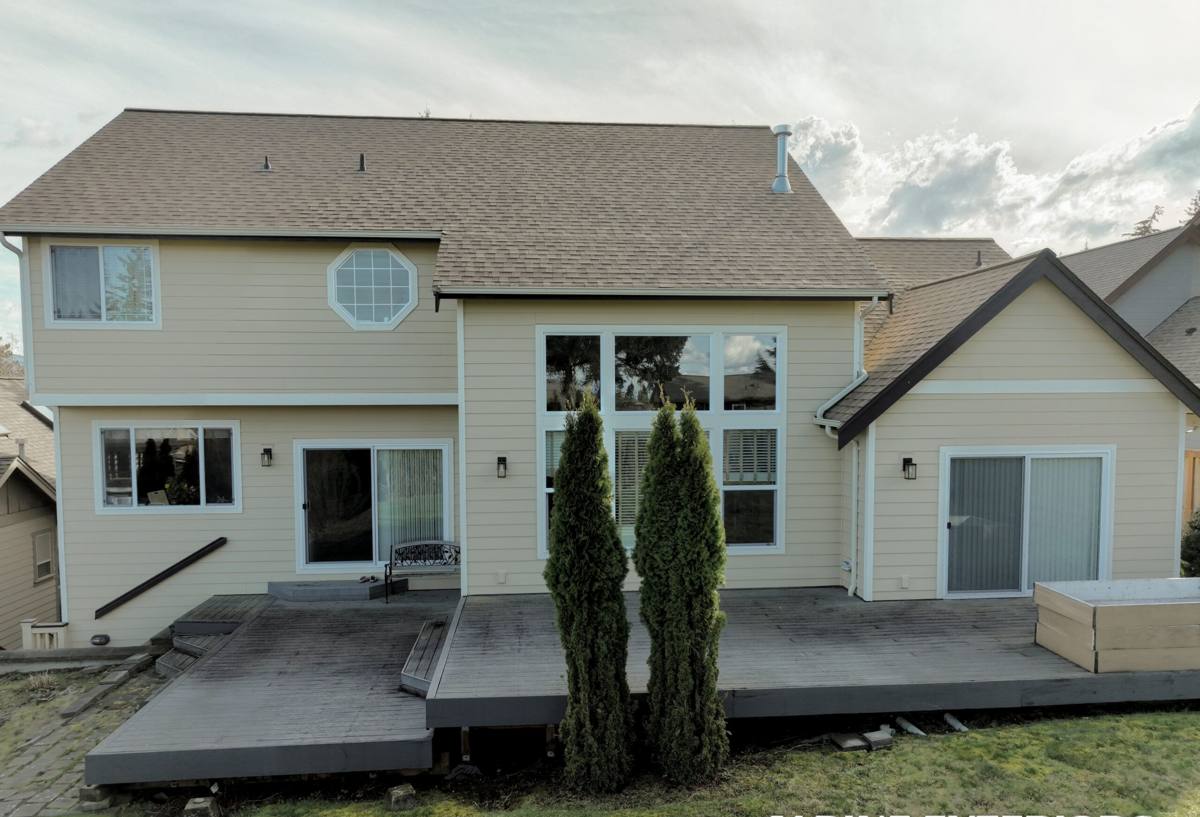
What a Correct Deck Repair Actually Involves
A repair that only replaces the boards you can see is a cosmetic fix, not a real repair. We evaluate the whole system before we touch a single deck board.
- Ledger board and house connection — the point where the deck attaches to your home is the single most important structural connection and the most common source of hidden rot.
- Joists and beams — checked for soft spots, splitting, and corrosion at hanger connections, not just visual sagging.
- Posts and footings — post bottoms near grade or in shaded, damp corners are a common failure point in this climate.
- Fasteners and hardware — every corroded screw, nail, or hanger gets flagged, since one weak connector can undermine an otherwise sound structure.
- Railings and guards — code-relevant for safety, and often the first thing to loosen as posts and fasteners weaken.
- Decking surface — boards, gaps, and drainage, including whether moss and algae growth points to a drainage or shading issue that will just recur.
Signs Your Point Roberts Deck Needs Attention Now
Most deck failures give warning signs long before anything becomes dangerous. Worth checking for:
- Soft, spongy, or springy spots underfoot, especially near stairs or the house connection
- Railings or posts that move when pushed, even slightly
- Rust streaking around screw heads or hanger hardware
- Persistent moss, algae, or dark staining that comes back within weeks of cleaning
- Gaps opening up between boards, or boards that have started to cup or crown
- Visible daylight or gaps at the ledger board where it meets the house siding
- A musty smell coming from underneath the deck
Repair or Replace? The Honest Factors
Not every damaged deck needs a full rebuild, but not every problem should be patched over either. Here's how we think through it:
| Factor | Leans Toward Repair | Leans Toward Replace |
|---|---|---|
| Structural frame (joists, beams, ledger) | Sound, isolated soft spots only | Widespread rot or repeated hidden moisture damage |
| Age of the deck | Under 10-15 years, built to a reasonable standard | Older structure already near end of service life |
| Fastener condition | Localized corrosion, easily replaced hardware | Widespread rust bleed across most connectors |
| Footings and posts | Stable, no movement or heaving | Settling, rot at post base, or undersized footings |
| Cost outlook | A few hundred dollars for a focused repair | Repair cost approaches a meaningful share of full rebuild cost |
Broadly, a targeted repair — a section of decking, a few joists, a railing rebuild — often runs from a few hundred dollars up into the low thousands depending on scope. A full structural rebuild is a different conversation, and we'll always tell you plainly which category your deck falls into before any work starts.
Our Deck Repair Process
- On-site evaluation — we inspect from the ground up, including underneath the deck where visible, not just the walking surface.
- Written scope — you get a clear explanation of what's failing, why, and what's actually needed to fix it correctly.
- Repair plan — we address the root cause (drainage, flashing, corroded hardware) alongside the visible damage, so the same problem doesn't reappear in two years.
- The work itself — structural repairs first, then decking, railings, and finish work.
- Final walkthrough — we check the repair with you before we consider the job done.
Why a Crew That Already Works Point Roberts Matters
Point Roberts is part of Whatcom County, but it isn't connected to the rest of Washington by road — reaching it by land means crossing into Canada and back through the border. That's a real logistical hurdle, and it's a big part of why many general contractors based elsewhere quietly avoid taking jobs there. Materials, tools, and crew all have to make that crossing, which means scheduling has to account for border wait times and cross-border transport in a way that a typical mainland job never does.
Because we already work in Ferndale and across Whatcom County, we've built the border crossing into how we plan and schedule Point Roberts jobs rather than treating it as a surprise. That means fewer last-minute delays, fewer contractors who quote a job and then quietly back out once they realize the logistics involved, and a crew that shows up when it says it will. For homeowners, that reliability matters as much as the repair work itself.
Materials We Use — and Our Reasoning
In a salt-air, high-moisture environment, material choice matters more than in a typical inland yard.
Fasteners and Hardware
We favor stainless steel or high-grade coated fasteners and connectors for anything close to grade or exposed to salt air, since standard galvanized hardware corrodes faster in this environment. It costs more up front, but replacing corroded fasteners twice costs more in the long run.
Decking Material
Cedar remains a solid, honest choice for homeowners who want a natural look and are willing to keep up with periodic sealing and cleaning. Composite decking trades that maintenance burden for a higher material cost and requires careful attention to manufacturer spacing and fastening specs, since improper installation is the main source of composite problems, not the material itself. Pressure-treated lumber is the budget-conscious option and performs well when properly sealed and maintained. We'll walk through the honest trade-offs for your specific deck rather than push one option.
Flashing and Drainage Details
Ledger board flashing and proper drainage detailing are where a lot of decks quietly fail. We treat this as a structural item, not an afterthought, because it's the difference between a repair that lasts and one that reopens the same rot in a few years.
Keeping Your Deck in Shape After the Repair
A good repair buys you years, but the same conditions that caused the original damage don't go away. A few habits make a real difference in this climate:
- Clean moss and algae off decking and railings at least once a year, ideally before the wet season sets in
- Keep gutters and downspouts directing water away from the deck structure, not onto it
- Reseal wood decking on the manufacturer's recommended schedule, not just when it looks faded
- Check railings and stair connections for movement each season
- Trim back vegetation that shades the deck and keeps it damp longer than it needs to be
If you're noticing soft spots, loose railings, or moss that keeps coming back no matter how often you clean it, we're happy to take a look. We offer free, no-pressure estimates for Point Roberts homeowners — use the form below to get one scheduled.