 Ferndale Exterior
 Windows Built for the Bellingham Area's Weather, Not a Showroom in Arizona
If you own a home in the Bellingham area, you already know your windows work harder than windows almost anywhere else in the country. Marine air off the Salish Sea carries salt that attacks metal hardware and finishes. Driving rain, pushed sideways by wind off the water, tests every seal and sightline. And for a good stretch of the year, low sun angles and heavy shade keep north-facing walls damp long enough for moss and algae to take hold. None of that is a knock on the area — it's just what "energy-efficient windows" has to mean here, as opposed to what it means in a catalog written for a drier climate.
We work throughout Whatcom County out of Ferndale, and Bellingham-area homes make up a steady share of our window replacement work. That matters because a window that performs well in this climate isn't just about the glass package — it's about how the whole unit, from frame to flashing, is chosen and installed to shed water and hold its seal year after year.
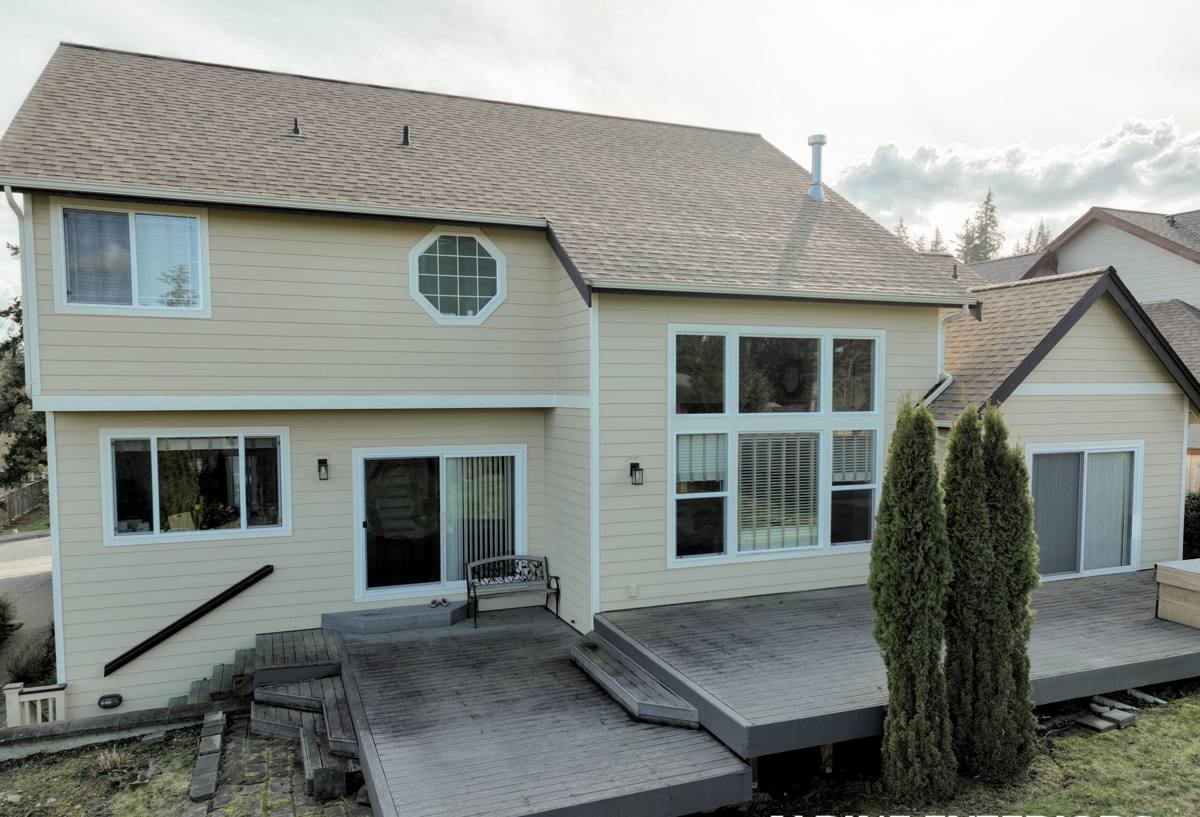
What "Energy-Efficient" Actually Means Here
Energy efficiency in a window comes down to a handful of measurable factors, and in a mild-but-wet marine climate like this one, they don't all carry equal weight.
U-Factor Matters More Than Solar Heat Gain
U-factor measures how well a window resists heat loss — the lower the number, the better it insulates. In Western Washington, where winters are long and mild rather than brutally cold, keeping heat inside the house during the wet months usually matters more than blocking solar heat gain, which is the bigger concern in sunnier, hotter climates. We size glass packages around that reality rather than defaulting to a generic national spec.
Gas Fills and Spacers
Most quality dual-pane windows use argon gas between the panes to slow heat transfer, and the type of spacer bar separating the panes affects both insulation and long-term seal life. Warm-edge spacers (typically a foam or composite material rather than solid aluminum) resist condensation better along the edge of the glass, which is a real issue in a climate with this much sustained humidity.
Air Infiltration Rating
A window can have great glass and still perform poorly if wind-driven rain finds a way through the frame or around the sash. Given how often wind and rain arrive together here, we pay close attention to a window's air infiltration rating, not just its insulating value.
Frame Material: What Holds Up in Salt Air and Constant Moisture
Frame material is one of the biggest decisions in a window replacement, and it's also where the marine climate narrows the field. Here's how the common options generally hold up under Whatcom County's coastal conditions:
| Frame Material | Performance in Salt Air & Rain | Maintenance Burden |
|---|---|---|
| Vinyl | Doesn't corrode; handles moisture well when properly welded and installed | Low — occasional cleaning |
| Fiberglass | Very stable, resists warping and corrosion, strong seal retention | Low |
| Wood (unclad) | Attractive but vulnerable to moisture intrusion and rot without diligent upkeep | High — regular painting/sealing |
| Wood-clad | Good if cladding and flashing details are done correctly; cladding seams are a moisture risk point | Moderate |
| Aluminum (non-thermally-broken) | Conducts cold and is prone to condensation and corrosion near salt air | Moderate to high |
We don't push one material on every homeowner — budget, style, and the specific exposure of a home all factor in. But we're honest that unclad wood and standard aluminum face real trade-offs in this environment, and we'll tell you that plainly rather than let you find out after the fact.
What a Correct Installation Actually Involves
The window itself is only part of the story. Most window failures we're called out to inspect in this region trace back to installation and flashing details, not the window product itself. A correctly installed window in a wet climate needs:
- Proper flashing integration with the existing weather-resistive barrier, so water is directed out and down, never trapped behind the siding
- Sill pan flashing under every window opening, creating a backup drainage path even if the primary seal is ever compromised
- Correct shimming and squaring so the sash operates smoothly and the seal compresses evenly on all four sides
- Compatible, weather-rated sealants at the perimeter — not just any caulk
- Careful integration with existing trim and siding so the water path around the opening isn't interrupted
Skip any one of these steps and you can end up with a window that looks fine and tests fine on install day, but starts letting moisture into the wall cavity within a year or two — often invisibly, until there's staining, soft trim, or a musty smell.
Signs Your Current Windows Are Costing You Money
Homeowners in the Bellingham area often live with underperforming windows longer than they need to, because the problems show up gradually. Some common signs worth paying attention to:
- Condensation forming between the panes (a sign the seal has failed and the gas fill is gone)
- Visible fogging or a cloudy haze on the glass that won't wipe away
- Cold drafts near the frame on windy, rainy days
- Difficulty opening or closing, or a sash that no longer sits flush
- Soft or discolored trim, sill, or drywall near the window
- Persistent moss, algae, or dark staining on the frame or sill that keeps returning after cleaning
Any one of these on its own isn't necessarily an emergency, but a combination usually means the window is no longer doing its job — either thermally, structurally, or both.
Our Process for a Bellingham-Area Window Replacement
We keep the process straightforward and give you a clear picture of what's happening at each stage:
- On-site assessment. We look at existing window condition, framing, and any signs of past moisture intrusion before recommending anything.
- Product selection. We walk through frame material, glass package, and hardware options suited to the home's exposure — more shaded and moss-prone sides of a house sometimes warrant different choices than a sun-exposed elevation.
- Written scope and pricing. You know what's included — flashing, sill pans, trim work, disposal — before work starts.
- Removal and inspection. Old windows come out carefully so we can check the framing underneath for hidden rot or moisture damage before it's covered back up.
- Installation with proper flashing and sealing. This is the step that determines whether the window performs for twenty years or five.
- Final check and walkthrough. We confirm operation, seals, and finish work with you before calling the job done.
Cost Factors for Energy-Efficient Window Replacement
Every home is different, so we won't quote a number without seeing the job, but a few factors tend to drive cost up or down across most projects in this area:
| Factor | Effect on Cost |
|---|---|
| Frame material (vinyl vs. fiberglass vs. wood/clad) | Vinyl is typically the most affordable; fiberglass and wood-clad run higher |
| Glass package (dual-pane vs. triple-pane, low-E coatings) | Upgraded glass packages add cost but improve comfort and efficiency |
| New construction vs. retrofit/insert installation | Full-frame replacement costs more than an insert but can address underlying flashing issues an insert can't |
| Number and size of window openings | Larger and more numerous openings increase material and labor |
| Extent of hidden damage found at removal | Rot or water damage discovered behind old windows adds repair scope |
| Trim and finish work | Matching existing trim profiles or repainting adds to the project |
Why a Crew That Already Works in Bellingham and Ferndale Matters
Anyone can sell you a window. Fewer contractors have actually spent time on roofs and walls throughout Whatcom County, seeing firsthand how salt air ages hardware, how driving rain finds the weak point in a flashing detail, and how moss establishes itself on shaded elevations near the water. That experience shapes real decisions — which sealants hold up, which frame materials we're comfortable standing behind here, and where extra flashing attention is worth the time even when it's not strictly required by code.
We're based in Ferndale and work the surrounding area regularly, including Bellingham. That means we're not learning this climate on your house — we've already seen what happens when window installation cuts corners in a place that gets this much wind-driven rain, and we build our process around avoiding those failures rather than fixing them later.
Ready for a Straightforward Look at Your Windows?
If your windows are fogging, drafty, hard to operate, or just old enough that you're wondering whether it's time, we're happy to take a look and give you an honest read on your options. There's no pressure and no obligation — just a clear assessment and a written estimate you can think over. Fill out the form below to get started.