 Ferndale Exterior
 Why Decks in Semiahmoo Wear Out Faster Than Most
Semiahmoo sits out on an exposed spit with water on more than one side, which means homes here take on a different kind of weather than a deck a few miles inland in Ferndale. Salt-laden air moves through almost year-round, wind-driven rain hits decks at angles that gutters and overhangs don't fully protect against, and Whatcom County's long, cool, wet stretch of the year keeps everything damp enough for moss to take hold and stay. None of that is a reason to avoid building or replacing a deck out here — it just means the job has to be done with those conditions in mind from the framing up, not just the surface down.
A deck that was built to a generic spec, or repaired with whatever hardware was on the shelf, tends to show its age early in this environment. Fasteners rust and streak the boards, ledger connections trap moisture against the house, and moss builds a slick, moisture-holding layer on the walking surface. A proper replacement addresses all of that, not just the parts you can see.
What "Deck Replacement" Actually Means
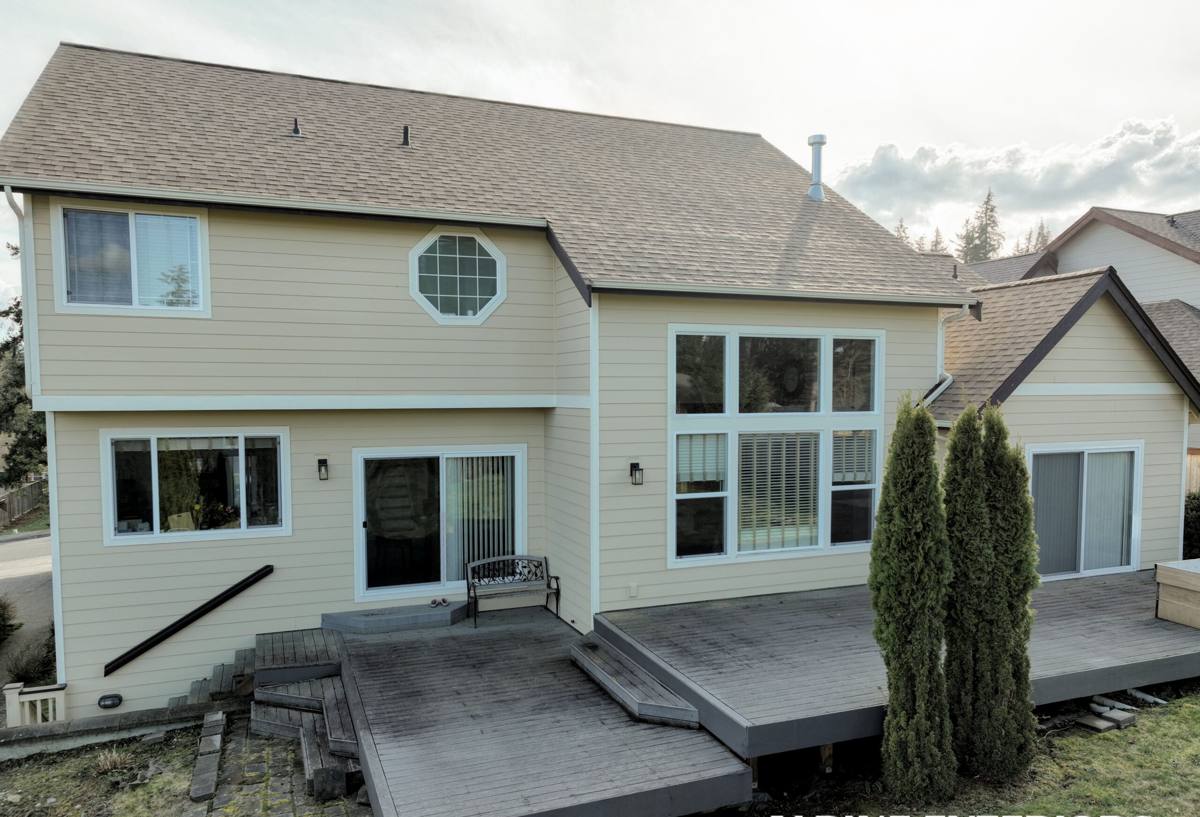
There's a real difference between resurfacing a deck and replacing it. Resurfacing swaps out the top boards and calls it done. That looks fine for a season or two, but if the framing, ledger flashing, or footings underneath were already compromised, the new boards are just sitting on top of the same problem. A true replacement starts by tearing off the old decking and railings and inspecting everything underneath — ledger board, joists, beams, posts, and footings — before anything new goes back in.
The Ledger Board Connection
The ledger board, where the deck attaches to the house, is the single most common source of hidden damage on coastal decks. If the flashing behind it was ever inadequate — or wasn't installed at all — rain gets pushed up behind the siding and into the band board and rim joist over time. On a replacement, we pull the ledger, inspect the wall framing behind it, and install flashing that actually sheds water away from the house, with the decking gapped and sloped so water moves off the structure instead of pooling against it.
Posts, Footings, and Framing
We also check that footings are set to an adequate depth for local soil and frost conditions, that posts aren't sitting where water collects against the base, and that joists are hung with proper metal connectors rather than toe-nailed in. None of this is visible once the decking goes down, but it's the difference between a deck that holds up for decades and one that needs attention again in a few years.
Choosing Decking Material for Salt Air and Moss
There's no single "best" decking material for every home — it depends on how much upkeep you want to do and how close you are to open water. Here's how the common options compare for a spit environment like Semiahmoo:
| Material | Moss & Moisture Resistance | Maintenance | Relative Cost | Typical Lifespan |
|---|---|---|---|---|
| Cedar | Good if sealed and cleaned regularly; can stain and green up if neglected | Annual cleaning and periodic sealing | $$ | 15–20 years |
| Pressure-Treated Lumber | Decent, but end grain and fastener points are still vulnerable | Regular cleaning, occasional sealing | $ | 15–20 years |
| Capped Composite | Very good — sealed shell resists moisture absorption and staining | Occasional washing, no sealing | $$$ | 25–30+ years |
| PVC | Excellent — non-organic, doesn't feed mold or moss growth | Occasional washing | $$$ | 25–30+ years |
Wood costs less up front and has a look plenty of homeowners want to keep, but it asks for more of your time every year to stay ahead of moisture. Capped composite and PVC cost more initially but shrug off the salt-air-and-moss combination with far less effort, which is worth weighing against how hands-on you want to be with maintenance.
Hardware and Fasteners: The Part Nobody Sees, But Everyone Should Ask About
This is where a lot of decks near the water actually fail first — not the boards, the hardware. Standard electro-galvanized screws and joist hangers weren't built for sustained salt exposure. They corrode faster here, streak the decking with rust, and eventually lose holding strength at the connections that matter most. Our standard on coastal jobs is stainless steel or hot-dip-galvanized fasteners and connectors rated for exposed, corrosive environments. It costs more than the generic hardware aisle option, but it's the trade-off that actually keeps a deck structurally sound instead of just looking finished on day one.
Designing for Moss and Standing Water From the Start
Moss doesn't just grow on roofs out here — it settles into anything that stays damp and shaded, and a deck surface with poor drainage is an easy target. A few things make a real difference over the life of the deck:
- Proper board spacing so water drains through instead of sitting on the surface
- Adequate clearance and airflow underneath the deck, not just at the visible edges
- Framing protected with joist tape so water can't sit directly on exposed wood
- Decking profiles chosen with drainage and grip in mind, not just appearance
- A realistic maintenance rhythm — even low-maintenance materials benefit from an occasional rinse during the wetter months
Hidden-fastener systems with deep grooves can look clean, but those grooves also collect debris and hold moisture if the board profile isn't designed to drain well. We factor that into the material and fastening approach we recommend rather than treating every decking product as interchangeable.
Permits, Codes, and Guardrails
Most deck replacements — especially anything attached to the house or elevated above grade — require a permit through the local building department, and Whatcom County is no exception. As a general rule, guardrails become a code requirement once a deck surface sits roughly 30 inches or more above the ground, with a common minimum guardrail height and baluster spacing meant to keep young kids from squeezing through or climbing over. Exact requirements can shift with code updates, so we confirm current specifics with the building department rather than working off memory, and we handle the permit and inspection process as part of the job so you're not chasing paperwork.
Our Deck Replacement Process
- On-site assessment — we look at the existing deck, the ledger connection, and the framing to understand what's actually failing versus what's just old.
- Tear-off and structural inspection — old decking and railings come off so we can inspect joists, beams, posts, and footings directly.
- Framing and ledger repair — any compromised framing gets replaced, and the ledger board is reflashed properly against the house.
- Footings and posts — checked and replaced or reinforced if they're undersized or improperly set.
- Decking installation — using corrosion-rated fasteners and hardware appropriate to the material you've chosen.
- Railings and stairs — built to current guardrail and baluster spacing requirements.
- Final walkthrough and inspection sign-off — including any required building department inspection.
- Cleanup and haul-away — old materials removed, site left clean.
Signs Your Deck Needs Replacement, Not Just Repair
- Soft, spongy, or bouncy spots in the decking or framing underneath
- Visible gaps, movement, or staining at the ledger board connection
- Rust streaking around screws, nails, or joist hangers
- Wobbly railings or posts that move when you lean on them
- Moss or mildew that returns quickly even after cleaning
- Cracked, split, or rot-softened support posts
- Water pooling on the surface instead of draining off
If you're only seeing one or two of these and the framing checks out sound, a repair may be enough. If several show up together, it's usually a sign the whole system — not just the top boards — has reached the end of its useful life.
Why a Crew That Already Works Semiahmoo Matters
A deck built to a generic inland spec doesn't hold up the same way out on an exposed spit. Working in Semiahmoo regularly means we already know which fastener grades actually last, how aggressively moss takes over a shaded deck in this part of Whatcom County, and how local permitting for attached structures typically goes. Being close by also matters after the job is done — if a question comes up during the first wet season on a new deck, we're not far away to take a look.
If your deck is showing its age or you're planning a full replacement, we're happy to take a look and give you a straightforward, no-pressure estimate — just fill out the form below to get started.