 Ferndale Exterior
 Composite Decking for Sumas Homes
Sumas sits out at the edge of Whatcom County, in the flat, low-lying farmland of the Sumas Prairie near the Canadian border. It's a different setting than the coastal neighborhoods closer to Bellingham Bay, but the weather pattern that drives our decking work is the same one that drives everything else we build out here: rain that comes in sideways as often as it falls straight down, a low-lying valley floor that holds moisture longer than a well-drained hillside lot, and a moss season that stretches across much of the year. A deck sitting low to the ground on a flat Sumas property takes that exposure directly, on a horizontal surface that can't shed water the way a wall does. We build composite decks for homes in Sumas on a regular basis, and the approach we bring accounts for what this specific climate actually does to a deck over time, not just what a product brochure says it can handle.
We install TimberTech composite decking. For a valley property that sees this much sustained moisture, it's the system we recommend without hesitation.
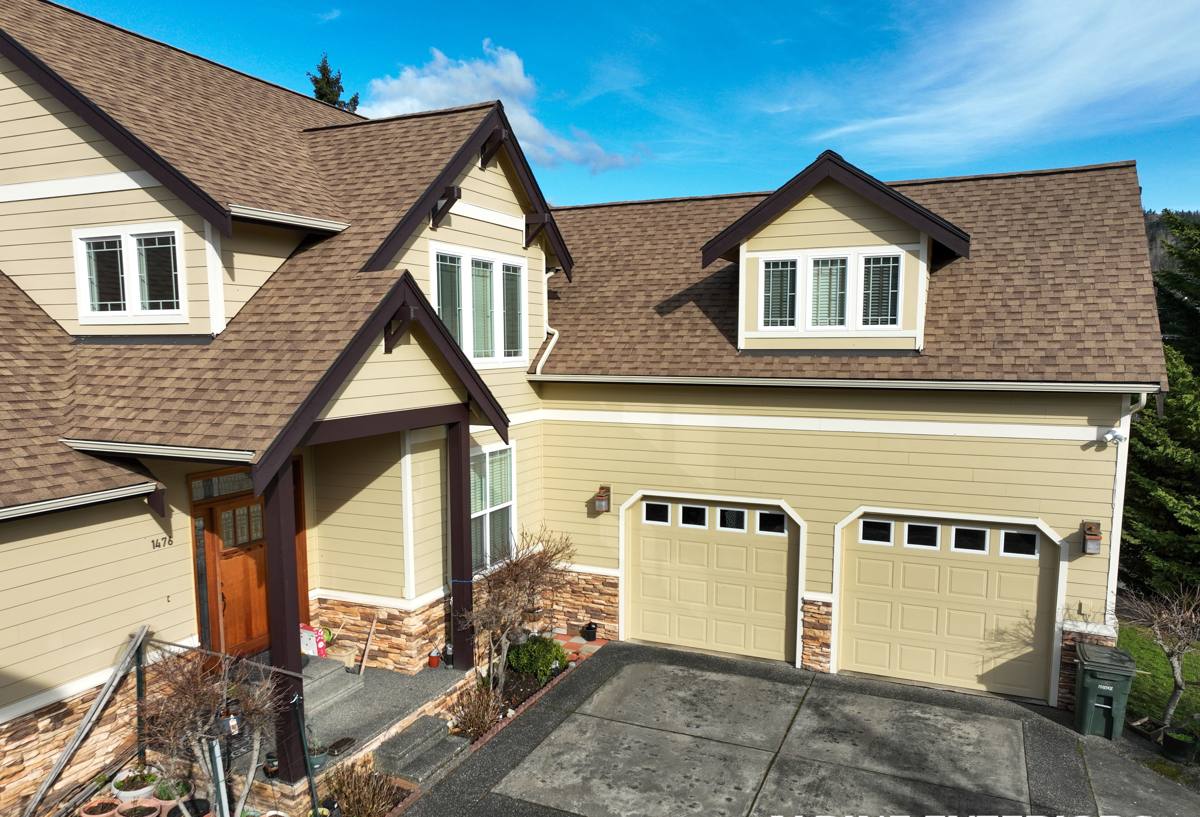
What the Sumas Climate Does to a Deck
Driving Rain on a Horizontal Surface
A deck is the one part of a home's exterior that faces the sky directly rather than shedding rain off a sloped or vertical surface. In Sumas, wind-driven storms push rain onto deck boards from multiple angles, and on a flat, low-lying property that water doesn't run off as quickly as it would on a sloped lot. Boards and framing that aren't detailed for standing water and slow drainage tend to show damage first at fastener points, board ends, and anywhere ledger flashing is doing less than it should.
Valley Damp That Doesn't Let Up
Because Sumas sits low on the valley floor near the Nooksack River system, ground moisture and humidity stay elevated longer after a storm passes than they do on higher, better-drained ground. A deck's substructure — the joists, beams, and posts underneath the visible decking — sits in that damp air for extended stretches, which is exactly the condition that leads to hidden rot in untreated or poorly detailed wood framing.
A Long Moss and Mildew Season
Persistent regional dampness and mild temperatures add up to a moss and mildew season that runs long in this part of the county, and a deck surface is more exposed to it than a wall. Shaded decks and north-facing outdoor spaces pick up green staining and slick surface growth if the material and drainage underneath aren't working together to shed water. On a walking surface, that's not just cosmetic — it's a slip hazard.
Freeze-Thaw Cycling
Sumas sees more frequent hard frosts than milder coastal parts of the county, and that adds a freeze-thaw dimension to any moisture that's already gotten into a deck board or fastener connection. Water trapped in a porous or poorly sealed material expands when it freezes, which accelerates cracking, splintering, and fastener failure faster here than in a purely wet-but-mild climate.
Why TimberTech Is What We Install
We've watched, across years of deck work throughout Whatcom County, which decking materials actually hold up under sustained valley moisture and which ones quietly turn into a maintenance burden — sanding, sealing, and replacing boards every couple of seasons. For a Sumas property dealing with valley damp, driving rain, and real freeze-thaw cycling, the case for composite decking is a strong one.
- Cap-stock protection: TimberTech's composite boards have a protective outer layer that resists moisture absorption, so the board core isn't soaking up valley damp the way an untreated wood board does.
- No sealing or staining: There's no annual sealing or staining cycle to keep up with, which matters on a property where the wet season runs long enough that a missed maintenance year shows up fast on real wood.
- Resistance to splintering and cracking: Composite boards don't dry out and splinter the way wood can after repeated wet-to-dry cycling, which matters for bare feet and kids on a backyard deck.
- Consistent color and grain: The color runs through a manufactured board rather than relying on a field-applied stain, so fading and blotching are far less of an issue over time.
- Strong transferable warranty: TimberTech backs its boards with a solid warranty structure when the deck is installed to spec, which gives a homeowner real protection instead of a marketing claim.
We don't build decks out of untreated dimensional lumber or lower-tier composite products. Plenty of homeowners elsewhere are satisfied with a wood deck they're willing to maintain every year, and that's a legitimate choice. But we made a professional call that one composite system we trust completely, installed on framing detailed for this valley's moisture, is worth more to a Sumas homeowner than a cheaper deck that quietly shifts sanding, sealing, and board replacement onto them a few years down the road.
Choosing the Right TimberTech Line for a Sumas Deck
| Product Line | Best Use | Why It Fits This Area |
|---|---|---|
| AZEK / PVC decking | Homes wanting maximum moisture resistance | Fully cellular PVC composition holds up well against sustained valley dampness and standing water exposure |
| Prime composite decking | Standard single-family decks and additions | Solid cap-stock protection at a moderate price point, a reliable fit for most Sumas homes |
| Legacy / premium composite lines | Larger decks, entertaining spaces, higher-traffic areas | Heavier cap-stock and deeper wood-grain texture for homeowners wanting a longer-term, higher-end surface |
| TimberTech railing and fascia | Rail systems, stair skirts, and deck edges | Matches the decking's moisture resistance so trim pieces aren't the weak point in a few years |
Color and board profile come down to the individual home and the homeowner's preference, but the underlying framing and drainage approach stay consistent — we build the structure underneath to handle a Sumas property's actual moisture exposure rather than defaulting to whatever's fastest.
What Correct Deck Installation Looks Like Here
The decking material only gets a Sumas deck halfway there. The rest comes down to what's underneath: joist spacing and fastening that account for real-world load and this area's freeze-thaw cycling, correct ledger board flashing where the deck meets the house so water isn't tracking into the wall behind it, post footings set below frost depth, and hidden fastener systems that don't leave exposed screw heads for water to collect around. On a low-lying property that holds moisture longer than a well-drained hillside lot, a rushed substructure tends to show problems within a season or two — even if the decking on top looks fine.
Repair vs. Full Rebuild
Not every deck problem in Sumas calls for a full tear-out. A handful of damaged boards, a loose rail section, or an isolated fastener issue can often be repaired without touching the rest of the deck. But if the ledger connection has been leaking for a while, or the framing underneath is an older wood structure that's been absorbing valley moisture for years, patching the surface usually just delays a bigger job while rot keeps spreading in the joists and posts underneath. We'll tell you honestly which situation you're actually looking at.
Deck Readiness Checklist
- Deck boards checked for soft spots, splintering, or discoloration
- Ledger board and house connection inspected for water staining or gaps
- Railing posts and connections checked for looseness or movement
- Joists and support posts inspected from underneath for soft or rotted wood
- Footings checked for settling, cracking, or frost heave
- Shaded and north-facing deck sections checked for moss buildup and slip risk
Roofing, Siding, and Windows in Sumas
A deck rarely fails in isolation. A gutter dumping water directly onto a deck surface, siding that's letting moisture behind the ledger connection, or a window above the deck that isn't flashed correctly can all feed water into a deck structure long before anyone traces the damage back to its actual source. Because we handle roofing, siding, and windows along with decks, we look at a Sumas property as one connected exterior system exposed to the same rain, wind, and freeze-thaw cycling, rather than treating the deck as a separate project disconnected from the rest of the house.
Ledger and Siding Considerations
Where a deck ledger attaches to the house is one of the more common places water finds its way into a wall assembly. Correct flashing at that connection, tied properly into the siding above it, matters as much as anything on the deck itself.
Gutter and Roof Considerations
A roof or gutter system that isn't managing water correctly above a deck can undo good decking work fast, dumping concentrated runoff onto boards and framing that weren't sized for that kind of repeated soaking.
Cost Factors for Sumas Deck Projects
| Factor | What It Affects | Why It Matters Here |
|---|---|---|
| Deck size and layout | Material quantity and framing complexity | Multi-level decks and stairs add labor and framing detail beyond a simple rectangular deck |
| Substructure condition | Whether existing framing can be reused | Older framing on a low-lying property may have absorbed years of valley moisture and need replacement |
| Footing depth | Excavation and concrete work | Footings need to sit below frost depth given this area's freeze-thaw cycling |
| Decking and railing line chosen | Material cost | PVC and premium composite lines cost more upfront but resist this valley's moisture exposure longest |
| Site access | Labor time and equipment needs | Rural and agricultural properties near Sumas can have longer driveways or wider staging needs than an in-town lot |
Exact costs depend on the specific property and its layout, which is why we walk the site in person before giving a real number instead of quoting off a generic price sheet.
Why a Local Crew Matters in Sumas
A crew that works this part of Whatcom County regularly understands how valley damp, driving rain, and freeze-thaw cycling behave on real decks here over a full year, not just how a product performs on a spec sheet. That experience shapes practical decisions on install day: how deep footings need to go, which board orientation drains best on a flat lot, and where extra flashing attention at the ledger pays off so a homeowner isn't dealing with a rot problem two winters later. Sumas sits far enough inland and close enough to the border that its exposure looks a little different from the rest of Ferndale's service area, and a crew with hands-on local experience treats that difference seriously instead of applying a one-size-fits-all approach built for a milder coastal lot.
What to Expect When You Call Us
- A walk-through of your existing deck or planned deck site, including the framing underneath if there's an existing structure
- An honest assessment of whether you're looking at a repair, a partial rebuild, or a full new deck
- A clear explanation of why we recommend TimberTech composite decking for a property with this kind of exposure
- A written estimate with no pressure to sign on the spot
If you're planning a new deck in Sumas or want an honest look at what's happening underneath an aging one, we're glad to take a look. Reach out using the form below to schedule a free, no-pressure estimate.