 Ferndale Exterior
 Composite Decking Built for Everson's Nooksack Valley Climate
Everson sits inland along the Nooksack River, in the flat farmland and low bench land that makes up this stretch of Whatcom County. It's a different setting than the towns closer to Bellingham Bay and the Sound — Everson doesn't get the direct salt air those coastal spots deal with — but it carries its own version of the same underlying problem: persistent valley dampness, driving rain that blows in sideways more often than it falls straight down, and a moss season that runs long here thanks to river humidity and plenty of shaded tree cover. A deck is an outdoor structure with no roof over it, sitting directly in whatever the local climate throws at it year-round, which makes material choice and build quality matter more here than they would on, say, a covered porch.
We're based in Ferndale and work Everson regularly as part of our regular Whatcom County service area. This page covers what an Everson home actually needs from a composite deck, what a correct build involves out here, and why hiring a crew that already knows this stretch of the Nooksack Valley is worth something beyond just picking whoever's closest on a map.
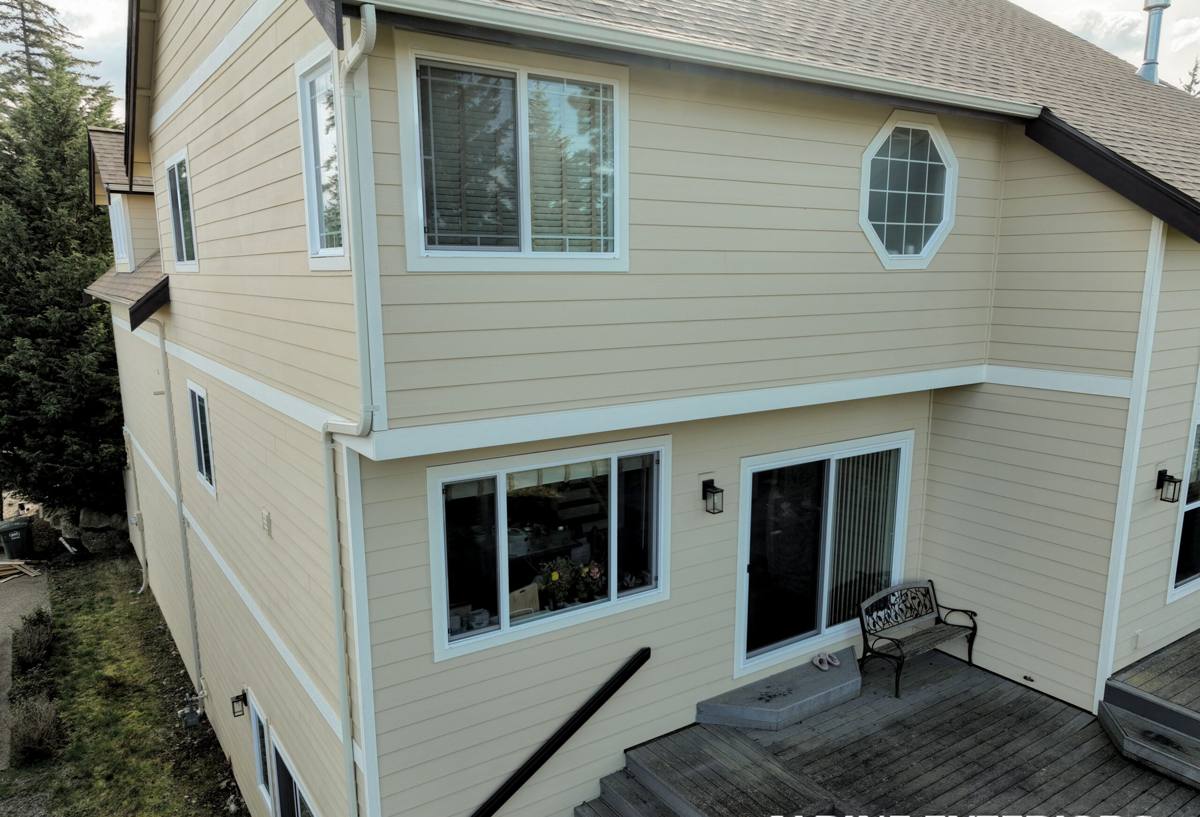
What Everson's Climate Does to a Deck
Valley Damp and Driving Rain
Storms moving through Whatcom County don't drop straight down as often as people assume — wind pushes rain sideways into railings, under board edges, and into ledger connections where the deck ties into the house. On the flatter, lower-lying ground around Everson and the Nooksack River, that moisture doesn't drain away as fast as it would on a hillside lot, so a deck here spends more time sitting damp between storms than one built on higher, better-drained ground. That distinction matters for both the decking surface and, just as much, for the framing underneath it.
River Humidity and Fog
Proximity to the Nooksack River keeps ambient humidity higher in Everson than in drier parts of the county, and cool-season mornings often bring fog that lingers over the low ground before it burns off. That sustained dampness is exactly the condition that lets moss, mildew, and surface staining get a foothold on any decking material with even a little surface porosity — and it gives that growth more days per year to work with than a drier inland town would.
A Long Moss Season
Mild temperatures, consistent moisture, and the tree cover common on rural Everson lots add up to a moss and mildew season that runs most of the year on shaded or north-facing surfaces. On a deck, that shows up first between boards and around post bases — the spots that hold water longest and dry out slowest after a rain.
Freeze-Thaw Winters
Everson sees harder frosts and more frequent freezing mornings than the milder coastal parts of Whatcom County closer to the water. Water that's worked its way into a porous or poorly sealed material and then freezes expands, which speeds up cracking and surface failure in a way a purely wet-but-mild climate wouldn't. It's one more reason a decking material's actual moisture absorption matters more here than the sales sheet number suggests.
Why Composite Decking Fits This Climate
Composite decking is generally a blend of wood fiber and plastic, but the category covers a wide performance range depending on the ratio, the plastic type, and whether the board is capped or left exposed. For a damp, shaded, freeze-prone property like a typical Everson lot, that distinction matters more than it would somewhere drier.
Capped vs. Uncapped Composite
Capped composite boards wrap a protective plastic shell around the wood-plastic core, which keeps moisture from soaking into the board and driving mold growth, staining, or freeze-cracking at the surface. Uncapped composite — the older style of the product — leaves that core exposed on all sides, so it absorbs more moisture and shows wear faster in a climate that stays damp this much of the year. We standardize on capped composite for Everson installs for that reason.
Where Wood and PVC Fit
Pressure-treated lumber and cedar are still common choices and can look good when new, but both need regular sealing or staining to hold up against sustained valley moisture, and wood is the material most likely to show moss and soft spots first if maintenance slips. Cellular PVC decking, which contains no wood fiber at all, resists moisture absorption completely and can be worth the added cost on a shaded, low-lying lot where dampness is the dominant concern — though it costs more up front and can flex more under heavy point loads than composite. We'll walk through which material actually fits a specific property rather than defaulting to one answer for every job.
| Material | Handling Valley Damp | Moss Resistance | Upkeep |
|---|---|---|---|
| Capped composite | Strong — cap layer blocks moisture absorption | Good on most product lines | Occasional washing, no sealing |
| Cellular PVC | Excellent — no wood fiber to absorb moisture | Strong, smooth non-porous surface | Occasional washing, no sealing |
| Uncapped composite | Moderate — some moisture absorption at exposed fiber | Fair; more prone to buildup over time | Periodic cleaning |
| Cedar | Moderate — needs sealing to hold up in sustained damp | Fair when sealed and maintained | Regular oiling or sealing |
| Pressure-treated wood | Weak without consistent maintenance | Poor without regular treatment | Regular sealing or staining |
What a Correct Composite Deck Build Involves in Everson
The decking boards get most of the attention, but on a damp, low-lying property, the framing and fastening details underneath are what actually decide whether the deck holds up. A build done right here includes:
- Framing material rated for sustained ground moisture — properly sized, pressure-treated lumber suited to the site's actual drainage conditions
- Corrosion-resistant fasteners throughout, since even inland Whatcom County moisture will work on standard-grade hardware over enough seasons
- Hidden fastener systems on the visible deck surface where the product allows, for a cleaner walking surface with less exposed metal
- Correct board gapping for drainage and material movement, so moisture can actually drain and the deck can dry out between rain events
- Proper ledger board flashing where the deck attaches to the house — one of the most common places moisture gets into a structure on a poorly built deck
- Joist spacing matched to the specific composite product's span rating, not a generic wood-framing layout
- Grading and drainage work around the substructure so water doesn't pool and sit against the framing on flatter ground
- Ventilation underneath the deck so shaded, low-airflow areas aren't trapping moisture against the joists between storms
Skip any of those steps and the deck usually still looks fine the day it's finished. The problems show up a few winters later — a soft joist, a post that's started to loosen, or moss and staining working in around fasteners that weren't rated for the job.
Design Considerations for Everson Properties
Beyond material and structure, a handful of site-specific questions come up on most Everson deck projects. Tree cover is common on rural lots out here, and shade patterns affect which decking colors and materials will resist moss best, since a heavily shaded deck needs different priorities than one that gets sun most of the day. Lot grading matters too — flatter properties near the river bench need more attention to drainage under and around the deck than a sloped lot would. And because many Everson properties sit on larger, more rural parcels than in-town lots, layout often has more room to work with, which opens up options for deck size and placement that a tighter in-town lot wouldn't allow.
How Our Process Works
We start with a site visit to look at what's actually there: existing deck condition if it's a replacement, drainage and grade around the build area, tree cover and shade patterns through the day, and how the site sits relative to the river or any low ground that collects water. From there we walk through material options that fit the budget and how the space will actually get used.
Permitting in Everson and the rest of Whatcom County generally follows standard setback, structural, and grading requirements, and we handle that as part of the job rather than leaving it for the homeowner to sort out. Once permitted, the build follows the sequence above — substructure and framing first, sized and fastened for the site's actual moisture exposure, then the decking surface, railing, and any stairs or trim. We close out with a walkthrough covering what your specific material actually needs going forward, which for most modern composite decking is minimal, but not nothing.
What Your Deck Still Needs From You
Composite decking is low-maintenance compared to wood, not maintenance-free — especially in a climate that stays damp and shaded this much of the year. A short list worth keeping in mind:
- Rinse or sweep the surface periodically to clear leaf litter, pollen, and organic buildup before it works into the cap layer or between boards
- Keep gaps between boards clear of debris so water and airflow can move through as designed
- Check railing posts and hardware once a year for early signs of corrosion or loosening, especially after winter freeze-thaw cycles
- Trim back trees or landscaping that hold moisture against the deck edge or block airflow underneath it
- Address any substructure concerns — a soft joist, standing water underneath — right away rather than waiting, since that's structural, not cosmetic
Why It Matters That We Already Work Everson
A crew that mostly builds decks closer to the coast can still install composite decking competently, but an inland Nooksack Valley property has its own variables — flatter drainage, more sustained shade and dampness, and freeze-thaw winters that hit harder than they do near the water. Working out of Ferndale and covering Everson regularly as part of our normal service area means we're not guessing at those conditions or learning them on your project. We know which framing details actually matter on low-lying ground here, which fastener grade holds up through a full freeze-thaw winter, and how local permitting works, because we've built to those standards on this same kind of property before.
That familiarity also shows up in smaller ways: knowing which composite lines actually resist moss over years of valley dampness rather than months, and being straightforward with Everson homeowners about what a deck here realistically needs versus what's just an upsell.
Get a Free, No-Pressure Estimate
Whether you're replacing a tired wood deck, planning a new build, or just want a straight answer about what a composite deck would take on your Everson property, we're glad to walk the site with you and lay out the options plainly. Reach out using the form below to schedule a free, no-pressure estimate.