 Ferndale Exterior
 Why Roofs in Everson Wear Out Faster Than the Warranty Sticker Suggests
Everson sits in the same weather system that soaks the rest of Whatcom County — long stretches of low, steady rain, damp air moving in off the Sound, and short winter days that never quite dry a roof out before the next system arrives. That combination is hard on shingles, hard on flashing, and it's exactly the environment moss loves. A roof that might last 25 years in a drier climate can start showing real problems well before that out here, especially if it wasn't detailed correctly the first time.
Most of the roof failures we get called out for in this area aren't dramatic. They're slow: a section of moss holding moisture against the shingles, a flashing detail that was never properly step-flashed, valleys that weren't given enough underlayment protection. By the time a homeowner sees a stain on the ceiling, the roof has usually been letting water in for a while. Understanding that pattern is the first step to deciding whether your Everson home needs a repair or a full replacement.
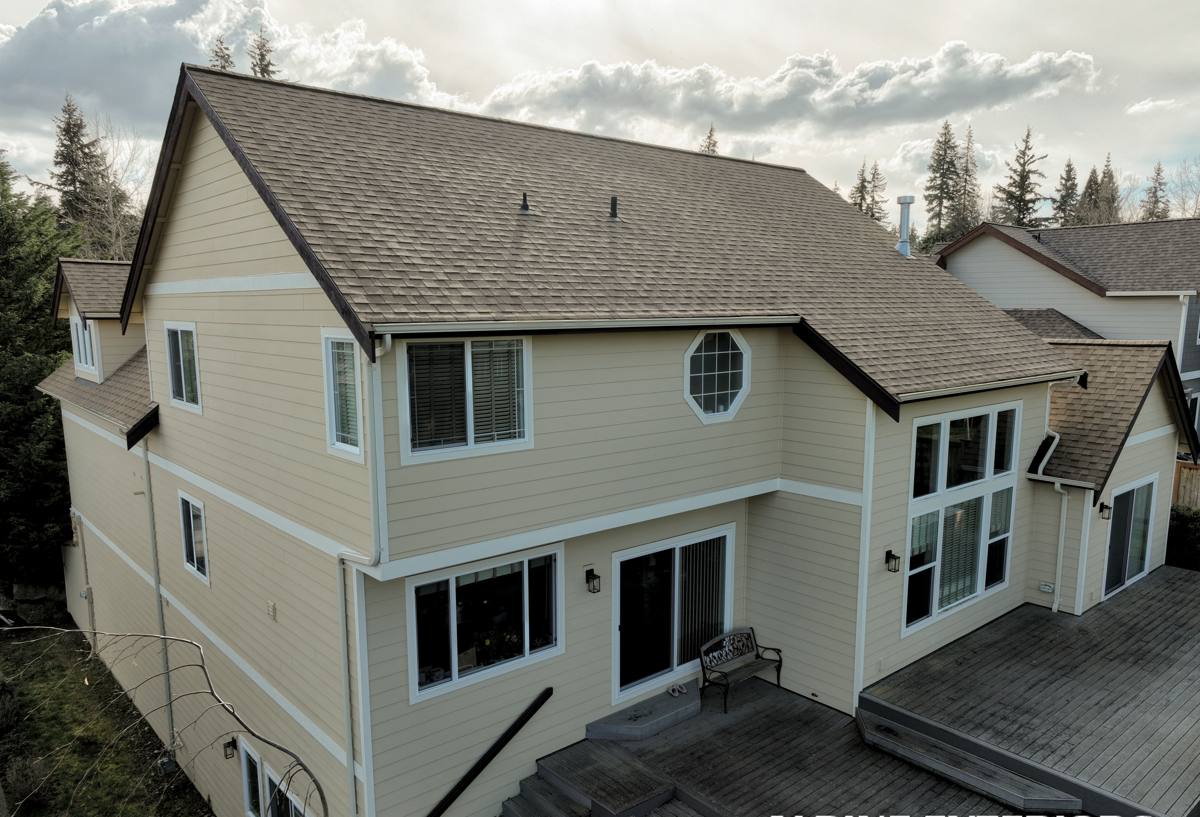
Signs a Repair Won't Cut It Anymore
Not every roof problem means a full tear-off. But there's a point where patching becomes throwing good money after bad. Some signs that point toward replacement rather than another round of repairs:
- Granule loss heavy enough that you're finding grit in gutters or downspout splash zones every time it rains
- Shingles that are curling, cupping, or cracking across multiple slopes, not just one isolated spot
- Moss that keeps returning within a year or two of cleaning, especially on north-facing or shaded slopes
- Soft or spongy decking felt underfoot during an inspection, which usually means water has already reached the wood
- A roof that's past 18–20 years old on standard asphalt shingles, particularly if the original installation used minimal underlayment
- Daylight visible through the attic decking, or insulation that's damp or matted near the eaves
If you're only seeing one or two isolated issues on an otherwise sound roof, a repair is usually the honest recommendation. We'll tell you that directly rather than push a replacement a roof doesn't need yet.
The Difference Between "It Looks Fine" and "It's Actually Sound"
A roof can look reasonable from the ground and still be failing underneath. Moss growth, sagging ridgelines, and dark streaking are visible clues, but the more important checks happen at the eaves, valleys, and any place the roof meets a wall, chimney, or skylight. Those transition points are where a correctly built roof and a poorly built one diverge the most, and they're also where Everson-area roofs tend to fail first because they take the brunt of wind-driven rain.
What a Correct Roof Replacement Actually Involves
A roof replacement done right is more than stripping old shingles and nailing down new ones. For a home in this climate, each layer has a job to do against sustained moisture, not just occasional weather:
- Full tear-off to bare decking, so we can actually inspect the sheathing rather than layering over hidden rot
- Decking repair or replacement for any sections that are soft, delaminated, or water-stained
- Ice-and-water shield at eaves, valleys, and any low-slope transitions, which matters more here than in drier regions because of how long moisture sits on a roof surface
- Synthetic underlayment across the full roof deck as a secondary water barrier
- Proper flashing at every wall, chimney, skylight, and vent penetration — step flashing and counter-flashing, not just caulk
- Balanced ventilation so intake at the eaves and exhaust at the ridge actually move air, reducing the trapped moisture that feeds moss and rot
- New shingles or roofing material installed to manufacturer spec, including correct nailing pattern and exposure
Skip any one of these steps and you get a roof that looks new for a few years but fails from the inside out. This is where a lot of corner-cutting happens on lower bids — the shingles are visible, the underlayment and flashing detail aren't, until they leak.
Choosing the Right Material for an Everson Roof
There's no single "best" roofing material — there's a best fit for your home, your roofline, and your budget. Here's how the common options actually compare for a coastal Whatcom County climate:
| Material | Typical Lifespan | How It Handles This Climate | Trade-Offs |
|---|---|---|---|
| Architectural asphalt shingle | 20–30 years | Good performance when paired with proper underlayment and ventilation; widest range of price points | More prone to moss growth on shaded slopes without periodic cleaning |
| Standing-seam metal | 40–50+ years | Sheds moss and moisture well due to smooth surface and fast water shedding | Higher upfront cost; installation quality matters even more since seams are the failure point |
| Synthetic composite (shake/slate look) | 30–50 years | Resists moisture absorption better than wood products, holds up to driving rain | Higher material cost; fewer installers experienced with proper detailing |
| Cedar shake | 15–25 years realistic in this climate | Traditional look, but wood holds moisture and feeds moss growth | Higher long-term maintenance burden; we're upfront that this isn't our default recommendation here for that reason |
We don't push one material on every roof. A steep, heavily shaded roofline near mature trees is a different conversation than a simple, sun-exposed gable. We'll walk your specific roof and give you a straight recommendation, not a sales script.
How We Approach a Replacement in Everson
Because we already work this part of Whatcom County regularly, our process is built around the realities of the area rather than a generic template:
- On-site inspection — we check the decking, flashing, ventilation, and moss/moisture patterns before quoting anything, not just a drive-by estimate
- Clear scope and material selection — you know exactly what's being torn off, what's being replaced, and why
- Weather-aware scheduling — we plan around the rain patterns typical to this area rather than rushing a job into a system moving in off the coast
- Full tear-off and deck inspection — no roofing over existing layers
- Correct underlayment and flashing detail at every penetration and transition, done to hold up against sustained wind-driven rain
- Ventilation check and correction if the existing intake/exhaust balance isn't adequate
- Final walk-through so you can see the completed work and ask questions before we consider the job done
Moss and Moisture: The Part That Determines How Long Your New Roof Actually Lasts
A new roof in this climate is only as good as its ability to shed water and resist moss regrowth. Moss itself doesn't just sit on top of shingles — its root structure lifts granules and holds moisture against the shingle surface, which accelerates wear well beyond normal aging. That's why ventilation and slope exposure matter as much as the shingle brand.
A few things that meaningfully extend the life of a roof replacement out here:
- Zinc or copper strips near the ridge on moss-prone slopes, which release trace metal ions that discourage regrowth over time
- Keeping overhanging branches trimmed back so shaded slopes get more sun exposure and airflow
- Clearing gutters and valleys at least twice a year so standing water doesn't sit against the roof edge
- A ventilation system that's actually balanced — too much exhaust with too little intake creates its own moisture problems
These aren't upsells we tack on to inflate a quote — they're the difference between a roof that needs another replacement in 15 years and one that reaches its full rated lifespan.
Why It Matters That We Already Work in Everson and Ferndale
A roofing crew unfamiliar with this specific stretch of Whatcom County is working from general assumptions about weather and roof performance. A crew that already works Everson and the surrounding Ferndale area knows which slopes typically hold moss, how local permitting works, and what kind of underlayment and flashing detail actually holds up against the rain patterns here rather than a textbook version of "coastal weather."
That local familiarity also means faster, more accurate quoting — we're not guessing at material lead times or crew availability for this region, and we're not learning the area's drainage quirks on your dime.
What a Roof Replacement Typically Costs — and What Moves the Price
Every roof is different, but the main variables that move a quote up or down are consistent. Use this as a general guide, not a fixed price:
| Cost Factor | How It Affects Price |
|---|---|
| Roof size and number of slopes | More square footage and complex rooflines (multiple valleys, dormers) mean more labor and material |
| Decking condition | Rotted or soft sheathing found during tear-off adds material and labor cost to replace |
| Material choice | Standard asphalt shingle is the most budget-friendly; metal and composite materials cost more upfront |
| Roof pitch and accessibility | Steep or hard-to-access roofs require more safety equipment and time |
| Ventilation and flashing upgrades | Bringing an older roof's ventilation or flashing up to current standards adds cost but extends the roof's lifespan |
| Tear-off layers | Removing multiple existing layers of roofing takes more labor than a single-layer tear-off |
We give a firm, written quote after inspecting your roof in person — not a phone estimate — because too many of these factors can't be judged from the street.
Questions Worth Asking Before You Hire Anyone
- Are you licensed and insured to work in Washington, and can you provide proof?
- Will you do a full tear-off to bare decking, or is roofing over the old layer an option you're offering?
- What underlayment and flashing details will you use at valleys, walls, and penetrations?
- How will you handle ventilation if the current setup isn't balanced?
- What does the manufacturer's warranty actually cover, and what voids it?
- Do you have references from work done in this area specifically?
- What's the plan if weather delays the job partway through?
Any contractor who gets uncomfortable with these questions is telling you something.
If your roof is showing its age — or you just want an honest opinion on whether it's repair or replace — we're happy to come take a look. The estimate is free, there's no pressure, and you'll get a straight answer either way. Use the form below to get started.