 Ferndale Exterior
 Kendall's Climate Is Harder on Siding Than Most Homeowners Realize
Kendall sits within Whatcom County's broader weather pattern, where wet, marine-influenced storm systems move through for much of the year and settle into the valleys and tree-covered lots that define this part of the county. Add heavy tree canopy, close-set homes, and long stretches of overcast, damp weather, and you get a climate that's less about any single dramatic event and more about relentless, cumulative moisture exposure. Siding here doesn't fail because of one bad storm. It fails slowly, from cladding that never fully dries out between rain events.
Moss, Mold, and Shade
Many Kendall properties back up to trees or sit on lots with partial shade most of the day. That shade keeps siding damp longer after rain, which is exactly the condition moss and mold need to take hold. On wood-based or fiberboard products, that sustained moisture doesn't stay on the surface — it works into the material itself, causing swelling, delamination, and soft spots that show up as soft, spongy siding long before anything looks visibly wrong from a distance.
Rain and Moisture Cycling
It's not the total rainfall that does the damage — it's the repeated wet-dry cycling. Siding gets soaked, partially dries, gets soaked again, dozens of times a season. Materials that absorb water and swell with each cycle degrade faster than materials engineered to resist water absorption in the first place. This is the single biggest factor separating siding that lasts decades from siding that needs attention within ten years.
Temperature Swings
Whatcom County sees real seasonal swings — cold, damp winters and warmer, drier summers. Siding has to expand and contract without cracking, cupping, or opening up gaps at the seams. Products with poor dimensional stability show this first at the joints and corners, right where water intrusion does the most damage.
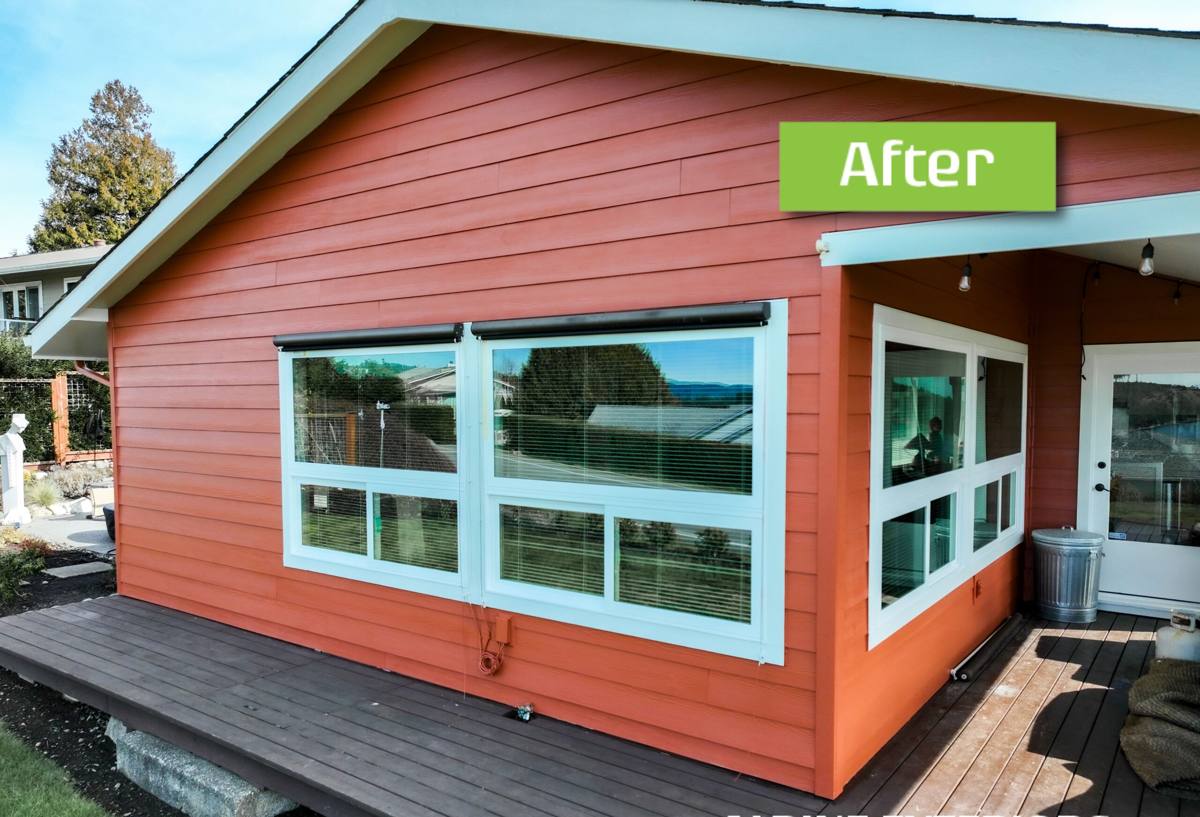
Why We Standardized on James Hardie for Homes Like These
We install James Hardie fiber cement exclusively. Not because it's the only decent siding product on the market, but because after years of seeing how different materials perform in this specific climate, Hardie consistently holds up the way homeowners expect their siding to hold up — without the maintenance surprises.
A Non-Combustible Core
James Hardie siding is fiber cement — it does not support flame spread the way wood-based products do. For homes in and around Kendall, closer to forested and semi-rural surroundings than many in-town properties, that non-combustible core is a meaningful, practical advantage, not a marketing point.
Factory-Applied ColorPlus Finish
ColorPlus finish is baked on at the factory under controlled conditions, not brushed or sprayed on-site. That matters directly in a climate like Kendall's: field-applied paint has to cure properly to bond and perform, and damp, cool weather is exactly what makes that harder. ColorPlus removes that variable entirely and comes backed by its own finish warranty.
HZ5 Engineering for Wet Climates
James Hardie's HZ5 product line is engineered specifically for regions with heavy moisture exposure and freeze-thaw cycling — which describes Kendall's conditions well. It's a different formulation than the products built for hot, dry climates, and it's the one we use here.
What a Correct James Hardie Installation Actually Involves
Hardie siding's reputation is built on the product, but its real-world performance depends heavily on installation. A poorly installed Hardie job can fail just as fast as a poorly installed anything else. Here's what has to happen for it to be done right:
- Proper water-resistive barrier installed and lapped correctly behind the siding, not just stapled up as an afterthought
- Rainscreen or drainage gap where conditions call for it, giving moisture somewhere to escape instead of sitting against the cladding
- Correct fastener type, spacing, and depth — over-driven nails are one of the most common causes of early Hardie failures
- Manufacturer-specified clearances at grade, decks, patios, and roof lines so siding isn't sitting in standing water or splashback
- Properly flashed and caulked window and door transitions, using sealants compatible with fiber cement
- Field-cut edges primed or sealed per Hardie's installation guidelines before they're closed up
- Correct panel and joint spacing to allow for expansion without forcing gaps or buckling
Every one of these steps is spelled out in James Hardie's own installation instructions. Skipping any of them can void warranty coverage — which is one reason we treat the installation manual as a requirement, not a suggestion.
Our Process for a Kendall Siding Project
- On-site assessment. We walk the property, check the current siding condition, look at drainage, grading, tree cover, and sun exposure specific to the lot.
- Moisture and structural check. Before quoting a full install, we check for existing rot, soft sheathing, or water intrusion that needs to be addressed first — not covered up.
- Product and color selection. We walk through Hardie's plank profiles, textures, and ColorPlus options so the finished look fits the home and the neighborhood.
- Written scope and timeline. A clear, itemized proposal covering removal, prep, house wrap, flashing details, and installation — no vague line items.
- Installation to manufacturer spec. Every fastening, clearance, and flashing detail follows James Hardie's published requirements, not shortcuts.
- Final walkthrough. We review the finished work with the homeowner before calling the job done.
Comparing Siding Options for a Home Like Yours
Homeowners in Kendall often ask why we don't offer the full range of siding products other contractors carry. The table below lays out the honest trade-offs as we see them, based on how these materials actually behave in this climate over time.
| Material | Moisture Behavior | Maintenance Burden | Fire Resistance |
|---|---|---|---|
| Vinyl | Doesn't absorb water itself, but seams and laps can let water behind it with nowhere to escape | Low, but prone to cracking and fading; hard to repair invisibly | Low — softens and melts at relatively low heat |
| LP SmartSide / engineered wood | Wood-strand core is vulnerable if edges aren't sealed and maintained | Moderate to high — edge sealing and caulk upkeep is ongoing | Moderate |
| Primed spruce / cedar | Absorbs moisture readily; needs consistent paint maintenance to stay protected | High — repainting and caulk checks on a regular cycle | Low — combustible |
| James Hardie fiber cement | Engineered to resist moisture absorption and dimensional swelling | Low — factory finish holds up without a repaint cycle | High — non-combustible |
None of the alternatives listed are bad products in every application. They're simply products we've decided not to install, because in a climate that punishes moisture-sensitive materials, we'd rather stand behind one system we trust than offer several we'd have to caveat.
Cost Factors Specific to Kendall Properties
Every home is different, but a few things consistently affect the scope and cost of a Hardie project in this area:
| Factor | Why It Matters Here |
|---|---|
| Existing siding removal and disposal | Older siding with hidden moisture damage often needs sheathing repair before new siding goes on |
| Tree cover and access | Wooded or shaded lots can mean more prep work, staging, and cleanup around landscaping |
| Trim and detail work | Corner boards, window trim, and fascia details affect both labor and material cost |
| Home size and stories | Multi-story homes require more staging and safety setup, affecting labor time |
| Color and profile selection | Certain ColorPlus colors and plank profiles carry different material costs |
Why a Crew That Already Works in Kendall Makes a Difference
Siding work isn't just about the material — it's about knowing how a specific area's conditions interact with an installation. A crew that regularly works Whatcom County properties like those in and around Kendall has already seen how shade patterns, tree cover, drainage, and moisture cycling play out on real homes here, not just in a training manual. That experience shows up in the small decisions: where to add extra flashing, how tight to run clearances at grade, which details need extra attention on a shaded north-facing wall. It also means a crew that's accountable locally — not a traveling outfit that's gone once the invoice is paid.
Caring for Your Hardie Siding After Installation
James Hardie siding is low-maintenance, not zero-maintenance. A simple annual check goes a long way:
- Rinse siding with a garden hose to clear moss spores, pollen, and grime before they build up
- Check caulking at windows, doors, and trim joints for cracking or separation
- Trim back vegetation and tree branches that keep siding shaded and damp
- Watch gutters and downspouts for overflow that could splash back onto siding
- Address any impact damage or chips in the finish promptly rather than letting them sit
None of this replaces professional inspection, but it's the difference between siding that reaches its full lifespan and siding that runs into avoidable problems.
If you're weighing a siding project for a home in Kendall, we're happy to take a look and walk you through what we'd actually recommend for your property — no pressure, no obligation. Use the form below to request a free estimate.