 Ferndale Exterior
 Decks Built for Marietta's Shoreline Conditions
Marietta sits close enough to the water that salt-laden air is a daily fact of life, not an occasional nuisance. Add in the driving rain that blows through Whatcom County for much of the year and a moss season that can stretch from fall through spring, and you have a set of conditions that will find every weak point in a deck within a few seasons. A deck built the same way you'd build one in a dry inland climate will show problems early: soft spots at the house connection, rusted fasteners bleeding through the boards, and a slick green film on every horizontal surface. A deck built for Marietta specifically holds up to all three.
This page covers what we actually do differently for a custom deck in this part of Ferndale — the material choices, the construction details, and the maintenance realities — so you know what a correct job looks like before you hire anyone.
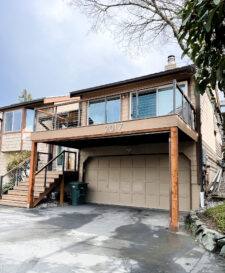
What Salt Air, Rain, and Moss Actually Do to a Deck
Each of Marietta's climate factors attacks a deck in a different way, and a good build has to answer all three at once.
Salt air and corrosion
Airborne salt accelerates corrosion on anything metal — fasteners, joist hangers, post hardware, and railing components. Standard galvanized hardware that's fine 20 miles inland can start rusting within a couple of years this close to the shoreline. Rust doesn't stay cosmetic; it weakens the connection itself.
Driving rain and water intrusion
Wind-driven rain doesn't just fall straight down — it gets pushed sideways into ledger connections, under railing posts, and into any gap that isn't properly flashed or sealed. Over time, that's how rot starts at the one connection point that holds the whole deck to the house.
Moss and prolonged dampness
Long stretches of overcast, damp weather mean deck surfaces rarely get a chance to fully dry out. Moss and algae take hold on anything that stays damp and doesn't get airflow or sun — decking boards, especially on the shaded or north-facing side of a house, are prime real estate. Beyond looking bad, damp moss holds moisture against the wood and makes boards dangerously slick.
Choosing the Right Decking Material for This Climate
There's no single "best" decking material — the right call depends on how much maintenance you want to do, your budget, and how exposed the deck is to weather. Here's how the common options actually perform under Marietta's conditions.
| Material | Moisture & Salt Air Performance | Moss/Algae Resistance | Maintenance | Relative Cost |
|---|---|---|---|---|
| Pressure-treated wood | Good if detailed correctly; end grain and fastener points are the vulnerable spots | Low — needs regular cleaning and periodic sealing | Annual cleaning, re-sealing every 1-2 years | $ |
| Cedar | Naturally rot-resistant but softer; still needs sealing against driving rain | Low-moderate — better than treated pine, still needs care | Sealing every 1-2 years to hold color and resist moisture | $$ |
| Capped composite | Excellent — doesn't absorb water, no rot risk | Moderate — surface texture and gapping still matter for moss | Occasional washing, no sealing or staining | $$$ |
| PVC decking | Excellent — fully synthetic, unaffected by salt air or moisture | Moderate-good, especially with grooved or textured profiles | Lowest — washing only | $$$ |
We'll walk through these options honestly during your estimate, including where a lower-cost material makes sense and where spending more up front saves you money in maintenance and replacement over the life of the deck.
The Construction Details That Actually Determine Whether a Deck Lasts
Material choice matters, but most deck failures in this climate come down to a handful of construction details that are easy to skip and expensive to fix later.
Ledger flashing at the house connection
The ledger board — where the deck attaches to the house — is the single most common failure point in wet Pacific Northwest climates. Correct flashing (not just caulk) diverts water away from that connection so it can't work its way behind the siding or into the rim joist. This is not an area to cut corners, and it's one of the first things worth asking a contractor about directly.
Fasteners and hardware rated for coastal exposure
Given the salt air here, we use stainless steel or coastal-rated fasteners and hardware rather than standard galvanized products, particularly for structural connections and anything near ground level or exposed to spray. It costs more up front and it's worth it — replacing rusted-out hardware under a finished deck is far more disruptive than specifying the right hardware the first time.
Board spacing and airflow
Correct gapping between boards and adequate clearance underneath the deck let air move and water drain instead of sitting. Decks built too low to the ground or with boards packed too tight trap moisture — that's exactly the environment moss needs to take hold.
Footings and post bases
Post bases that keep wood elevated off the concrete footing (rather than embedded in it) prevent the end grain from wicking up moisture from the ground. In low-lying, shoreline-adjacent areas like Marietta, where the water table can sit closer to the surface, footing depth and drainage around footings matter more than they would on higher, better-drained ground.
Living With Moss Season: What Ongoing Care Looks Like
No deck material is entirely maintenance-free in this climate, and moss growth is manageable rather than something to eliminate outright. A few habits keep it from becoming a real problem:
- Sweep debris — needles, leaves, seed pods — off the deck regularly so it can't trap moisture against the boards
- Rinse or lightly wash the surface a couple of times a year, more often on shaded sections
- Keep gutters and downspouts near the deck clear so runoff isn't dumping extra water onto the surface
- Trim back overhanging branches that keep sections of the deck shaded and damp
- Check and re-seal wood decking on the schedule recommended for the product — skipping a cycle lets moisture in fast
- Have railing posts and ledger flashing checked periodically, since these are the spots that fail quietly
We'll go over the specific care schedule for whatever material you choose so you know exactly what upkeep to expect — some materials genuinely need very little.
Permits, Setbacks, and Guardrail Requirements
Deck permitting in unincorporated Whatcom County areas like Marietta, as well as within Ferndale city limits, generally depends on the deck's height above grade and its size — decks above a certain height typically trigger both a permit and a code-required guardrail, along with specific baluster spacing rules. Setback requirements from property lines can also apply, especially on lots closer to the shoreline. We handle the permit application and inspection scheduling as part of the project, so you're not the one tracking down requirements or waiting on inspections.
Our Process for a Marietta Deck Project
1. On-site assessment
We walk the property, look at sun and wind exposure, drainage patterns, and how the deck will connect to the house, and talk through how you actually want to use the space.
2. Design and material selection
We put together a design and go through material options honestly, including the trade-offs in the table above, so you're choosing based on real information rather than a sales pitch.
3. Permitting
We prepare and submit the permit application and coordinate inspections, factoring in the guardrail and setback requirements that apply to your specific lot.
4. Construction
We build with the flashing, fastener, and drainage details covered above as standard practice, not upgrades — because in this climate, they're what determines whether the deck is still solid in ten years.
5. Final walkthrough
We go over the finished deck together, plus the maintenance schedule for your specific decking material, so you know what to expect going forward.
Signs an Existing Marietta Deck Needs Attention
If you already have a deck and are weighing repair against replacement, these are the signs worth taking seriously:
- Soft or spongy spots anywhere in the decking, especially near the house
- Rust staining bleeding through boards around fastener heads
- Visible gaps, cracking, or separation at the ledger board connection
- Persistent moss or algae that comes back within weeks of cleaning
- Railing posts that wobble or flex under light pressure
- Water pooling on the surface instead of draining off
Any one of these on its own might just need a repair. Several together, or anything involving the ledger connection or structural posts, usually means it's time to talk about a rebuild.
Why It Matters to Hire a Crew That Already Works Marietta
A lot of deck problems in this area trace back to details that make sense in a drier, calmer climate but don't hold up here — standard hardware instead of coastal-rated fasteners, a ledger detail that's fine for light rain but not driving rain, or decking laid without enough thought for moss and drainage. A crew that regularly builds and repairs decks around Ferndale and the surrounding Whatcom County shoreline has already seen where those shortcuts fail, and builds around them from the start rather than learning the hard way on your project.
If you're planning a new custom deck in Marietta or want an honest look at whether your current deck needs repair or replacement, we're happy to come take a look. Fill out the form below for a free, no-pressure estimate.