 Ferndale Exterior
 Board & Batten Siding Built for the Nooksack Area's Climate
Homes in the Nooksack area, on the edge of Ferndale in Whatcom County, sit in one of the more demanding stretches of Western Washington weather. You're close enough to Bellingham Bay and the Salish Sea to deal with salt-laden air, low enough in the Nooksack River valley to collect fog and standing humidity, and far enough north that the rainy season runs long and the moss season runs longer. Board and batten siding can look sharp and hold up well here, but only if it's installed with this specific climate in mind. A lot of the siding failures we get called out to inspect aren't failures of the style — they're failures of product choice or installation shortcuts that never accounted for what this stretch of Whatcom County actually throws at a house year-round.
This page is about doing board and batten right for Nooksack conditions specifically: what the climate demands, what a correct installation looks like underneath the surface, and why we only use one product system to deliver it.
What Board & Batten Siding Actually Is
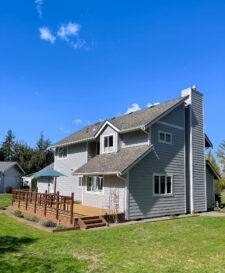
Board and batten is a vertical siding pattern: wide flat panels installed with narrow strips (battens) covering the seams between them. It's one of the oldest siding styles in American building, originally developed as a practical way to cover gaps in vertical board sheathing, and it's had a resurgence because it reads as clean, modern, and farmhouse-traditional at the same time — a look that suits a lot of the rural and semi-rural properties around Ferndale and the Nooksack corridor.
The style is popular, but the style is not the product. Board and batten can be built from vinyl, engineered wood, cedar, or fiber cement, and those materials perform completely differently once they're exposed to years of Pacific Northwest weather. We install James Hardie's fiber cement version — HardiePanel vertical siding paired with HardieTrim battens — because it's the only version of this look we're willing to warranty against what Nooksack's climate does to a wall over a 20- or 30-year timeline.
Why the Vertical Pattern Matters for Water Management
Vertical siding sheds water differently than horizontal lap siding. Done correctly, board and batten channels rainwater straight down the face of the battens with fewer horizontal ledges for water to sit on. Done incorrectly — wrong batten spacing, no drainage gap behind the panel, caulk used as a substitute for flashing — it can trap moisture behind the boards instead of shedding it, which is worse than a standard lap job gone wrong because the trapped moisture has nowhere to escape.
The Specific Climate Problems We Build Around Here
Salt Air and Corrosion
Proximity to Bellingham Bay and the broader Salish Sea means airborne salt is a real factor for Ferndale and Nooksack-area homes, even a few miles inland. Salt accelerates corrosion of exposed metal fasteners, degrades cheaper paint finishes faster than inland exposure would, and slowly breaks down materials that aren't rated for coastal-adjacent conditions. Fastener selection and finish quality matter more here than they would on a similar home fifty miles east.
Driving Rain and Wind-Driven Moisture
Whatcom County storms frequently come in with real wind behind them, which pushes rain sideways into wall assemblies rather than letting it fall straight down and run off. That means every seam, joint, and penetration in a board and batten wall is a potential entry point unless it's flashed and gapped correctly — not just caulked and hoped for.
The Long Moss Season
Damp, shaded, and slow-drying conditions run for a large part of the year in this part of Washington. Moss and algae don't just look bad on siding — sustained organic growth holds moisture against the surface longer than bare siding would, which is exactly the kind of slow, chronic exposure that wears out inferior materials well before their expected lifespan.
What a Correct Board & Batten Installation Involves
The visible part of board and batten siding is the easy part. What separates a siding job that lasts three decades from one that needs repair in five years is almost entirely in the details you can't see once the crew packs up.
- A drainage plane / rain screen gap behind the panels so incidental moisture can escape instead of pooling against the wall sheathing
- Correct batten spacing and fastening pattern matched to the panel manufacturer's engineering specs, not "close enough"
- Stainless or coated fasteners appropriate for salt-air exposure, placed to manufacturer torque and spacing specs
- Proper flashing at every horizontal joint, window, door, and roofline intersection — not sealant used as a flashing substitute
- Factory-finished panel edges sealed correctly at cut ends, since a raw cut edge is the fastest way moisture gets into fiber cement
- Ventilation detailing at the top and bottom of the wall plane so trapped humidity has somewhere to go
Skip any one of these and the siding can still look fine for a year or two — the problems that show up from cut corners are almost always slow ones, which is why they're so often blamed on "bad luck" or "bad weather" instead of the installation that actually caused them.
Why We Only Install James Hardie for This Application
We don't install vinyl board and batten, LP SmartSide, Cemplank, Allura, primed spruce, or cedar board and batten. That's not a marketing position — it's a standard we set based on watching how these products actually perform over time in this specific climate, and we think homeowners deserve the honest reasoning rather than a sales pitch.
Vinyl board and batten is inexpensive and low-maintenance in mild climates, but it expands and contracts significantly with temperature swings, and in wind-driven rain it relies heavily on lap and overlap geometry that vertical battens don't always replicate well — seams can work looser over time. Engineered wood products like LP SmartSide perform reasonably when installation and maintenance are perfect, but they're wood-based, and wood-based siding in a climate with this much sustained moisture and moss pressure carries an ongoing maintenance burden most owners underestimate at time of purchase. Cedar and primed spruce board and batten look beautiful new, but they need repainting, caulking, and moisture monitoring on a cycle that's hard to keep up with, and any breach in the finish invites rot in exactly the kind of damp, shaded conditions Nooksack sees for months at a time.
James Hardie fiber cement doesn't share those weak points. It's non-combustible, it doesn't swell or rot from moisture exposure the way wood-based products can, and the ColorPlus factory finish is baked on and warrantied against fading and peeling — which matters in a climate where a homeowner repainting siding every few years isn't a reasonable ask. Hardie also engineers specific product lines (HZ5, for the Pacific Northwest's wetter, cooler climate zone) rather than selling one national product everywhere, which lines up with how we already think about building for this specific corner of Whatcom County.
Board & Batten Material Comparison for Nooksack Conditions
| Factor | James Hardie Fiber Cement | Vinyl | Engineered Wood / Cedar |
|---|---|---|---|
| Moisture tolerance in wind-driven rain | High when installed to spec | Moderate — seam-dependent | Low to moderate — finish-dependent |
| Resistance to moss / algae staining | Good; factory finish resists absorption | Fair; can discolor over time | Poor without regular cleaning/treatment |
| Maintenance cycle | Minimal; occasional wash | Minimal but seams degrade with age | Repaint/reseal every few years |
| Combustibility | Non-combustible | Combustible | Combustible |
| Typical warranty structure | Long-term, factory-backed, transferable | Varies widely by manufacturer | Shorter, finish-dependent |
Cost varies by project scope, so we won't quote numbers here that don't reflect your specific home, roofline, and prep work — but material cost up front is only part of the real comparison. The maintenance and repair costs that show up over a 15- to 25-year window are where the differences in this table actually matter most.
Our Process for Nooksack Board & Batten Projects
Every board and batten project we take on in the Nooksack area starts with an on-site look at the existing wall assembly, not just a measurement for panels. We check for existing moisture damage, evaluate the current sheathing and any existing drainage plane, and talk through color and reveal-width options in Hardie's ColorPlus line before anything gets ordered.
From there, installation follows the sequence that actually protects the wall: prep and repair of any compromised sheathing first, correct drainage plane and flashing details second, then panel and batten installation to Hardie's fastening specification, followed by a final check of every joint, corner, and penetration before we consider the job finished. We don't treat caulk as a flashing substitute, and we don't skip the drainage gap to save an afternoon — those are the exact shortcuts that turn into water damage two or three winters down the road.
Why It Matters That We Already Work in Nooksack
A crew that only occasionally works this part of Whatcom County can still install siding competently, but they're guessing at exposure conditions instead of knowing them. Working Ferndale and the surrounding Nooksack area regularly means we've already seen how salt air, driving rain, and moss pressure behave on real homes in this specific microclimate — not a generalized Pacific Northwest average. That local pattern recognition is what shapes decisions like fastener choice, drainage detailing, and where extra flashing attention is worth the time, before a problem ever shows up.
If you're considering board and batten siding for a home in the Nooksack area, we're glad to walk the property, look at what you're dealing with now, and give you a straight answer about what a correct installation would involve — no pressure, no inflated claims, just a clear estimate.