 Ferndale Exterior
 Why Sandy Point Homes Wear Out Siding Faster Than Most
Sandy Point sits right up against the water, and that changes what a home's exterior has to deal with every day. Salt-laden air moves in off the Strait, driving rain comes in sideways during winter storms, and the shoulder seasons stay damp long enough for moss and algae to get a foothold on anything that holds moisture. None of that is unique to one house — it's the baseline for the whole community. Siding here has a harder job than siding three or four miles inland in Ferndale proper, and it shows on homes where the wrong product or a rushed install was used.
We've worked on enough homes along this stretch of Whatcom County to know the failure patterns before we even get up on a ladder: soft trim at inside corners, staining and streaking on north-facing walls that never fully dry out, and paint that's chalking or peeling years ahead of schedule. Fiber cement siding, installed correctly, is built to handle this environment. Cheaper materials and shortcut installs are where the trouble starts.
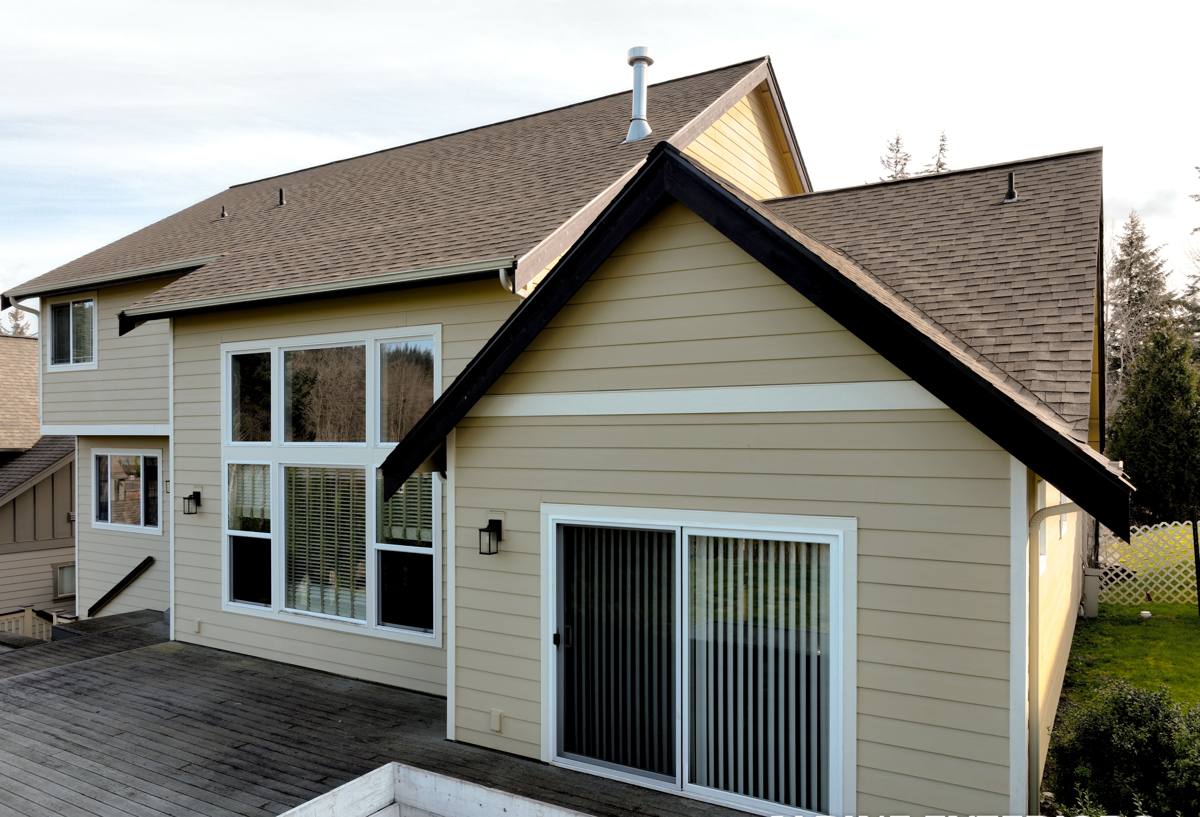
What Salt Air and Driving Rain Actually Do to a House
Salt Air
Airborne salt is corrosive to metal fasteners, flashing, and hardware, and it accelerates the breakdown of lower-grade paint finishes. On siding products that rely on a thin factory coating or field-applied paint, salt exposure shortens the repaint cycle considerably. It also settles into surface texture over time, which is part of why homes near the water often look duller and more weathered than homes just a short distance inland, even when they're the same age.
Driving Rain
Wind-driven rain doesn't just fall on a wall — it gets pushed sideways and upward into laps, seams, and any gap where the water-resistive barrier or flashing detail wasn't done right. This is the single biggest reason siding fails prematurely on exposed sites: not the material itself, but water finding a way behind it. A product that resists moisture on its face is only half the equation. The installation details behind it matter just as much.
Moss and Algae Season
Western Washington's long wet season gives moss, mold, and algae plenty of time to establish on shaded and north-facing walls, under eaves, and anywhere airflow is limited. Porous or wood-based siding products absorb moisture and give organic growth something to hold onto. Dense, engineered fiber cement doesn't offer the same foothold, which matters a lot on a heavily treed, shaded lot near the water.
Why We Install Only James Hardie Fiber Cement
We don't install LP SmartSide, vinyl, Cemplank, Allura, or unfinished cedar or primed spruce siding, and that's a deliberate standard, not an oversight. Each of those products has real strengths, but each also has a trade-off — moisture sensitivity at cut edges, a factory finish that fades or chalks faster than we're comfortable with, or a track record that doesn't hold up to close inspection in a wet coastal climate. On a site like Sandy Point, those trade-offs get exposed faster than they would somewhere drier and more sheltered.
James Hardie fiber cement is a cement, sand, and cellulose fiber composite. It's non-combustible, dimensionally stable in wet-dry cycling, and it doesn't feed moss and algae the way wood-based products can. Hardie also engineers its siding by climate zone — homes in our region fall into what Hardie designates as its northern climate specification, built for freeze-thaw cycling and sustained damp conditions rather than the hot, humid profile its southern-zone products are designed around. That distinction isn't marketing; it changes the product's engineering to match the weather it's actually going to face.
The factory-applied ColorPlus finish is the other half of the argument. It's baked on under controlled conditions with a finish designed to resist fading and chalking far longer than field-applied paint, and it comes backed by its own finish warranty separate from the product warranty. In a location that gets steady salt exposure and long wet stretches, a factory finish that isn't relying on a painter's timing, temperature, and technique on installation day is a real advantage.
What a Correct Installation Actually Involves
Fiber cement siding is only as good as the details behind it. A correct install on a site exposed to driving rain and salt air includes:
- A properly lapped and sealed water-resistive barrier behind the siding, with all penetrations flashed before a single board goes up
- Correct fastener type, spacing, and embedment depth — undersized or overdriven fasteners are one of the most common causes of early siding failure
- Manufacturer-specified clearances at grade, roof lines, and horizontal trim so water has somewhere to go instead of wicking into the bottom edge of a board
- Properly primed and sealed cut edges on-site, since factory finish doesn't extend to a field cut
- Rain-screen or drainage gap detailing appropriate to the wall assembly, especially on shaded or north-facing elevations
- Butt joints and trim transitions sealed with a flexible, paintable sealant rated for exterior use — not caulked over and forgotten
Skip any one of these and the siding itself stops mattering much. We've seen Hardie siding fail early because of a bad install, and we've seen lesser products outperform expectations because someone did the flashing and gapping right. Material quality and installation quality both have to be there.
Our Process on Sandy Point Projects
1. On-Site Assessment
We start by looking at the whole wall assembly, not just the visible siding — sheathing condition, existing moisture damage, trim detailing, and how the home is oriented relative to wind and rain exposure. Homes on more exposed lots often need different flashing and drainage detailing than a home tucked behind trees or a neighboring structure.
2. Tear-Off and Substrate Check
Once old siding comes off, we inspect the sheathing and framing underneath for rot or hidden moisture damage before anything new goes up. On coastal homes, this step regularly turns up problems that weren't visible from the outside — better to find and fix them now than bury them under new siding.
3. Weather Barrier and Flashing
This is the step that determines whether the siding lasts fifteen years or fifty. We install and lap the water-resistive barrier correctly and flash every window, door, and penetration before siding installation begins.
4. Hardie Installation to Spec
Boards, panels, and trim go up following James Hardie's published fastening, clearance, and joint-treatment requirements — the same requirements that keep the product warranty valid. We don't deviate from spec to save time.
5. Final Walkthrough
We check caulking, trim lines, and clearances against grade, decking, and roofing before calling a project finished, and we walk the property with the homeowner so nothing is left as a question mark.
Why Local Experience in Sandy Point Matters
A crew that mostly works inland projects doesn't always account for the extra wind exposure, salt spray, and moisture load a beachfront lot deals with year-round. Detailing that's "good enough" a few miles from the water can fall short right on the shoreline. Working this area regularly means we already know where wind-driven rain tends to find its way in, which elevations stay damp longest, and how the local moss and algae pattern typically develops — so those factors get addressed at the flashing and drainage stage instead of showing up as a callback two winters later.
If your property is part of a community with its own design or exterior guidelines, that's also easier to work around when a contractor already understands the general character of the area rather than treating it like any other job site.
Cost Factors on a Sandy Point Siding Project
Every home is different, but the factors below are what typically move the price on a fiber cement siding project in this area. We'll walk through actual numbers for your home during a free estimate.
| Factor | Why It Matters Here |
|---|---|
| Existing siding removal and disposal | Older wood or vinyl siding on wet-exposed walls sometimes hides substrate damage that adds scope once uncovered |
| Sheathing repair or replacement | Coastal moisture exposure makes hidden rot more common than on sheltered inland homes |
| Wall complexity and elevation exposure | Homes with more corners, dormers, or wind-facing walls need more flashing and detail work |
| Product line and profile | Lap siding, panel siding, and shingle-style profiles carry different material and labor costs |
| ColorPlus finish vs. primed product | Factory-finished boards cost more upfront but remove the need for a full-house repaint later |
| Trim and accessory scope | Fascia, soffit, and trim board replacement is often bundled with a siding project for a consistent result |
A Homeowner's Checklist Before Starting a Siding Project
- Ask what climate-zone product line is being specified for your home, not just the siding brand
- Confirm who is responsible for flashing and water-resistive barrier work — it should never be an afterthought
- Get the fastening and clearance specs in writing, matched to manufacturer requirements
- Ask how cut edges will be sealed on-site
- Understand what's covered by the product warranty versus the workmanship warranty, and what could void either one
- Ask whether the crew has worked on homes in exposed, waterfront, or high-moisture locations before
Ready to Talk About Your Home
If your Sandy Point home's siding is showing moss, streaking, soft spots, or a paint job that isn't holding up the way it used to, it's worth having someone look at what's actually happening behind the surface. We offer free, no-pressure estimates and can walk your property with you to talk through what correct James Hardie installation would look like for your specific home and exposure. Fill out the form below to get started.