 Ferndale Exterior
 Full Siding Replacement in Blaine: Why the Whole System Matters, Not Just the Boards
A full siding replacement is a different project from a patch repair or a partial re-side, and homes in Blaine are a good example of why that distinction matters. Blaine sits at the northern edge of Whatcom County, close enough to Semiahmoo Bay and Drayton Harbor that salt-laden air, wind-driven rain, and a long moss season are simply part of owning a house there. We're based just down the road in Ferndale, and Blaine is regular territory for our crew, not an occasional stop between bigger jobs elsewhere in the county. That familiarity matters most on a full replacement, where the decisions made behind the new siding, not just the finish on top of it, determine whether the job holds up for decades or starts letting moisture in within five or six years.
We install siding, roofing, windows, and decks, and on siding specifically, we install James Hardie fiber cement exclusively. This page focuses on what a full siding replacement actually involves for a Blaine home: when it's the right call instead of a repair, what correct installation looks like from tear-off to final walkthrough, and why a crew that already works this stretch of coastline is worth having on a project this size.
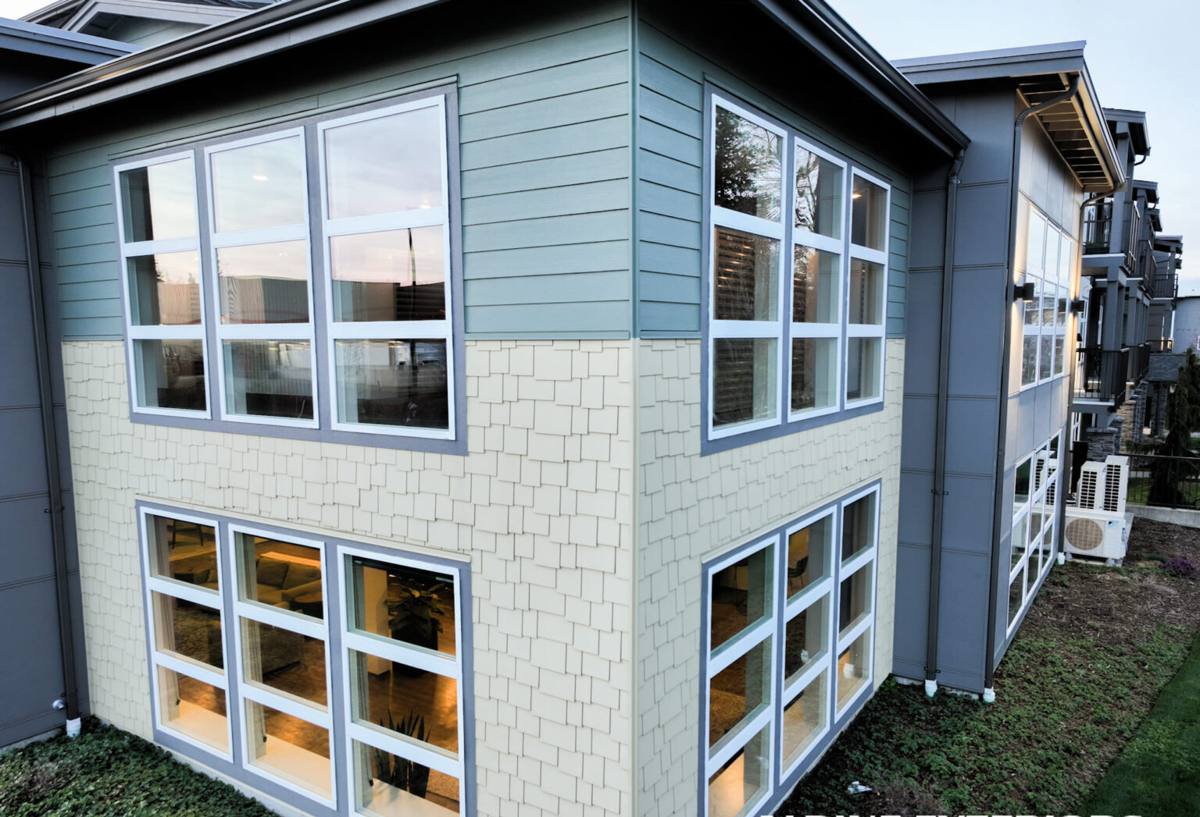
What Blaine's Climate Does to a Full Siding System Over Time
Salt Air Off the Water
Homes near Semiahmoo Bay and Drayton Harbor take on a steady dose of salt-laden air that inland Whatcom County towns don't see at the same intensity. Over years, that salt exposure corrodes fasteners, flashing, and lower-grade trim hardware faster than a dry, inland climate would, and it wears down weaker finishes well before their expected lifespan. On a full replacement, this is exactly the kind of long-term factor that should drive material and hardware choices, since a full system needs to hold up for decades, not just look good on install day.
Driving Rain Off the Strait
Storms moving in off the water rarely drop rain straight down on a Blaine home. Wind pushes it sideways into siding laps, window flashing, and the transitions where roof meets wall, and that sideways load is harder on a wall assembly than the same rainfall total would be in a calmer climate. A full replacement is the point where a home's weather barrier and flashing details can be rebuilt correctly from scratch, which is a real advantage over a repair that has to work around whatever's already there.
A Moss Season That Runs Most of the Year
Mild temperatures and near-constant moisture give moss and mildew a long growing season on shaded and north-facing walls, and tree-covered lots around Blaine see this especially. Any siding material that holds moisture against the substrate, rather than shedding it, becomes a growth surface over time. A full replacement is a chance to address ventilation and drainage behind the wall, not just swap out what's visible from the street.
How We Decide: Full Replacement, Overlay, or Repair
Not every siding problem calls for a full tear-off, and we won't sell a bigger job than a house actually needs. But we also won't recommend an overlay or a patch repair when the underlying problem is already past that point, particularly on a coastal property where moisture damage tends to be more advanced than it looks from the ground.
| Approach | When It Makes Sense | Risk If Used in the Wrong Situation |
|---|---|---|
| Spot repair | Isolated damage — a cracked panel, storm impact, a small area of trim failure | Doesn't address moisture already tracking behind the wall elsewhere |
| Overlay (new siding over old) | Existing siding and sheathing are sound, homeowner wants a faster, lower-cost update | Traps any existing moisture problem behind two layers instead of one; not something we recommend on a home with active water intrusion |
| Full tear-off replacement | Siding has reached the end of its service life, moisture has gotten behind the wall, or the home needs a different product system entirely | Higher upfront cost and longer project timeline than the alternatives |
For a Blaine home specifically, we lean toward recommending a full replacement more often than we would in a drier, more sheltered part of the county, simply because covering an existing moisture problem here tends to cause more damage, faster, than it would somewhere with less salt and wind-driven rain working against the wall.
What a Full Tear-Off Replacement Actually Involves
Complete Removal of the Old Siding
Every board, panel, and piece of trim comes off, not just the sections that look bad. This is what separates a real replacement from an overlay, and it's the only way to actually see what's happening behind the wall rather than guessing.
Sheathing Inspection and Repair
Once the old siding is off, we check the sheathing underneath for rot, soft spots, or water staining before anything new goes up. On a coastal property, this step regularly turns up more than the homeowner expected, since moisture can travel behind failing siding for years before it shows up as a visible problem on the outside. We address what we find here rather than covering it and letting it continue.
Weather Barrier and Rain Screen
A full replacement is the point where the house wrap and drainage plane get rebuilt correctly, including a rain screen gap that lets any moisture that does get past the siding drain and evaporate instead of sitting against the sheathing. Given how much coastal siding failure comes from water getting behind the cladding rather than through it, this layer matters as much as the visible siding itself.
Flashing at Every Penetration
Windows, doors, hose bibs, light fixtures, and every other wall penetration need flashing that's properly lapped and sealed, especially on walls that catch wind-driven rain directly off the water. This is easy to rush and nearly impossible to inspect once the new siding is up, so it's a step we build time into the schedule for rather than treating as incidental.
Installation to Manufacturer Spec
James Hardie's warranty depends on installation following their published specifications: correct fastener type and spacing, proper clearances above grade and roofline, and correctly sealed field cuts and butt joints. We treat that spec as the baseline for every replacement, not as an upgrade option.
Choosing the Right James Hardie System for a Blaine Home
Lap Plank vs. Panel Siding
HardiePlank lap siding is the more common choice for traditional home styles and gives a shadow-line look that reads as classic siding from the street. HardiePanel vertical siding suits more modern homes or accent areas, and it can simplify some of the horizontal joint detailing that's a common point of water entry on lap siding if it's not sealed correctly. Which one fits depends on the home's architecture and the homeowner's preference, and we walk through both during the estimate rather than defaulting to one.
HZ5 Formulation and ColorPlus Finish
We spec Hardie's HZ5 product line on Blaine replacements because it's engineered for regions with sustained moisture exposure and freeze-thaw cycling, a close match for this coastline. Pairing it with a factory-applied ColorPlus finish means the color is baked on under controlled conditions rather than brushed on in the field, which holds up longer against fading and salt-air exposure than a field-applied paint job would on a full replacement of this scale.
Why James Hardie Is the Only Siding We Install
We install one siding system because a full replacement is a decades-long decision, and we'd rather stand fully behind one product than offer a menu of options with uneven long-term performance.
- Non-combustible core: Fiber cement doesn't feed a fire the way wood-based siding products can, which matters for both safety and insurance underwriting.
- Dimensional stability: It doesn't swell, cup, or warp the way engineered wood siding can after repeated wetting cycles in a marine climate.
- A strong transferable warranty: Hardie backs the product with one of the more robust warranty structures in the industry, provided installation follows their spec, which is exactly what a full replacement lets us guarantee from the start.
We don't install LP SmartSide, vinyl siding, Cemplank, Allura, primed spruce, or cedar. Each has a place in the broader market, but on a project the size of a full replacement, in a climate this demanding, we'd rather commit to the system we trust completely than offer a cheaper alternative that shifts maintenance risk onto the homeowner a few years down the road.
What a Full Replacement Costs, and What Drives the Number
| Factor | Why It Moves the Price |
|---|---|
| Home size and number of stories | More square footage and taller walls mean more material, labor, and equipment (staging, lifts) time |
| Sheathing condition once old siding is off | Rot or water damage found during tear-off adds repair scope that can't be priced sight-unseen |
| Trim and architectural detail | More corners, dormers, and window trim mean more joints and cuts, which adds labor |
| Product line and color | HZ5 plank, panel, and specialty trim options carry different material costs |
| Site access and proximity to the water | Tighter lots, tree cover, or direct water exposure can affect staging and the level of detail work required |
These are the factors that consistently move a number, but every estimate is specific to the actual house. We walk the property and give a real figure based on what we find, not a per-square-foot guess made from the street.
Living Through a Full Replacement: What to Expect
A full tear-off is a bigger disruption than a repair, and knowing what's coming makes the project easier on everyone in the house.
- Expect noise and activity around the exterior of the home during working hours for the length of the project
- Landscaping and anything stored close to the walls should be cleared back before work starts
- Some walls will be open to the sheathing for periods during the project — this is normal and part of doing the job correctly, not a sign something's wrong
- Weather can shift the schedule, particularly during Blaine's wetter months, since siding and weather barrier materials need dry conditions to install correctly
- A dumpster or material staging area will typically sit in the driveway or yard for the duration of the project
- We walk the finished job with the homeowner before calling it complete, covering care and maintenance specific to a coastal property
Why a Ferndale-Based Crew Handling Blaine Replacements Matters
A full siding replacement is exactly the kind of project where local experience pays off in ways that are hard to see until years later. Being based in Ferndale means we're a short drive from Blaine, working there regularly enough to know which walls stay wet longest given the wind direction off the water, where extra flashing attention earns its keep, and which install-day details are worth the time so a homeowner isn't dealing with a callback two winters later. It also means that if a warranty question comes up once the job's done, it's a call to a crew still working in the same part of Whatcom County, not a company that's moved on somewhere else.
If your Blaine home needs a full siding replacement, or you're not sure yet whether replacement, overlay, or repair is the right call, we're glad to come take a look and give you a straightforward, no-pressure estimate. Reach out using the form below to get started.