 Ferndale Exterior
 Building or Framing a Home in Sudden Valley? Get the Windows Right the First Time
New-construction windows go in before the siding closes up the wall, which means there's no second chance to fix a bad seal without tearing into finished exterior work. For homeowners and builders working in Sudden Valley, that first installation has to account for Whatcom County's weather from day one — not get patched later after moisture finds its way in. We install new-construction windows on homes in this area regularly, and the same handful of details separate a window system that holds up for decades from one that starts causing problems within a few winters.
This page covers what Sudden Valley homes specifically need from their new-construction windows, what a correct installation actually involves, and how our process is built around getting it right the first time.
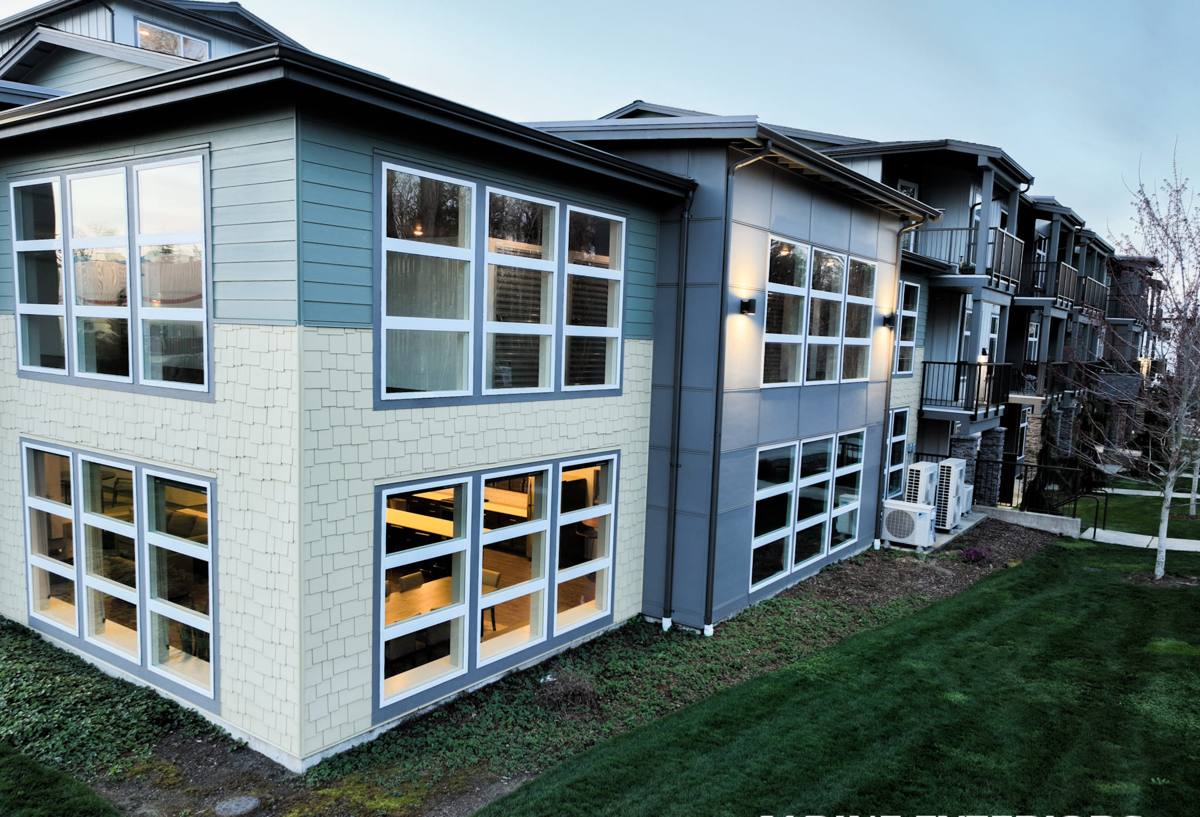
What Ferndale-Area Weather Does to New Windows
Whatcom County sits in a stretch of Washington that gets a specific combination of exposures: salt-tinged air moving in off Puget Sound and the Strait of Georgia, long stretches of driving, wind-blown rain rather than gentle vertical rainfall, and a moss and mildew season that can run most of the year on shaded or north-facing walls. Any one of these is manageable on its own. Together, over years, they expose weak points in a window installation that would never show up in a drier or calmer climate.
Salt Air
Airborne salt accelerates corrosion on fasteners, hardware, and unprotected metal flashing. It also breaks down cheaper sealants faster than inland climates would. New-construction installation gives us the chance to use corrosion-resistant fasteners and flashing materials from the start, rather than discovering a corroded component years later hidden behind siding.
Driving Rain
Wind-driven rain doesn't just fall on a window — it gets pushed sideways and upward against the wall assembly, testing every lap and seam in the flashing. A window that would be fine under still, straight-down rain can leak under Whatcom County's wind patterns if the flashing sequence isn't built to shed water outward at every layer, including the sill pan and the head flashing above the unit.
Moss and Sustained Moisture
Extended damp periods keep wall assemblies wetter for longer stretches than a drier region would ever see. That means any gap, no matter how small, has more opportunity to let moisture in and less opportunity to dry out before the next rain arrives. Correct new-construction detailing is what keeps that moisture on the outside of the weather-resistive barrier where it belongs.
What a Correct New-Construction Window Installation Involves
New-construction windows have a nailing fin (or flange) that gets integrated directly into the wall's weather-resistive barrier before siding or trim goes on. Done correctly, this creates a continuous drainage plane where water is directed out and away from the wall at every layer. Done poorly — or rushed to keep a framing schedule moving — it creates hidden entry points that won't show symptoms until there's already rot or mold behind the wall.
- A sloped sill pan under the window opening, so any water that gets past the glass drains outward instead of pooling on the rough sill
- Weather-resistive barrier integration with the correct shingle-lap sequence: sill first, then jambs, then head flashing over the top, always overlapping downward like shingles
- Corrosion-resistant fasteners suited to salt-air exposure, set at the manufacturer's specified pattern and spacing
- Sealant used only where it's designed to be the primary barrier and never as a substitute for correct flashing sequence
- Proper shimming so the window operates square and isn't stressed by the frame settling as the house cures
- Insulation of the gap between the window frame and rough opening, without over-packing in a way that bows the frame
The frame material and glass package matter, but they only perform to spec if this underlying installation is correct. A high-end window installed with a rushed flashing job will leak sooner than a mid-range window installed correctly.
New-Construction Windows vs. Retrofit (Replacement) Windows
It's worth understanding the difference, especially if you're weighing options for a new build, an addition, or a section of wall that's already open.
| Factor | New-Construction Window | Retrofit / Replacement Window |
|---|---|---|
| When it's used | New builds, additions, or full wall re-siding projects where the sheathing is exposed | Existing homes where the siding stays in place and only the window unit is swapped |
| Flashing access | Full access to integrate flashing directly with the weather-resistive barrier | Limited — relies more on the existing wall's condition and careful sealant work |
| Long-term weatherproofing | Generally the more robust option when installed correctly, since the whole drainage plane is rebuilt | Can perform well, but only as good as what's already behind the existing siding |
| Disruption | Involves exterior wall work; typically planned into a build or renovation schedule | Faster, less invasive, no siding removal required |
For Sudden Valley homes going up new or undergoing a full exterior renovation, new-construction windows are usually the right call — they let us build the drainage detailing from scratch rather than working around whatever is already in the wall.
Frame Material Considerations for This Climate
We get asked which frame material holds up best in Whatcom County conditions. There's no single right answer for every home, but here's how the common options actually behave under salt air, sustained rain, and moss-prone shade.
| Frame Material | How It Performs Here | Maintenance Reality |
|---|---|---|
| Vinyl | Doesn't corrode from salt air; handles moisture well; can flex slightly in temperature swings | Low — occasional cleaning, no repainting needed |
| Fiberglass | Very stable dimensionally, resists moisture and corrosion well, holds paint if a custom color is wanted | Low, though paint (if used) will eventually need attention |
| Aluminum | Strong and slim-profile, but standard aluminum conducts cold and can corrode faster in salt air unless it's a marine-grade or properly coated product | Moderate — watch for corrosion at fasteners and hardware over time |
| Wood / Wood-Clad | Excellent appearance, but the wood core is the most vulnerable component to sustained moisture and moss-prone shade if any exterior seal is compromised | Higher — requires monitoring finish integrity, especially on shaded walls |
We'll walk through these trade-offs with you based on where the window sits on the house — a south-facing wall with full sun exposure has different needs than a shaded wall that stays damp longer through the moss season.
Our Installation Process
- Site and opening review — we confirm rough opening sizes, orientation, and exposure before ordering windows, since a shaded, rain-facing wall may warrant different detailing than a sheltered one.
- Flashing plan walkthrough — before any window goes in, we confirm the sill pan, WRB integration, and head flashing sequence with the builder or homeowner so everyone's expectations match what's actually going in the wall.
- Sill pan and WRB integration — sloped sill pan first, then weather-resistive barrier tied in with the correct shingle-lap order.
- Window setting and shimming — units are set square and plumb, shimmed correctly, and fastened per the manufacturer's pattern.
- Head flashing and cladding tie-in — head flashing laps over the WRB above the window so water sheds outward and down, ready for siding to close over it.
- Interior insulation and air-sealing — the gap between frame and rough opening is filled and sealed without overcompressing the frame.
- Final check — operation, square, and seal are all verified before the crew moves on or siding closes the wall.
What to Check Before Windows Go In
If you're a homeowner working with a builder, or managing your own project, this is worth confirming before the window crew shows up:
- Rough openings are framed to the exact dimensions the window manufacturer specifies, with allowance for shimming
- The weather-resistive barrier is already installed and in good condition, not torn or improperly lapped
- A sill pan is part of the plan for every opening, not just the ones facing prevailing wind
- Fastener and flashing materials are rated for coastal/salt-air exposure, not generic inland-spec hardware
- There's a clear sequence agreed on for WRB, sill pan, window, and head flashing — not left to be improvised on site
- Someone is checking each window is square and properly shimmed before the crew moves to the next opening
What Affects the Cost
| Cost Factor | Why It Matters |
|---|---|
| Number and size of openings | More openings and larger units mean more material and labor hours |
| Frame material chosen | Vinyl, fiberglass, aluminum, and wood-clad units carry different material costs |
| Glass package | Double vs. triple pane, and low-E or gas-fill options, affect unit price and long-term energy performance |
| Wall exposure and detailing needs | A shaded, rain-facing wall may call for extra flashing attention that adds labor time |
| Access and scheduling | Coordinating with a builder's framing schedule or working on an occupied home changes logistics |
We'll always walk through actual numbers for your specific project rather than quote off a general range — every home and opening count is different.
Why It Matters to Hire a Crew That Already Works in Sudden Valley
Window installation instructions look the same on paper everywhere in the country. What changes is how much margin for error the local climate allows. A crew that mostly installs in a drier, calmer region can do competent work and still leave gaps that Whatcom County's driving rain and salt air will eventually find. A crew that regularly works Ferndale and the surrounding Whatcom County area already builds in the extra attention to flashing sequence, fastener choice, and sill detailing that this climate demands — not as an upsell, but because it's what holds up here.
We also know what a house in Sudden Valley is up against over a full year: the wet season that keeps walls damp for extended stretches, the shaded areas where moss takes hold fastest, and the wind-driven rain events that test flashing far harder than a calm rainstorm would. That local pattern recognition is part of what you're hiring when you bring in a crew with real experience in this specific area, not just general window installation experience.
Ready to Talk Through Your Project?
Whether you're framing a new home in Sudden Valley, adding on, or planning a full exterior renovation, we're happy to walk the site, review your window plan, and give you a straightforward estimate — no pressure, no hard sell. Use the form below to request a free estimate and we'll follow up to schedule a time that works.