 Ferndale Exterior
 Blaine Decks Face a Tougher Climate Than Most
Blaine sits right up against Semiahmoo Bay and the Strait of Georgia, which means homes here deal with a combination most inland decks never see: salt-laden air, near-constant winter rain blowing in off the water, and a moss season that can run from October clear through April. Add Whatcom County's naturally high humidity and short window of dry, sunny days for maintenance, and it's easy to see why decks in Blaine tend to show wear faster than the same deck would inland in, say, Sumas or Deming.
Salt air is the piece homeowners underestimate most. It doesn't just dull finishes — it accelerates corrosion in fasteners, hardware, and any exposed metal connectors. A deck built with the wrong fastener package can develop hidden hardware failure years before the visible wood shows serious damage. Combine that with driving rain that gets pushed sideways under railings and ledger flashing, and you get a maintenance profile that's genuinely different from a typical Pacific Northwest deck a few miles inland.
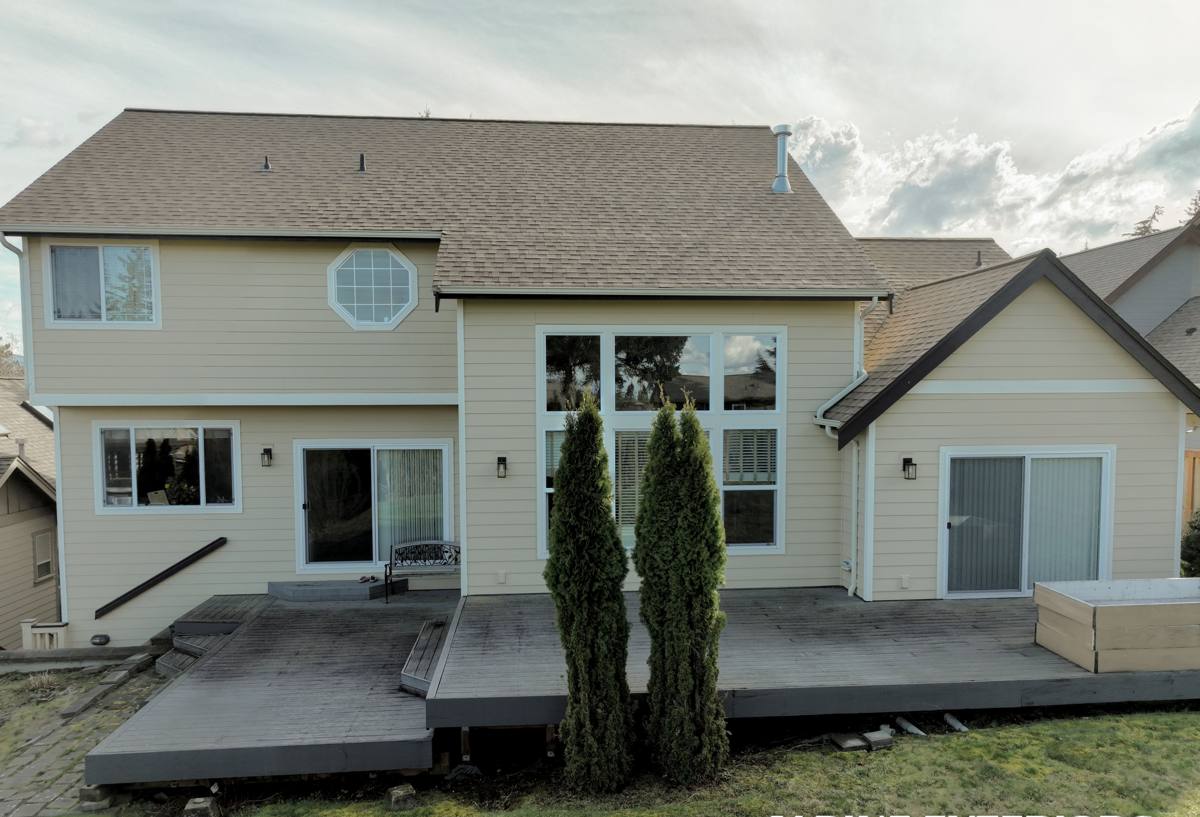
Signs Your Deck Needs Repair
Most deck problems don't show up as one dramatic failure — they show up as small signals that get ignored until they compound. Here's what we tell Blaine homeowners to watch for between now and the next dry stretch:
- Soft or spongy spots underfoot, especially near the house or at board ends
- Green or black staining that keeps coming back within weeks of cleaning
- Rust streaks below screw heads or around joist hangers
- Railings or posts that flex or wiggle more than they used to
- Gaps opening up between the ledger board and the house siding
- Stairs that feel less solid, or treads that have started to cup or crack
- Water pooling on the surface instead of draining off after rain
Any one of these on its own might just mean routine maintenance. Two or three together, especially structural signs like a soft ledger area or a wobbly post, usually mean it's time for an actual repair assessment rather than another round of cleaning and sealing.
What a Correct Deck Repair Actually Involves
Structural First, Cosmetic Second
A repair that only replaces the boards you can see, without checking what's underneath, is a repair that gets redone in a year or two. The framing — joists, beams, posts, and especially the ledger board where the deck attaches to the house — carries the load and takes the brunt of moisture intrusion. In our experience, ledger board and post-base rot are the two most common structural issues we find on Blaine decks, and both are hidden until someone actually pulls a board or probes the wood with a screwdriver.
Fastener and Hardware Condition
Given the salt air along the water here, we always check hardware condition as part of any repair, not just the wood. Corroded joist hangers, rusted-through screws, and degraded post connectors are a structural liability even when the surrounding lumber looks fine. Replacing rotten boards but leaving compromised hardware underneath isn't a full repair — it's a cosmetic fix on top of an unresolved problem.
Drainage and Water Management
A large share of deck damage traces back to water that had nowhere to go. Flashing at the ledger board, gaps between boards for airflow, and proper slope away from the house all matter more here than in drier parts of the state. Part of a correct repair is making sure water is actually shedding off the structure, not just replacing the boards that rotted from standing water in the first place.
Common Deck Repair Issues We See in Blaine
| Issue | Typical Cause | What We Do |
|---|---|---|
| Ledger board rot | Poor or missing flashing where deck meets house, combined with driving rain | Remove affected sections, inspect house rim joist, re-flash and reattach to code |
| Corroded fasteners and hardware | Salt air exposure, incompatible metal types, age | Replace with corrosion-rated hardware matched to the fastener and connector type |
| Persistent moss and algae | Shade, poor airflow under boards, long wet season | Clean, address underlying drainage/airflow, treat and reseal surface |
| Loose or wobbly railings | Post rot at the base, loosened lag bolts, freeze-thaw movement | Repair or replace post base, re-secure to structural framing, not just surface trim |
| Cupped, split, or splintering boards | Sun/rain cycling, age, inconsistent sealing over the years | Replace individual boards or full decking surface depending on extent |
| Soft stair stringers or treads | Water pooling at the base of stairs, ground contact rot | Rebuild affected stringers, correct grade/drainage at the base |
Repair or Replace? How We Help You Decide
Not every deck problem calls for a full rebuild, but not every deck is worth patching either. We walk this decision with homeowners honestly rather than defaulting to the bigger job. A few factors we weigh:
- Age of the deck: A 10-year-old deck with isolated board and railing issues is usually a repair candidate. A 20-plus-year-old deck with structural rot at multiple points often isn't.
- Extent of structural damage: Rot confined to one joist or a section of ledger board is repairable. Rot found at multiple structural points usually means the whole system has been compromised by the same conditions.
- Original build quality: Decks built without proper flashing, ledger attachment, or adequate fastener spec tend to have recurring problems no matter how many individual repairs go into them.
- Your plans for the space: If you're planning to reconfigure size, add a roof, or change railing style down the road, it sometimes makes more sense to rebuild now than repair twice.
Our default position is to repair what can genuinely be repaired well. We don't push a rebuild when a targeted repair will hold up — but we'll tell you plainly when patching isn't going to be worth the cost over the next few years.
Our Deck Repair Process
1. On-Site Inspection
We start by walking the whole structure — surface, railings, stairs, and underneath where accessible — probing suspect wood and checking hardware condition rather than just eyeballing the visible boards.
2. Straightforward Scope and Options
You get a clear explanation of what's actually wrong, what's optional versus necessary, and what a repair scope looks like versus a partial or full rebuild if that's genuinely the better call.
3. The Repair Itself
Structural issues get addressed first — framing, ledger attachment, post bases, hardware — before any cosmetic board or railing work goes back on top. We match fasteners and connectors to the exposure conditions rather than using whatever's standard for an inland job.
4. Cleanup and Final Check
We clear debris, check that everything is secure and level, and walk the finished repair with you before we consider the job done.
Materials We Use and Why
Material choice matters more on a Blaine deck than it does a few miles inland, because of the salt air and moisture load. For framing repairs, we use pressure-treated lumber rated for ground contact where appropriate, and we're deliberate about fastener and hardware selection — stainless steel or heavy-duty coated fasteners designed to resist corrosion in coastal exposure, rather than standard-grade hardware that can start rusting within a few seasons here.
For decking surfaces, both quality wood and composite materials have a place, and the right choice depends on your budget, how much upkeep you want to do, and how the deck is exposed to sun and moisture. Wood decking costs less up front and can look excellent when properly maintained, but it needs regular cleaning and sealing to hold up against the moss and rain cycle here. Composite decking costs more initially and needs less routine sealing, but it isn't maintenance-free — it still needs periodic cleaning to prevent surface algae and mildew, and board-to-board drainage still has to be designed correctly or moisture gets trapped underneath. We'll walk you through the honest trade-offs for your specific deck rather than pushing one product across every job.
Maintenance That Actually Matters Here
A repaired deck in Blaine stays in good shape longer with a few habits that are worth more here than in drier climates:
- Clean moss and algae off the surface at the start and end of the wet season, not just once a year
- Keep gutters and downspouts clear so runoff isn't dumping extra water onto or under the deck
- Reseal or restain wood decking on the schedule the product actually calls for — salt air and UV both shorten the effective life of a coating
- Check hardware and fasteners for early rust signs during your fall inspection, before winter rain sets in
- Keep planters and other items that trap moisture off the deck surface where possible
None of this requires a big time investment, but skipping it is how a repaired deck ends up needing the same work again in half the time it should have lasted.
Why Hire a Crew That Already Works in Blaine
Deck repair done right depends on understanding the specific conditions a deck has been exposed to — and a crew that works Blaine and the surrounding Whatcom County coastline regularly knows what salt air does to fasteners over five years, what driving rain does to ledger flashing, and how aggressive the moss season really gets on north- and shade-facing decks near the water. That's the difference between a repair that's built for the conditions here and one that's built for a generic climate and happens to hold up for a while.
Ferndale Exterior Co works throughout Ferndale and Whatcom County, including Blaine, and we bring that same regional knowledge to every deck repair — matching materials and hardware to what actually lasts in this environment, not just what's standard everywhere else.
If your deck in Blaine is showing soft spots, rust, persistent moss, or a wobble that wasn't there last year, we're happy to take a look. Reach out for a free, no-pressure estimate using the form below — we'll give you a straight assessment of what's needed and what it will take to fix it right.