 Ferndale Exterior
 Siding in Custer Has a Different Job to Do
Custer sits close enough to the water and open farmland that homes here take a steadier beating than siding fifteen miles inland. Salt-laden air off the Strait moves through on a regular basis, wind-driven rain finds every gap in a wall system, and the long gray stretch from October through April keeps exterior surfaces damp far more often than they're dry. Add in the shade from mature trees and windbreaks that a lot of Custer properties have, and you get ideal conditions for moss and algae to take hold on anything that stays wet.
None of that is unusual for Whatcom County. But it means siding material choice matters more here than it does in a drier climate, and it means installation details that would be minor elsewhere — flashing laps, gaps at trim, caulk joints — become the difference between siding that looks good at year fifteen and siding that's already showing rot or paint failure at year seven.
Why We Only Install James Hardie
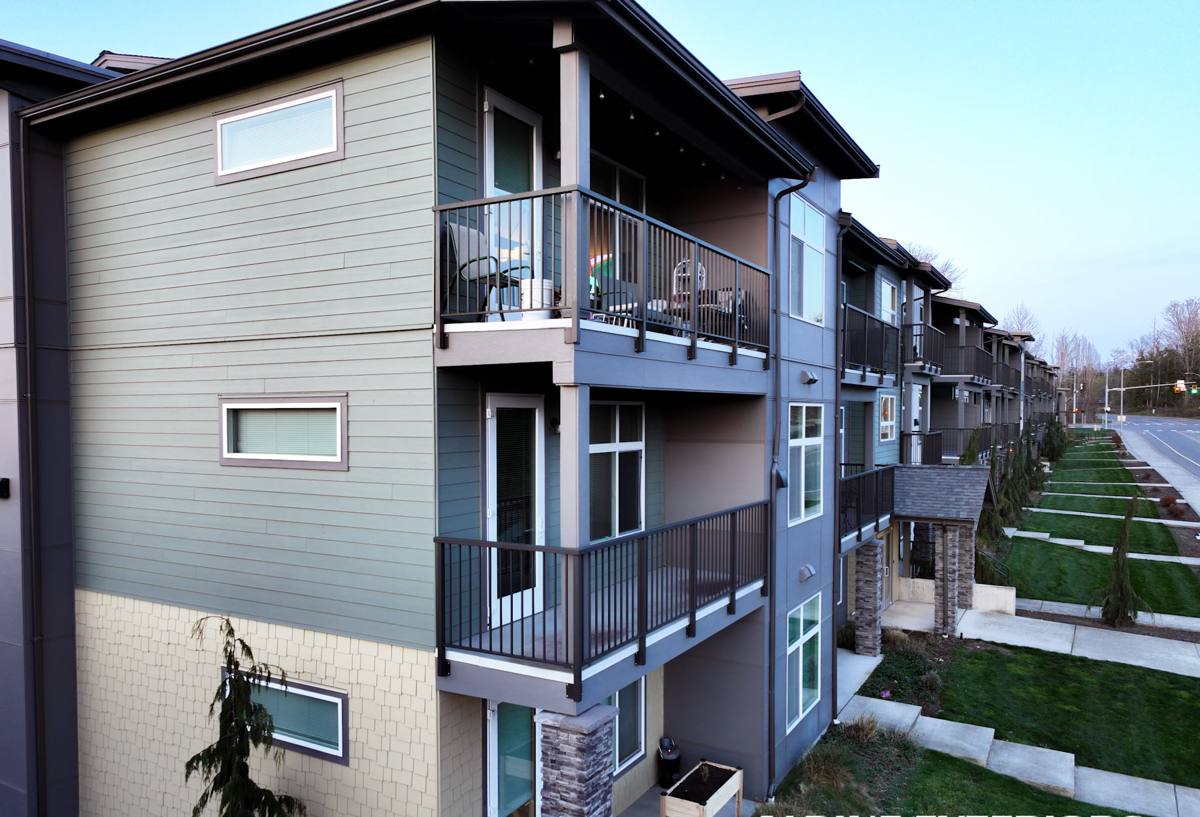
Ferndale Exterior Co installs James Hardie fiber cement siding exclusively. We don't install vinyl, LP SmartSide, cedar, primed spruce, or other fiber cement brands, and we're upfront about why: those products each carry trade-offs — moisture sensitivity, shorter finish life, higher maintenance, or warranty limitations — that we've seen play out on homes in this climate. James Hardie's fiber cement is non-combustible, dimensionally stable in wet-dry cycling, and available in HZ5 formulations engineered for exactly the freeze-thaw and moisture exposure that Pacific Northwest coastal areas deal with. It's not the cheapest material on the market, but it's the one we're willing to stand behind on a Custer property.
What "Climate-Engineered" Actually Means
James Hardie makes region-specific formulations — HZ5 and HZ10 for northern, wetter climates — that adjust the cement composition for better resistance to moisture absorption and freeze-thaw cycling compared to a one-size-fits-all product. For Whatcom County, that's not a marketing detail; it's the reason the siding doesn't swell, crack, or delaminate the way lower-grade fiber cement or engineered wood products can after a few wet winters.
What Salt Air and Moss Actually Do to Siding
It helps to understand the specific mechanisms at work, because they explain why some materials fail faster here than they would fifty miles inland.
- Salt air accelerates corrosion on fasteners, flashing, and any exposed metal trim. It also breaks down lower-grade paint and coatings faster than inland UV exposure alone would.
- Driving rain pushes water sideways into laps, seams, and butt joints rather than just running down the face of the wall. Siding systems and installation details that aren't built for wind-driven moisture let water behind the cladding, where it does the real damage.
- Moss and algae need sustained moisture and shade to establish, and Custer has both. Once organic growth takes hold on a porous or poorly sealed surface, it holds moisture against the substrate and accelerates whatever decay process is already underway.
- Extended damp season means any material that absorbs water — even a small amount — stays wet longer between drying cycles, compounding rot risk at cut edges, fastener penetrations, and butt joints.
James Hardie fiber cement doesn't eliminate these forces, but it doesn't feed them the way wood-based or vinyl products can. It won't rot, it doesn't provide organic material for moss to root into the way cedar can, and its factory-applied ColorPlus finish resists the fading and chalking that salt air and UV exposure cause on field-painted surfaces.
What a Correct Hardie Installation Involves
The product is only half the equation. A huge share of siding failures we get called out to inspect — regardless of brand — trace back to installation shortcuts, not the material itself. On a Custer property, we treat these as non-negotiable:
Water Management Behind the Siding
Every wall gets a proper weather-resistive barrier and rainscreen or drainage plane appropriate to the wall assembly, so any moisture that does get past the siding face has somewhere to drain and dry rather than sitting against sheathing.
Flashing at Every Penetration
Windows, doors, and any wall penetration get correctly lapped flashing — installed so water sheds outward and downward at every transition, never relying on caulk alone to do a flashing detail's job.
Fastener Spec and Placement
Corrosion-resistant fasteners, driven to Hardie's specified depth and spacing. Over- or under-driven nails are one of the most common defects we find on prior installs, and in a salt-air environment, the wrong fastener corrodes and stains the face of the siding within a few years.
Clearances and Gaps
Proper clearance from grade, roof lines, decks, and dissimilar materials, plus correctly sized gaps at trim and butt joints, sealed with a quality sealant rated for exterior movement — not just gapped tight and painted over.
Comparing Common Siding Materials in a Custer Climate
| Material | Moisture Behavior | Maintenance | Typical Finish Life |
|---|---|---|---|
| James Hardie fiber cement (HZ5) | Dimensionally stable, doesn't rot | Occasional wash, no repainting for years | 15+ years on ColorPlus finish |
| Vinyl | Doesn't rot but warps/cracks with UV and cold | Low, but can't be repainted easily | Fades, brittle over time |
| Cedar (untreated or primed) | Absorbs moisture, prone to rot without upkeep | High — regular sealing/painting | 5-10 years between refinishing |
| Engineered wood (e.g. LP SmartSide) | Resin-treated but still wood-based, edge-swell risk if not sealed correctly | Moderate — repainting on a cycle | Depends heavily on install quality |
Our Process on Custer Properties
We approach every Custer siding job the same structured way, because skipping a step is how the moisture problems above get baked into a wall for the next decade.
- On-site assessment. We look at existing siding, sheathing condition where accessible, drainage around the foundation, and any specific exposure issues — tree shade, prevailing wind direction, low-lying grade.
- Tear-off and sheathing inspection. Old siding comes off and we check the sheathing underneath for rot or moisture damage before anything new goes up. This step gets skipped by crews trying to save time, and it's the step that matters most.
- Weather barrier and drainage plane installation. Correct house wrap or building paper, lapped properly, with a drainage gap where the wall assembly calls for one.
- Flashing at all penetrations. Windows, doors, vents, and anywhere else water can find a way in.
- Hardie panel or lap installation to manufacturer spec — fastener depth, spacing, clearances, and butt joint treatment.
- Trim, caulking, and final inspection against Hardie's installation checklist so the warranty is fully valid.
Why Hiring a Crew That Already Works Custer Matters
A lot of siding problems we see on service calls aren't material failures — they're installation mistakes made by crews unfamiliar with what this specific stretch of Whatcom County throws at a building envelope. A contractor based somewhere drier, or one that treats every job the same regardless of exposure, is more likely to under-spec the water management details that actually matter here. Working Custer and the surrounding Ferndale area regularly means we already know which orientations take the worst of the driving rain, where moss tends to establish fastest, and what a wall assembly needs to hold up through a full wet season — not just look good on installation day.
What to Ask Before Hiring Anyone for This Job
- Are they a certified James Hardie installer, and can they explain their flashing and drainage plane approach specifically?
- Will they inspect and address sheathing condition before installing new siding, not just cover over it?
- What fastener type and spec do they use, and is it corrosion-resistant for a coastal-influenced climate?
- Do they carry manufacturer-backed warranty coverage, and does their installation process keep that warranty valid?
- Can they walk you through how they handle butt joints, trim gaps, and sealant — the details that fail first?
Warranty and Long-Term Value
James Hardie's ColorPlus finish and product warranties are transferable and structured around correct installation — which is part of why we're strict about our own process. A siding job that's installed to spec on a Custer home should mean minimal maintenance beyond periodic washing, stable color for years without repainting, and a wall assembly that's actually managing the moisture this area sees every winter, not just hiding it behind a new face.
If you're planning a siding replacement or new construction project in Custer or elsewhere around Ferndale, we're happy to walk your property, look at what's actually going on with your current siding or wall assembly, and give you a straightforward estimate — no pressure, no upsell to a product we wouldn't put on our own homes.