 Ferndale Exterior
 Why Custer Homes Take a Different Kind of Beating
Custer sits close enough to the water and open farmland that homes here deal with a specific combination of stresses: salt-laden air moving in off the Strait of Georgia and Puget Sound, long stretches of driving rain through fall and winter, and a moss and algae season that can run most of the year in shaded, north-facing exposures. None of these things are dramatic on their own, but together they wear on exterior siding faster than most homeowners expect, especially on products that weren't engineered for this specific climate.
Salt air is corrosive to fasteners and accelerates the breakdown of certain siding coatings. Driving rain, especially wind-driven rain that hits a wall at an angle instead of falling straight down, finds every weak seam, gap, or nail hole in a siding system and pushes moisture behind it. And moss doesn't just look bad — it holds moisture against the wall surface, which is exactly the wrong thing to happen to a material that isn't moisture-stable. Whatcom County's climate isn't the harshest in the country, but it is relentless, and relentless is what actually wears siding out.
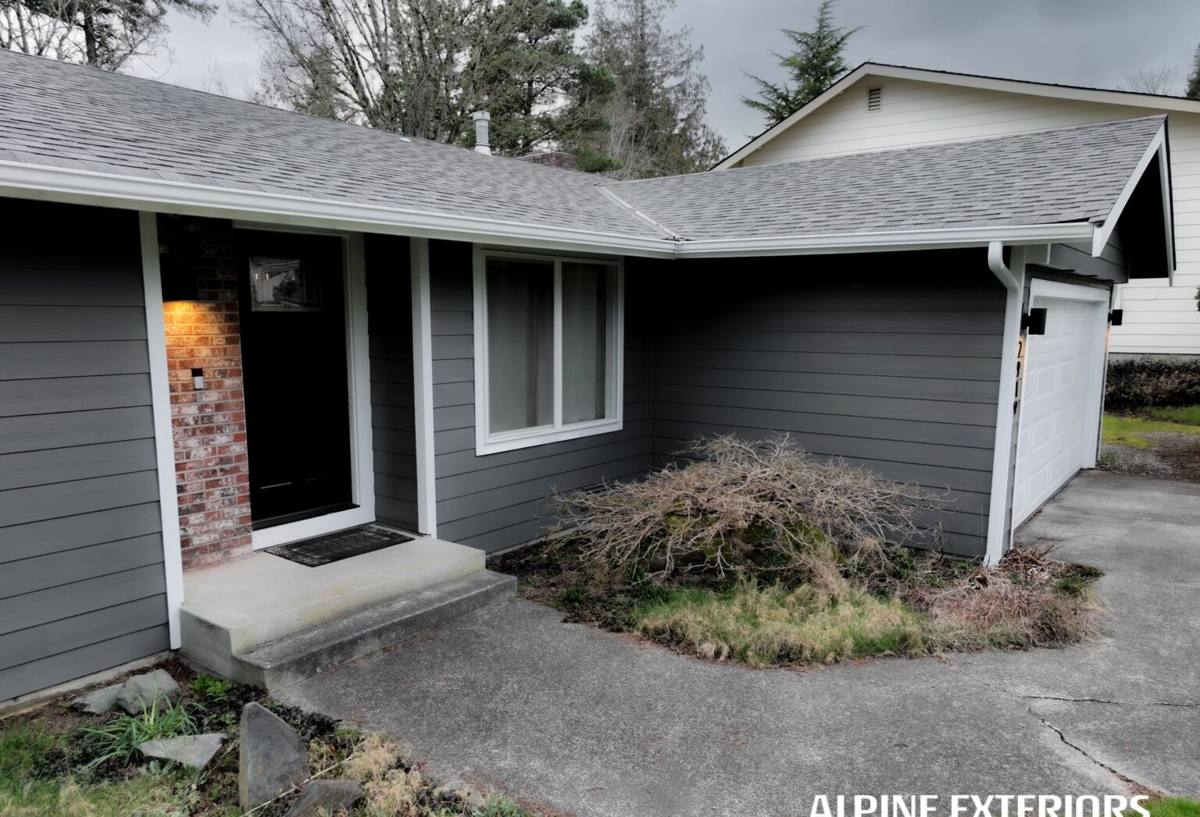
Signs a Custer Home Needs Siding Replacement, Not Just Repair
Homeowners often ask for a patch or repair when what the wall actually needs is a full siding replacement. Here's how to tell the difference:
- Soft or spongy spots when you press on the siding, especially near the bottom courses or below windows
- Persistent moss or dark streaking that comes back within a season of cleaning
- Visible cupping, warping, or bowing in individual boards or panels
- Paint that won't hold — peeling, bubbling, or chalking faster than a normal repaint cycle
- Gaps opening up at seams, corners, or trim where caulk keeps failing
- Interior signs like musty smells or staining on interior walls that share an exterior wall
One or two of these on a small section can sometimes be repaired. Several of them, or any sign of rot in the wall sheathing behind the siding, usually means it's time to plan a full replacement before the damage spreads.
Why We Only Install James Hardie Fiber Cement
We've made a deliberate decision as a company: we install James Hardie fiber cement siding, and we don't install LP SmartSide, vinyl, Cemplank, Allura, primed spruce, or cedar. That's not a marketing line — it's a standard we hold ourselves to because of what we've seen play out on homes in this climate over time.
Vinyl siding is affordable and low-maintenance in mild climates, but it expands and contracts significantly with temperature swings, and its seams and J-channels are a common entry point for wind-driven rain when installed in areas with real weather exposure. Wood products like cedar and primed spruce look great initially but require an ongoing maintenance commitment — recaulking, repainting, and moisture monitoring — that most homeowners don't sign up for and few contractors are upfront about. Engineered wood products like LP SmartSide use a resin-treated wood strand core, which performs well when installation details are followed exactly, but the product is more sensitive to field cutting and caulking mistakes than fiber cement, and any moisture that does get past the surface has a wood-based core to work on. Cemplank and Allura are also fiber cement, and are reasonable products in general — our reason for standardizing on Hardie specifically comes down to the depth of their climate-specific engineering (the HZ5 product line built for this region), the consistency of their factory-applied ColorPlus finish, and the strength of their transferable warranty when the installation is done to their specifications.
Fiber cement, done right, doesn't expand and contract the way vinyl does, doesn't have a wood core that can rot, and is non-combustible — a real consideration given how many homes in this area back up to trees, brush, or farmland. That's the combination we want standing on a Custer home for the next several decades, not just the next few years.
What "Done Right" Actually Means
Fiber cement is only as good as its installation. Hardie's own warranty terms are conditional on following their installation manual — proper clearances, fastener patterns, and flashing details. A lot of the siding failures we get called out to inspect aren't product failures at all; they're installation shortcuts.
What a Correct Siding Replacement Involves
A proper siding replacement is a system, not just a new outer layer. Skipping any one of these steps is how homes end up with hidden rot five or ten years down the line, especially in a wet climate like this one.
- Full tear-off and inspection — removing the old siding down to the sheathing so we can actually see the wall, not guess at its condition
- Sheathing repair — replacing any rotted or compromised sheathing before anything new goes up
- Weather-resistive barrier — a properly lapped and taped moisture barrier that manages any water that gets past the siding
- Flashing at every penetration — windows, doors, hose bibs, vents, and anywhere else water can find a path inward
- Correct fastening — the right fastener type, spacing, and depth for the Hardie product being installed, following manufacturer specs
- Proper clearances — siding held off the roofline, deck surfaces, and grade so it isn't sitting in standing water or snowmelt
- Sealed joints and trim — using the right sealants at the right joints, not caulk everywhere as a substitute for good flashing
This is also where salt air matters directly: fastener choice and flashing material need to hold up to that corrosive coastal-adjacent air, not just to rain.
Our Process for Custer Siding Replacement Projects
We keep the process straightforward because homeowners deserve to know what's happening to their house and when:
- On-site assessment — we look at the current siding, the wall assembly where accessible, and the specific exposure your home has to wind, rain, and moss growth
- Product and color selection — choosing the right Hardie product line and ColorPlus finish for your home's exposure and style
- Written scope and timeline — a clear plan before any work starts, no surprises mid-project
- Tear-off and sheathing check — removing old material and repairing anything compromised underneath
- Weather barrier and flashing installation — the part of the job that determines whether the siding lasts
- Hardie installation to manufacturer spec — so your warranty coverage is actually intact if you ever need it
- Final walkthrough — going over the finished work with you before we consider the job done
Choosing the Right Hardie Product for Custer's Exposure
Not every wall on a home faces the same conditions. A north-facing wall shaded by trees deals with moss and prolonged dampness; a west-facing wall may take more direct wind-driven rain. Part of doing this job right is matching the product and detailing to the exposure, not applying one blanket approach to the whole house.
| Exposure Type | Primary Concern | What We Prioritize |
|---|---|---|
| Shaded / north-facing walls | Moss, prolonged moisture, algae | Ventilation gap detailing, moisture barrier lapping, ColorPlus finish resistance |
| Wind-exposed / open-field walls | Wind-driven rain intrusion | Flashing at all penetrations, tight seam and joint sealing |
| Coastal-adjacent walls | Salt air corrosion of fasteners and trim | Corrosion-resistant fastener selection, durable trim materials |
| Ground-level / low-clearance areas | Splash-back moisture, standing water | Correct clearance from grade, deck, and hardscaping |
What Siding Replacement Typically Costs — and Why It Varies
We don't quote prices without seeing the home, because too many variables affect the real number. What we can tell you is what actually drives cost up or down on a project like this:
| Cost Factor | Why It Matters |
|---|---|
| Sheathing condition | Rotted sheathing found during tear-off adds repair work that can't be predicted until the old siding is off |
| Home size and wall complexity | More corners, gables, and trim detail means more labor and material cuts |
| Hardie product line selected | Lap siding, panel siding, and shingle-style products differ in material and labor cost |
| Story height and access | Two-story and steep-lot homes require more scaffolding and safety setup |
| Existing siding removal | Multiple layers of old siding or trapped moisture damage add tear-off time |
Anyone quoting a firm number over the phone without walking the property is guessing. A real estimate starts with a real look at your home.
What to Ask Before Hiring a Siding Contractor
Whatcom County has no shortage of contractors willing to install siding. Fewer of them will walk you through the details that actually determine whether the job lasts. Before hiring anyone for a Custer siding replacement, ask:
- Are you a certified or factory-trained installer for the specific siding product being used?
- Will you replace or repair damaged sheathing as part of the scope, not as a change-order surprise?
- What weather-resistive barrier and flashing details will you use, specifically?
- Does the manufacturer's warranty stay valid with your installation method?
- Can you show me the fastener type and clearance specs you'll follow for this product?
- Do you carry current liability insurance and workers' comp coverage?
A contractor who already works regularly in Custer and the surrounding Ferndale area will have concrete, specific answers to these questions — not general reassurances. Local experience with this exact climate is the difference between a siding job that looks good at handoff and one that's still performing correctly in fifteen years.
Get a Straight Answer for Your Home
If your Custer home's siding is showing moss that won't quit, soft spots, failing paint, or open seams, it's worth having someone look at it before the next wet season makes the problem worse. We'll walk the exterior, tell you honestly whether you're looking at repair or replacement, and if it's replacement, explain exactly what a correct James Hardie installation would involve on your specific home. Reach out below for a free, no-pressure estimate.