 Ferndale Exterior
 Building Decks for a Salt Air, High-Rain Corner of Whatcom County
Custer sits close enough to the water that salt-laden air is part of everyday exposure for most properties out here, not just the ones with a water view. Add in wind-driven rain that doesn't fall straight down for most of the year, and a moss and mildew season that runs across most of the calendar because temperatures stay mild and moisture stays constant, and you've got three separate stresses working on every exterior surface at once — including a deck. A deck built to a generic spec sheet, without those three things in mind, tends to look fine for a few seasons and then start showing problems all at once: soft spots, corroding hardware, slick surfaces, and rot at the exact joints that are hardest to inspect. This page is about what a deck actually needs to hold up in Custer specifically, not a generic overview of decking in general.
We build custom decks throughout Ferndale and the surrounding Whatcom County area, and Custer jobs get the same standards as everywhere else — but the material choices, fastener specs, and framing details we lean on here are shaped by this particular stretch of coastline and its climate.
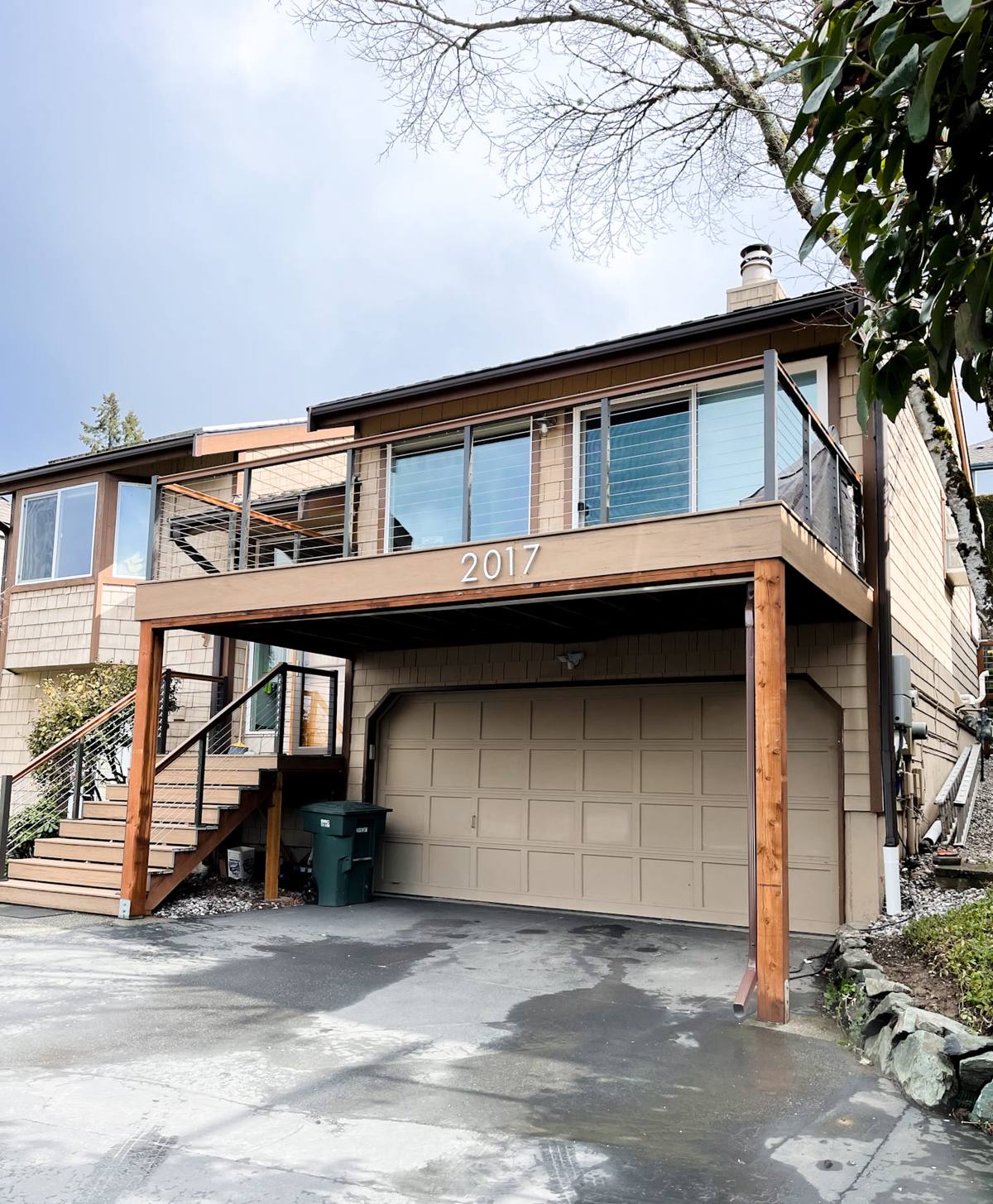
What This Climate Actually Does to a Deck
Salt Air
Salt exposure speeds up corrosion on any exposed metal — fasteners, joist hangers, railing brackets, post bases. A deck that would hold together fine forty miles inland can develop rust streaks and failing hardware here within a handful of years if the fastener spec wasn't chosen with that exposure in mind. This is one of the most common problems we find when we're asked to look at an older deck in this area: the wood is often still sound, but the metal holding it together isn't.
Wind-Driven Rain
Rain that's pushed sideways by wind gets into places straight-down rain never would — under railing caps, behind ledger boards, into any gap where two deck boards or two framing members meet. That matters more for a deck than most people expect, because the ledger board connection (where the deck attaches to the house) is one of the most failure-prone points in deck construction nationally, and wind-driven rain is exactly the condition that exposes a poorly flashed ledger.
A Long Moss Season
Mild temperatures and steady moisture mean moss and algae growth for most of the year on shaded or tree-lined lots, which describes a good number of Custer properties. On a deck surface, that's not just a cosmetic problem — moss holds moisture against the decking material, and a slick, damp deck surface is also a real slip hazard, especially on stairs.
Decking Material Options for This Climate
There isn't one right decking material for every homeowner — budget, maintenance appetite, and how the deck will be used all factor in. But some materials handle this specific combination of salt air, rain, and moss better than others, and it's worth understanding the trade-offs before you pick one.
| Material | How It Handles This Climate | Maintenance |
|---|---|---|
| Pressure-treated lumber | Good rot resistance from the treatment chemicals, but surface graying and moss uptake happen quickly without regular cleaning and sealing | Annual cleaning; re-sealing every 1-2 years |
| Cedar | Naturally rot- and insect-resistant with real visual appeal, but it's an organic surface that moss and mildew take to readily in a damp climate | Regular cleaning; periodic staining or sealing to hold color and shed moisture |
| Composite decking | Non-organic wear layer resists moss uptake and doesn't rot, splinter, or need sealing; performs consistently across wet seasons | Occasional washing; no staining or sealing |
| PVC decking | Fully synthetic, essentially impervious to moisture and moss staining; holds up well in salt-air exposure | Occasional washing; lowest long-term upkeep |
We install all of the above depending on what a homeowner wants, but we're upfront in every estimate about what each choice means for upkeep here. A pressure-treated deck can absolutely last for decades in Custer — it just needs an owner who's going to keep up with cleaning and sealing on schedule. Composite and PVC cost more upfront but trade that for a lot less maintenance in a climate that's actively working against a bare wood surface most of the year.
Framing and Structural Details That Matter Here
The decking surface is what you see, but the framing underneath is what determines whether the deck is actually safe and long-lasting — and it's where a lot of the climate-specific decisions really live.
Ledger Flashing
Where the deck attaches to the house, we use proper flashing — typically a metal flashing piece integrated with a self-adhering waterproof membrane behind it — to keep wind-driven rain from working its way behind the ledger board and into the house's wall framing. This is one detail we won't skip or shortcut regardless of budget, because a rotted ledger connection is both a repair headache and a structural safety issue.
Footings and Posts
Footings need to be sized and set to local frost depth and soil conditions, with post bases that hold the post above standing water and wet ground contact rather than burying wood directly in soil. We use corrosion-resistant post bases and connectors rated for the exposure, not just whatever's cheapest at the yard.
Joist Hangers and Fasteners
Every joist hanger, screw, and structural connector on a Custer deck gets specified for the exposure it's actually going to see, which in this area generally means stainless steel or a high-grade coated fastener rather than standard galvanized hardware. It costs more upfront. It's also the single biggest factor in whether the hidden structure of a deck is still sound in fifteen years or already rusting through.
Spacing for Drainage
Deck board spacing and any under-deck drainage system need to account for how much water this area actually sees, so water sheds off the surface and out from under the structure instead of sitting and feeding moss growth in the gaps.
Railings and Hardware in a Salt-Air Environment
Railing systems take a lot of the same exposure as the framing, plus they're handled constantly, so wear shows up faster. Aluminum and powder-coated steel railings generally hold up better against salt air than uncoated steel or lower-grade hardware, and cable railing systems need corrosion-resistant cable and end fittings specifically, since a failing cable component is both unsightly and a safety concern. Whatever railing material a homeowner chooses, we spec the fasteners and brackets the same way we do for the framing — for the exposure this specific location sees, not a generic inland spec.
Our Process From Estimate to Finished Deck
Every Custer deck project follows the same basic sequence, though the details shift with the site and the scope of the job.
- On-site walkthrough and estimate. We look at the house's ledger attachment point, the grade and drainage around the proposed footprint, sun and shade exposure, and how the deck will actually be used, then put together a written estimate with material options.
- Design and material selection. We work through decking material, railing style, and layout with the homeowner, including the maintenance trade-offs specific to this climate covered above.
- Permitting. Deck projects above certain size and height thresholds typically require a building permit through the applicable local jurisdiction. We handle that process rather than leaving it to the homeowner to sort out.
- Framing and structural work. Footings, ledger flashing, framing, and all structural connections go in first, inspected before the decking surface goes on.
- Decking, railings, and finish work. The visible surface, railings, stairs, and any trim or skirting are installed last, with fasteners and hardware matched to the material and exposure.
- Final walkthrough. We go over the finished deck with the homeowner, including what maintenance schedule fits the material chosen.
Permits and Local Building Considerations
Deck construction in and around Ferndale generally falls under the applicable local building code, and most decks attached to a house or elevated above a certain height need a permit and inspection before, during, and after construction. Requirements vary based on the deck's size, height, and whether it's attached to the structure, so this isn't something to assume either way before checking. We pull permits as part of our process on jobs that require them, which also means the structural work gets an independent inspection rather than just our own sign-off — worth knowing if you're comparing bids and one contractor's price seems to skip that step entirely.
Keeping a Custer Deck Ahead of Moss and Weather
The maintenance a deck needs here depends heavily on the material, but a few basics apply across the board given the climate:
- Sweep and clear leaves and debris regularly, especially in fall — trapped organic matter is where moss growth typically starts.
- Wash the deck surface at least once or twice a year to clear moss and algae before it gets established, more often on shaded sections.
- Check railing posts, stair stringers, and any visible hardware periodically for rust streaks or looseness, which can be an early sign of fastener corrosion.
- For wood decking, keep sealing or staining on schedule rather than waiting until graying or moisture damage is visible.
- Keep an eye on the area right around the ledger board attachment, since that's the spot most prone to hidden moisture problems.
- Make sure gutters and downspouts near the deck are directing roof runoff away from the structure rather than onto it.
None of this is complicated, but it's the difference between a deck that looks and performs the same at year fifteen as it did at year two, and one that needs early repairs because moss and moisture got a foothold and nobody caught it.
Why Hiring a Crew That Already Works in Custer Matters
A lot of deck problems we get called out to fix started with a design or material choice that worked fine somewhere drier and got copied here without adjustment — a fastener spec pulled from a generic plan set, a ledger flashing detail that was technically code-compliant but not built for sustained wind-driven rain, a decking material chosen without accounting for how much shade and moss pressure the lot actually gets. A crew that's already built and repaired decks in this specific area has usually seen those failure patterns firsthand, which changes what gets specified before the first board goes down rather than after something fails. That's the value of local experience on a project like this: it shows up in decisions you don't see on the finished deck, but that determine how long it actually lasts.
If you're planning a new deck or replacing one that's showing its age in Custer, we're happy to come take a look and put together a free, no-pressure estimate. There's a form below to get that started.