 Ferndale Exterior
 Why Semiahmoo Homes Need a Roof Built for This Exact Coastline
Semiahmoo sits close enough to the water that salt air isn't an occasional visitor — it's a daily fact of life for anything on your roof. Add Whatcom County's long, wet fall-through-spring stretch and the shade cover from mature evergreens common in this area, and you've got a roofing environment that punishes cheap fasteners, thin coatings, and rushed flashing work faster than almost anywhere else in the county. A roof that would hold up fine twenty minutes inland can start showing corrosion streaks, moss colonization, and fastener failure years ahead of schedule out here.
Metal roofing, done correctly, is one of the better answers to this specific combination of salt, rain, and shade. But "done correctly" is doing a lot of work in that sentence — the wrong panel system, the wrong fastener metal, or a flashing detail that traps moisture instead of shedding it will undercut everything metal roofing is supposed to be good at. This page is about what a metal roof actually needs to hold up on a Semiahmoo property, not a generic rundown of metal roofing in general.
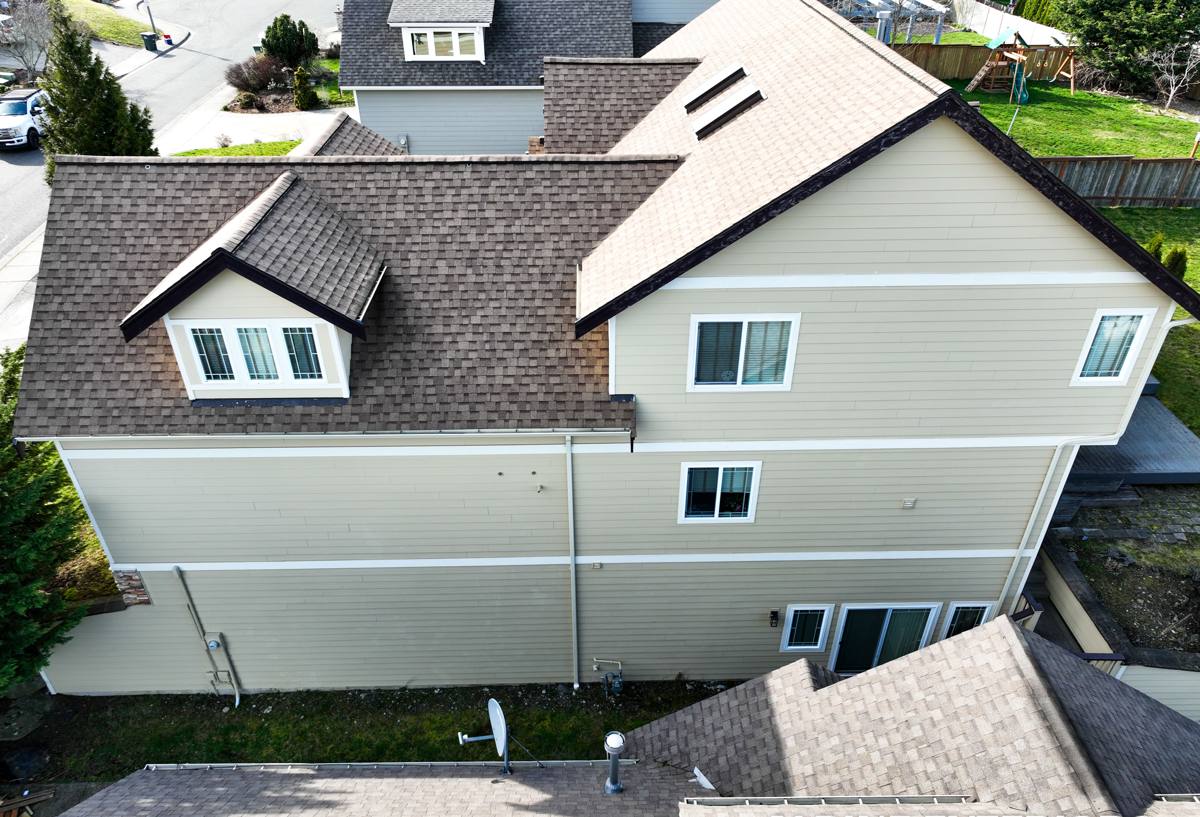
What Salt Air Actually Does to a Roof
Salt-laden air carries chloride particles that settle on any exposed metal and accelerate oxidation, especially at cut edges, fastener heads, and any spot where two dissimilar metals touch. This isn't unique to waterfront lots — prevailing winds off the water carry salt further inland than most homeowners assume, so even homes a few blocks back from the shoreline in the Semiahmoo area see accelerated wear compared to roofs further into Ferndale proper.
The Failure Points We Watch For
- Exposed cut edges on panels that weren't factory-sealed or field-treated
- Fasteners made from a different metal than the panel, which sets up galvanic corrosion
- Fastener washers that have hardened or cracked, letting water track down the shaft
- Flashing laps and end-wall details that weren't sealed for driving, wind-blown rain
- Coating breakdown at high-wear zones like valleys and eave edges
None of these are metal roofing "failing" as a product — they're what happens when a system isn't matched to the environment or isn't installed with the fastener and flashing discipline salt air demands.
Moss, Shade, and the Long Wet Season
Whatcom County's roofing season is long and damp, and Semiahmoo's tree cover means a lot of roofs here stay shaded and slow to dry for much of the year. Moss and algae don't damage metal roofing the way they damage shingles, but they still cause problems: moss mats hold moisture against fasteners and seams, they can lift and clog gutters, and a poorly detailed ridge or valley gives moss a foothold it wouldn't get on a smoother, better-pitched section. A correctly installed metal roof sheds water fast enough and has few enough moisture traps that moss struggles to establish — but panel choice, seam style, and slope all factor into how true that stays over time.
Panel Systems: What We Recommend and Why
Not every metal roofing product performs the same way in a salt-air, high-moisture environment. We steer Semiahmoo homeowners toward systems that minimize exposed fasteners and use metals proven for coastal exposure, because the maintenance burden and failure points of the alternatives show up faster here than in drier, inland parts of the county.
| System | Fastener Exposure | Coastal Fit | Trade-Offs |
|---|---|---|---|
| Standing seam (concealed fastener) | None on the field of the panel | Strong — our default recommendation near the water | Higher material and labor cost than exposed-fastener panels |
| Exposed-fastener panel | Every rib, every course | Workable inland; higher maintenance near salt air | Fastener washers age and need periodic inspection/replacement |
| Stone-coated steel | Concealed under coating | Good, if coating and cut edges are properly sealed | Repairs can be harder to blend than plain metal |
| Aluminum standing seam | None on the field | Excellent — naturally corrosion-resistant, no rust to begin with | Softer material, needs careful handling during install |
For most Semiahmoo homes, we lean toward standing seam in steel or aluminum. Concealed fasteners remove the single biggest long-term weak point in a coastal metal roof, and the panel seams are engineered to shed wind-driven rain rather than rely on sealant that degrades over time. Aluminum is worth a serious look on properties closest to the water, since it doesn't rust the way steel can if a coating is ever compromised.
Fasteners and Flashing: The Details That Actually Determine Lifespan
On an exposed-fastener system, we use fasteners matched to the panel metal with EPDM-backed washers rated for the coastal exposure, not generic hardware. On standing seam, clip spacing and clip type get matched to the wind exposure of the specific roof plane — a roof facing open water or a wind corridor needs tighter clip spacing than a sheltered slope. Flashing at valleys, walls, chimneys, and penetrations gets layered and lapped correctly for the direction water and wind-driven rain actually travel on that roof, not just installed to a generic diagram. This is the part of a metal roof job that's invisible once it's done and is exactly where corner-cutting shows up five or ten years later.
What a Correct Metal Roof Installation Involves
A metal roof is only as good as what's underneath it and how it's fastened down. For Semiahmoo homes, our installs typically include:
- Tear-off and deck inspection, replacing any sheathing that's soft, rotted, or moisture-damaged
- A high-temp synthetic or self-adhered underlayment suited to the panel type and roof slope
- Ice-and-water shield or equivalent protection at eaves, valleys, and penetrations where moisture load is highest
- Panel and fastener selection matched to the roof's specific wind and salt exposure, not a one-size answer for the whole job
- Properly lapped, sealed flashing at every wall, valley, chimney, and vent penetration
- Ridge and hip venting detailed to keep the attic dry without creating a wind-driven-rain entry point
Skipping any one of these doesn't necessarily cause an immediate problem — it causes a problem three, five, or eight years down the road, usually starting at exactly the weak point that got shortcut.
Cost Factors for a Semiahmoo Metal Roof
Metal roofing costs more upfront than asphalt shingles, and the final number on any given Semiahmoo home depends on more than square footage. Rather than quote a number that won't actually apply to your roof, here's what moves the price:
| Factor | Why It Matters Here |
|---|---|
| Panel system | Standing seam and aluminum cost more than exposed-fastener steel but reduce long-term maintenance in salt air |
| Roof complexity | Valleys, dormers, and multiple planes mean more flashing work and labor time |
| Deck condition | Older homes near the water sometimes need sheathing repair before panels go on |
| Tear-off scope | Removing existing roofing versus roofing over adds cost but is usually the right call for a full metal system |
| Ventilation and flashing detail | Correct ridge venting and wall flashing add labor but are not optional in this climate |
We'll walk your specific roof and give you a real number based on what's actually there — not a phone estimate based on square footage alone.
Maintenance: What Metal Roofing Still Needs Near the Water
Metal roofing is lower-maintenance than shingles, but "low-maintenance" isn't "no-maintenance," especially with Semiahmoo's salt exposure and shade cover. We recommend:
- An annual walk-around inspection, checking fastener washers, flashing seals, and cut edges
- Keeping gutters and valleys clear of needle and leaf debris, which holds moisture against the panel
- Gentle moss removal rather than pressure-washing, which can damage coatings and force water under seams
- Rinsing accumulated salt residue off the roof periodically if the home is directly exposed to onshore wind
A roof installed correctly for this environment should need very little beyond that — but skipping inspections is how a small fastener or flashing issue turns into a deck repair.
Why Local Experience on This Specific Coastline Matters
Semiahmoo isn't generic coastal Washington — it's a specific combination of salt exposure, tree shade, and driving rain patterns that comes from its position relative to the water and the surrounding terrain. A crew that mainly works drier, inland roofs won't automatically know to spec aluminum over steel on a shoreline-facing plane, or to tighten clip spacing on the side of the roof that takes the worst of the wind. We work roofs across Ferndale and Whatcom County regularly enough to know which details actually matter here and which are just extra cost with no real benefit for this climate.
That local pattern-recognition is also why we don't push products or systems that look good on paper but create maintenance headaches in this specific environment — we'd rather spec the system that's still performing well in a decade than the one that's cheapest to quote today.
Get a Straight Answer for Your Roof
If you're weighing metal roofing for a Semiahmoo property, we're glad to come take a real look — check the deck, the exposure, the existing flashing — and give you a straightforward estimate with no pressure to sign anything on the spot. Use the form below to request a free estimate.