 Ferndale Exterior
 Siding Repair for Cordata Homes
Cordata sits in a part of Whatcom County that takes a specific kind of weather beating: salt-laden air drifting in off the Salish Sea, rain that arrives sideways as often as it falls straight down, and a moss season that can stretch across most of the calendar year. None of that is unique to any one street or subdivision in the neighborhood, but taken together it adds up to real wear on a home's siding over time — wear that shows up as small, fixable problems long before it becomes a full re-side. We repair siding for homes in Cordata regularly, and the approach we bring is shaped around what this specific combination of salt, rain, and moss actually does to a wall assembly, not a generic repair checklist.
We install and repair James Hardie fiber cement siding exclusively. When a Cordata homeowner calls about a repair, that focus lets us match new material to existing siding cleanly and give an honest answer about whether a repair will actually hold.
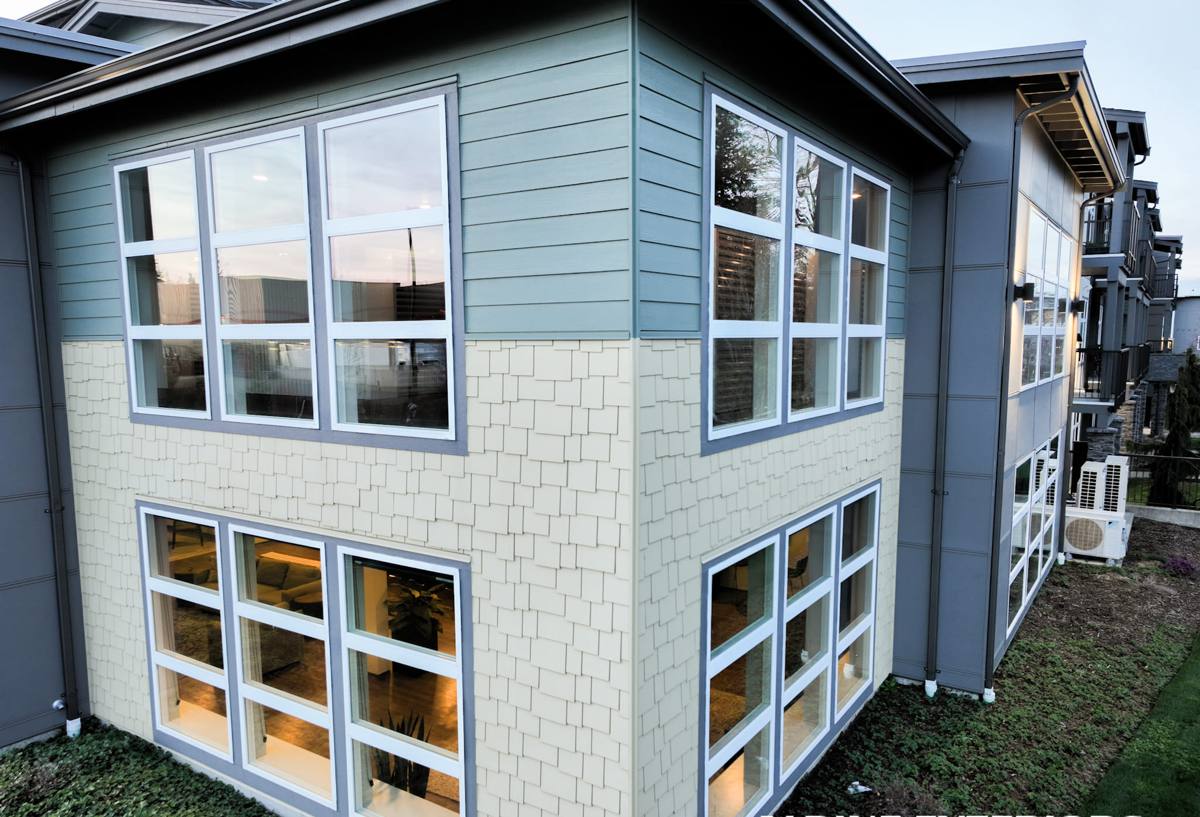
What the Cordata Climate Does to Siding
Salt Air and Corrosion
Proximity to Bellingham Bay and the broader Salish Sea means airborne salt is a real factor for exterior materials in Cordata, even a few miles inland. Salt-laden moisture accelerates corrosion on fasteners, flashing, and any metal trim components, and it can speed up wear on caulking and paint finishes that aren't built to resist it. A repair that reuses corroded fasteners or skips a marine-grade detail is a repair that's likely to need doing again sooner than it should.
Driving Rain
Storms moving through this part of Whatcom County frequently push rain sideways into walls rather than letting it run straight down and off. That matters enormously for repair work specifically, because wind-driven rain finds its way into exactly the kind of small gaps a repair is meant to close — a cracked panel, a separated seam, a piece of trim that's pulled away from the wall. A repair that doesn't account for wind-driven rain, and only addresses the visible damage, tends to leave the underlying entry point for water still open.
A Long Moss and Mildew Season
Mild, damp conditions for much of the year make Cordata a place where moss and mildew growth on shaded and north-facing walls is common, and it often runs from fall through spring without much of a break. Moss holds moisture directly against a wall surface, and where it's allowed to sit for an extended period, that trapped moisture is a common contributor to the kind of soft, damaged siding sections we're called out to repair.
Freeze-Thaw Cycling
Whatcom County sees enough hard frosts through the winter that freeze-thaw cycling is a genuine factor here, even though the climate overall skews mild and wet. Water that has already worked its way into a crack or a compromised seam expands when it freezes, which turns a small crack into a larger one over a single cold snap. This is one of the more common ways a minor, easily repairable issue in fall becomes a bigger job by spring if it isn't caught early.
What a Correct Siding Repair Actually Involves
A good siding repair is more than swapping a damaged board for a new one. It starts with figuring out why that section failed in the first place — whether it's a one-time impact, a flashing detail that was never right, or ongoing moisture intrusion from somewhere else on the wall — because repairing the visible symptom without addressing the cause just buys time before the same spot fails again.
- Diagnosis before demolition: We check whether damage is isolated or a sign of a larger moisture problem working behind the wall before deciding on a repair scope.
- Matching material and profile: Repairs use James Hardie product matched to the existing siding's profile, exposure, and color line wherever possible, so the repaired section doesn't stand out.
- Correct fastening and flashing: Given the salt air and wind-driven rain common here, we don't cut corners on fastener quality or flashing detail just because it's a smaller job.
- Sealing to the surrounding assembly: Joints get properly lapped and sealed into the existing house wrap and trim, not just caulked over as a shortcut.
- A look at what's behind the siding: Where damage suggests moisture has been present for a while, we check sheathing and framing condition before closing the wall back up.
Repair vs. Full Replacement
Not every siding issue in Cordata calls for a full re-side, and we'd rather give an honest recommendation than upsell a job the home doesn't need yet. The table below covers the situations that typically point one way or the other.
| Situation | Usually Points To | Why |
|---|---|---|
| Isolated impact damage (one or two panels) | Repair | Localized damage with sound siding around it can be cut out and matched without disturbing the rest of the wall |
| Cracked or separated caulk joints only | Repair | Often a maintenance-level fix if caught before water has tracked behind the siding |
| Soft or spongy siding in multiple areas | Full replacement likely | Widespread softness usually means moisture has been getting behind the wall for some time, not just at the surface |
| Older non-Hardie siding (vinyl, LP, cedar) nearing end of life | Full replacement | Patching an aging or discontinued product usually just delays a larger job while hidden issues keep spreading |
| Persistent moss or staining on one or two walls only | Repair plus cleaning | Often addressable without touching unaffected walls, provided the wall assembly underneath tests sound |
We'll walk the home, tell you honestly which category your situation falls into, and explain the reasoning rather than defaulting to the most expensive option.
Why We Only Repair With James Hardie
We used to work with a broader range of siding products before standardizing on one system, and that decision came out of years of seeing which materials actually held up under sustained Whatcom County moisture and salt exposure versus which ones turned into recurring repair calls. For Cordata specifically, dealing with salt air, driving rain, and an extended moss season, fiber cement holds up in ways that matter for repair work as much as for new installation.
- Non-combustible core: Fiber cement doesn't feed a fire the way wood-based siding products can, which matters for both safety and insurance underwriting.
- Factory-applied ColorPlus finish: The finish is baked on in a controlled factory process rather than applied on site, so repaired sections resist fading and moisture intrusion as well as the original siding does.
- Climate-engineered HZ product lines: Hardie builds formulations for different climate zones, including versions engineered for sustained moisture and coastal-influenced exposure — a real match for Cordata's conditions.
- Dimensional stability: Fiber cement doesn't swell, cup, or warp the way engineered wood can after repeated wet-season cycles, which keeps a repaired section sitting flush with the surrounding wall.
- Strong transferable warranty: When repairs are done to spec with genuine Hardie product, they stay covered under Hardie's warranty structure rather than creating a gap in coverage.
We don't install or repair with LP SmartSide, vinyl siding, Cemplank, Allura, primed spruce, or cedar. Homeowners with those products elsewhere aren't wrong to have chosen them, but we made a professional call that repairing and installing one system we trust completely serves a homeowner better than stretching across several products we'd have to hedge on. If your home already has a non-Hardie product and needs a repair, we'll still take a look and give you a straight answer about your options, even if that means recommending a full replacement with Hardie down the line rather than patching a product we don't install new.
Our Repair Process
- Inspection and diagnosis: We walk the affected area and the surrounding wall, checking for the underlying cause of the damage, not just the visible symptom.
- Honest scope recommendation: We tell you whether you're looking at a spot repair, a larger section replacement, or something that points toward full re-siding.
- Material matching: Where a repair is the right call, we source James Hardie product that matches the existing profile and color as closely as possible.
- Correct installation: Proper fastening, flashing, and sealing appropriate to Cordata's salt air and wind-driven rain exposure — the same standard we'd use on a new install.
- Written estimate, no pressure: You get a clear number and a clear explanation before any work starts.
Siding Repair Readiness Checklist
- Walls checked for soft spots, staining, or gaps at seams and corners
- Trim and flashing around windows and doors inspected for cracking or separation
- North-facing and shaded walls checked for moss, mildew, or persistent dark staining
- Fasteners and metal trim checked for corrosion consistent with salt air exposure
- Grade clearance confirmed so siding isn't sitting too close to wet ground
- Recent storm or impact damage documented while it's still isolated and repairable
Cost Factors for Siding Repair in Cordata
| Factor | What It Affects | Why It Matters Here |
|---|---|---|
| Extent of hidden moisture damage | Whether repair stays a repair or grows into replacement | Salt air and a long moss season can let moisture work behind siding before it's visible on the surface |
| Color and profile matching | How seamlessly the repair blends with existing siding | Older ColorPlus finishes weather over time, which can affect how closely a new panel matches |
| Fastener and flashing condition | Long-term durability of the repair | Salt-influenced corrosion on existing fasteners and flashing may need addressing beyond the damaged panel itself |
| Access and wall height | Labor time and equipment needs | Some Cordata homes have multi-story sections or limited side-yard access that affect staging |
| Underlying substrate condition | Whether sheathing repair is needed before new siding goes on | Prolonged trapped moisture from moss or wind-driven rain can affect what's underneath the visible siding |
Exact repair costs depend on the specific damage and what we find once we open up the affected area, which is why we give a real number after walking the home rather than quoting blind over the phone.
Why a Local Crew Matters for Repairs in Cordata
Repair work rewards local experience in a way new construction sometimes doesn't. A crew that works this part of Whatcom County regularly has a feel for which wall orientations in Cordata tend to hold moss longest, how salt air shows up differently on a repair five years in versus fifteen, and which flashing shortcuts from an earlier, less careful installation tend to cause the callbacks we get asked to fix. That local pattern recognition is part of what makes a repair estimate accurate instead of a guess, and it's part of why we can usually tell fairly quickly whether a damaged section is an isolated issue or a sign of something larger happening behind the wall.
What to Expect When You Call Us
- A walk-through of the damaged area and the surrounding wall to check for hidden moisture or related issues
- An honest assessment of whether you need a spot repair, a larger section replacement, or a full re-side
- A clear explanation of material matching and why we work exclusively in James Hardie fiber cement
- A written estimate with no pressure to sign on the spot
If siding on your Cordata home is cracked, soft, stained, or just showing its age, we're glad to take a look and give you a straight answer. Reach out using the form below to schedule a free, no-pressure estimate.