 Ferndale Exterior
 Why Sumas Homes Take a Different Kind of Beating
Sumas sits up against the Canadian border in the northeast corner of Whatcom County, and its siding problems aren't quite the same as what you'd see on a house closer to Bellingham Bay or out along the coast. Homes here deal with a mix of marine-influenced moisture pushing in from the west and colder, wetter winters that settle into the low ground near the Nooksack River valley. Add in the region's long stretch of overcast, damp months, and you get siding that spends more of the year wet than dry.
That combination — salt-tinged air carried in from Puget Sound, driving rain that hits siding at an angle instead of falling straight down, and a moss season that can run from late fall through spring — is hard on cheap or poorly installed siding. Paint fails early. Seams open up. Moss and algae take hold in shaded, north-facing walls and stay there because the wall never gets enough sun or airflow to dry out. We install James Hardie fiber cement siding for Sumas homeowners specifically because it holds up to this pattern of exposure better than the alternatives, and because a well-installed Hardie system is boring in the best possible way — it just keeps doing its job year after year without drama.
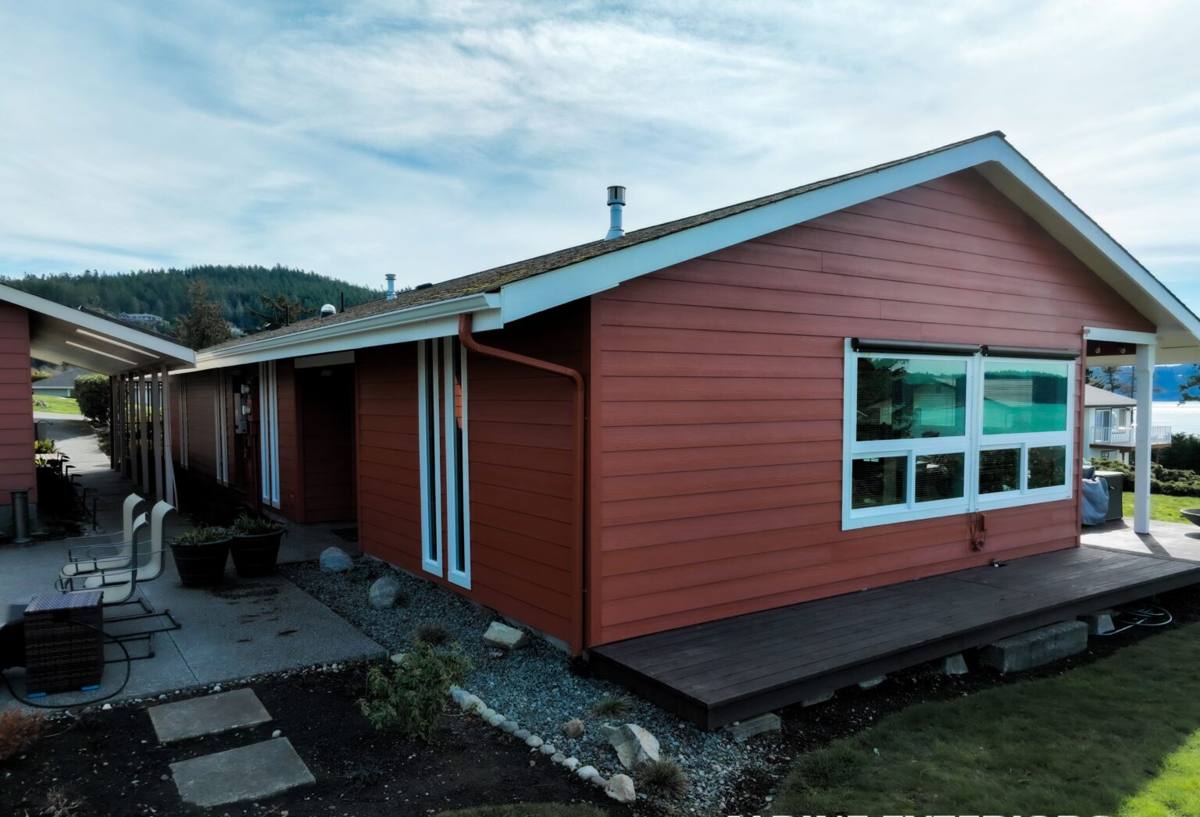
What Sumas Siding Actually Needs to Handle
Persistent Moisture, Not Just Rain Totals
It isn't the total rainfall number that wears out a wall — it's how long that wall stays wet after the rain stops. Whatcom County's cloud cover and humidity mean siding on shaded elevations can stay damp for days at a stretch during the wetter months. Materials that absorb moisture and hold it, or that rely on paint film alone to keep water out, degrade faster here than they would in a drier climate.
Moss and Algae Growth
Moss doesn't need standing water to get established — it just needs consistent surface moisture and shade, both of which are common on north- and east-facing walls, under eaves, and near tree lines around Sumas properties. Once moss roots into a seam or a soft spot in the material, it holds moisture against the wall and accelerates whatever damage was already starting.
Wind-Driven Rain at the Details
Storms coming off the water or funneling down the valley don't always rain straight down — wind pushes water sideways into corners, around window and door trim, and up under lap joints. This is where a lot of siding failures actually start: not on the open field of the wall, but at the transitions and penetrations where water finds a way in if the flashing and lapping weren't done correctly.
Why We Install Only James Hardie
We made a deliberate decision as a company to install James Hardie fiber cement exclusively — not vinyl, not LP SmartSide, not Cemplank or Allura, not primed spruce or cedar. Each of those products has real strengths, and we're not going to pretend otherwise. Vinyl is inexpensive and low-maintenance in mild climates. Wood has genuine curb appeal for the right homeowner. Engineered wood products like LP SmartSide have improved a lot over the years.
But in a climate like this one, the trade-offs matter. Vinyl can warp, fade, and crack in temperature swings, and its seams are a long-term weak point against wind-driven rain. Wood and engineered-wood sidings depend heavily on paint and caulking staying intact to keep moisture out — once that film fails, rot can start underneath before it's visible from outside. James Hardie fiber cement is non-combustible, dimensionally stable across temperature and moisture swings, and comes with a factory-applied ColorPlus finish that's baked on rather than site-applied, so it holds color and resists the kind of fading and peeling that damp climates accelerate. Hardie also builds specific product lines engineered for different climate zones (HZ5 and HZ10), and Western Washington falls into the range those products were designed for. We standardized on one product because we'd rather be excellent at installing it correctly than average across five different systems.
What a Correct Installation Actually Involves
Fiber cement siding fails less often because of the material and more often because of how it was installed. A rushed or careless install can undermine even the best product on the market. On every Sumas project, our process includes:
- Inspecting and repairing the water-resistive barrier (house wrap) before any siding goes up — a torn or improperly lapped barrier is one of the most common hidden causes of moisture damage
- Correct rainscreen or furring strip application where the wall assembly calls for it, so siding can dry out on both sides instead of trapping moisture against the sheathing
- Proper flashing at every window, door, and roof-to-wall transition, installed to shed water outward rather than relying on caulk alone
- Following Hardie's specified nailing pattern, fastener type, and clearance requirements — under-driven or over-driven fasteners are a common warranty-voiding mistake
- Maintaining the manufacturer's minimum clearance from grade, roofline, and decks so siding isn't sitting in standing water or snow load
- Factory-mitered or properly caulked joints at corners and seams, not gaps filled after the fact
Skipping any one of these doesn't necessarily cause an obvious problem on day one — it shows up two, five, or ten years later as a soft spot, a stain, or a section that needs to come off and be redone. That's the real cost of a rushed install, and it's exactly what a careful process is meant to prevent.
Our Process for Sumas Projects
1. On-Site Assessment
We start by walking the exterior with you, looking at current siding condition, problem areas (shaded walls, low-clearance spots, areas already showing moss or paint failure), and any trim, window, or flashing issues that should be addressed at the same time as the siding.
2. Product and Line Selection
We help you choose the right Hardie product line, plank exposure, and color for your home, taking into account sun exposure and the specific moisture pattern of your property.
3. Tear-Off and Barrier Repair
Old siding comes off, the sheathing underneath gets inspected for hidden rot or damage, and the water-resistive barrier is repaired or replaced before anything new goes up.
4. Installation to Manufacturer Spec
Siding, trim, and flashing go on following James Hardie's published installation requirements — not a generalized approach, but the specific fastening, clearance, and lapping details that keep the manufacturer's warranty intact.
5. Final Walkthrough
We walk the finished job with you, checking seams, caulking, and trim details before calling it complete.
Cost Factors to Understand Before You Start
Every Sumas home is different, so we don't quote sight-unseen — but these are the variables that actually move the price on a fiber cement siding project:
| Factor | Why It Matters |
|---|---|
| Extent of existing damage | Rot or moisture damage found under old siding needs repair before new siding can go on correctly |
| Home size and wall complexity | More corners, dormers, and trim details mean more labor and material cutting |
| Plank profile and exposure | Different reveal widths and textures (smooth vs. cedar-shake style) affect material needs |
| Trim and accessory scope | Whether trim boards, soffits, and fascia are being replaced alongside the siding |
| Access and site conditions | Grading, landscaping, and structure height affect scaffolding and staging time |
Maintenance That Actually Fits This Climate
One of the practical advantages of James Hardie fiber cement in a place like Sumas is how little upkeep it demands compared to wood or engineered wood siding. It won't need repainting on the same schedule wood does, and the factory finish resists the fading that site-applied paint experiences under years of damp, low-light conditions. That said, no siding is maintenance-free:
- Rinse siding periodically to clear pollen, dirt, and early moss growth before it takes hold
- Keep gutters clear so overflow doesn't run down the wall face repeatedly
- Trim back vegetation and tree cover that keeps a wall section shaded and damp longer than the rest of the house
- Check caulking at trim joints every year or two and have it touched up if it's cracking or pulling away
Why It Matters That We Already Work in Sumas
A crew that mainly works in drier or milder parts of the state doesn't necessarily think about rainscreen gaps, flashing sequencing, or clearance from grade the same way a crew that works Whatcom County year-round does. We've seen how Sumas properties actually perform through a full wet season — which walls take the worst of the wind-driven rain, where moss shows up first, and which details tend to get overlooked by out-of-area installers working from a generic playbook. That local pattern recognition is part of what you're paying for when you hire a crew that already knows this area, not just a crew that knows fiber cement in general.
If your Sumas home's siding is showing early paint failure, moss buildup, or soft spots near the base or trim, we're happy to take a look. We offer free, no-pressure estimates — walk the exterior with us, ask questions, and get a straight answer about what your home actually needs before you commit to anything.