 Ferndale Exterior
 Everson's Climate and What It Does to Siding
Everson sits in the same weather system that defines exterior work across Whatcom County: long stretches of driving rain carried in off the Pacific, damp air that lingers in the shade of mature trees, and a moss season that can run from October through April. Add in the salt-tinged moisture that moves inland from the Strait of Georgia and Bellingham Bay on windy days, and you have a combination that is genuinely hard on a home's exterior. Siding here doesn't just get wet — it stays wet, cycles through freeze-thaw swings a few times each winter, and sits under moss and algae growth for months at a stretch.
Wood-based and wood-adjacent siding products struggle in this exact environment. Moisture wicks into seams and butt joints, paint and coatings break down faster under UV and damp cycling, and once moss gets a foothold on a north-facing wall, it holds water against the surface almost permanently. None of that is a hypothetical — it's the normal, unremarkable weather pattern of a Whatcom County winter, and it's the reason siding choice matters more here than it does in drier parts of the country.
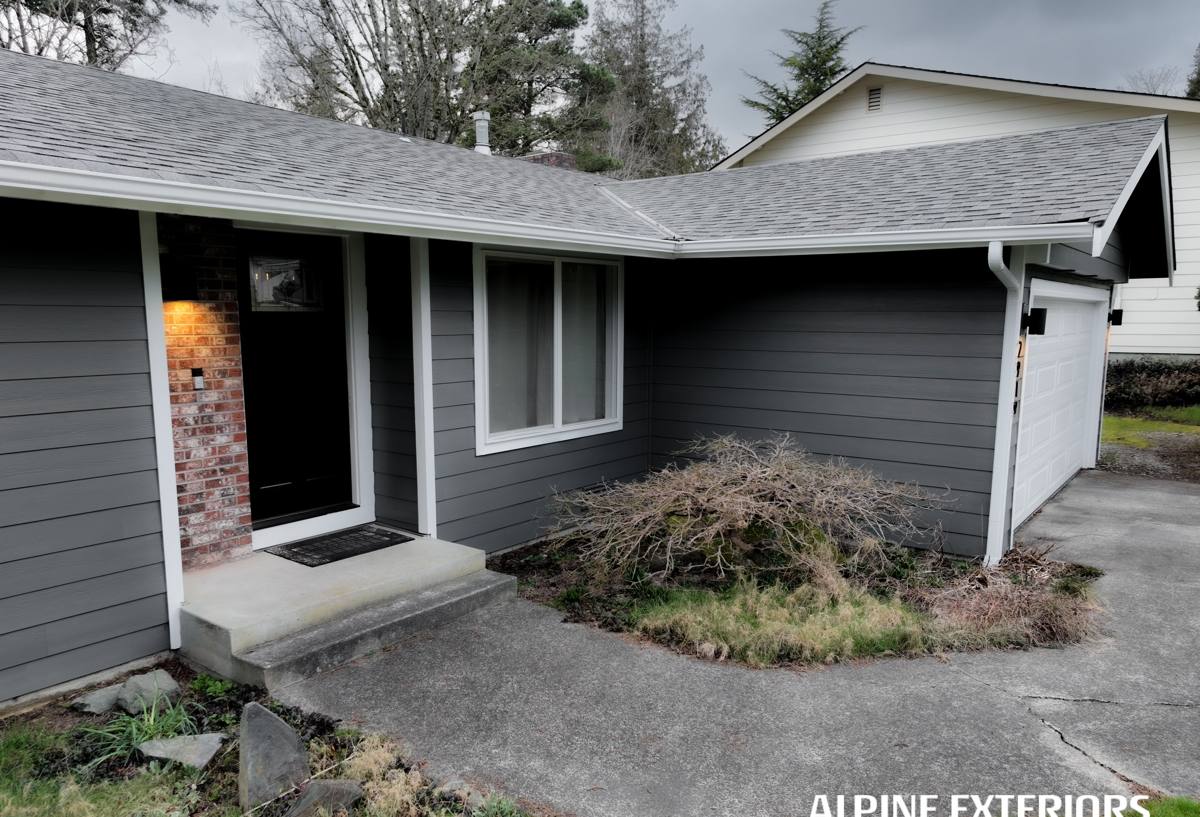
Why This Crew Installs Only James Hardie
We made a deliberate decision to stop installing LP SmartSide, vinyl, Cemplank, Allura, primed spruce, and cedar. That's not a marketing line — it's a standard we hold ourselves to because we've watched how these products age in exactly the climate Everson homes sit in. Wood-based composite products can perform well for years and then fail quickly once moisture finds a way in at a cut edge or fastener point. Vinyl expands and contracts with temperature swings and can crack or bow over time, and it isn't designed to be a long-term structural cladding in the way fiber cement is. Cedar is a beautiful material, but it requires a maintenance commitment — re-staining, re-sealing, and vigilant moss control — that most homeowners don't sign up for and don't keep up with.
James Hardie fiber cement is non-combustible, engineered specifically for wet coastal Pacific Northwest conditions, and backed by a factory finish and warranty structure that holds up under the kind of scrutiny we'd want if it were our own house. That's the whole reason we standardized on one product line instead of offering a menu of options — we'd rather install one thing correctly than install several things adequately.
What "climate-engineered" actually means
Hardie doesn't sell one universal product worldwide. The company engineers regional formulations — HZ5 for markets like ours that see heavy moisture and freeze-thaw cycling, and different formulations for hot, dry, or high-humidity Southern climates. The HZ5 line is formulated and tested for exactly the rain-and-moss cycle that defines a Whatcom County winter, which matters more than most people realize when comparing it to a generic composite or wood product with no regional formulation at all.
The Engineering Behind Hardie's HZ5 Line
Moisture and substrate behavior
Fiber cement is made from cement, sand, and cellulose fiber, cured under pressure. Unlike wood-based products, it doesn't absorb water the same way and doesn't swell, rot, or delaminate when it gets wet repeatedly. That matters enormously in Everson, where siding can go weeks without a fully dry day during the wet season. The board itself isn't fighting the climate — it's built to sit in it.
Fire resistance
Fiber cement is non-combustible. That's not the primary reason most Whatcom County homeowners choose it — this isn't wildfire country in the way parts of eastern Washington are — but it's a real, permanent property of the material that adds a layer of protection wood-based sidings simply can't offer, and it factors into insurance conversations for some homeowners.
ColorPlus Technology: Finish That Doesn't Chalk or Peel
A huge percentage of siding failures aren't failures of the substrate — they're failures of the paint. Field-applied paint on any siding material is exposed to UV and moisture from day one and typically needs recoating within 7-10 years, sooner in a climate as damp as ours. Hardie's ColorPlus finish is baked on in a factory setting, in multiple coats, before the boards ever reach a job site. It's engineered to resist fading, chipping, and chalking far longer than a field-applied coat, and it comes with its own dedicated finish warranty separate from the substrate warranty.
For a home in Everson, that finish durability is the difference between repainting siding every decade and going 15 or more years before the color even needs attention — a meaningful gap when the local weather is actively working against any coating year-round.
What Correct Installation Actually Involves
Fiber cement is unforgiving of shortcuts in a way that's easy to miss if you haven't installed a lot of it. The material itself is excellent, but nearly every real-world Hardie complaint traces back to installation error, not the product. A correct job in a climate like ours includes:
- Proper weather-resistive barrier and flashing detail behind every board, with special attention to window and door head flashing where most water intrusion actually starts
- Correct fastener type, spacing, and placement — over-driven or under-driven nails void warranty coverage and create long-term water paths
- Minimum clearance gaps at grade, roofline, and any horizontal surface so the board never sits in standing water or snow load
- Properly caulked and primed cut ends, since factory-primed edges are the ColorPlus finish's weak point if left exposed
- Correct panel and joint layout to shed water downward at every horizontal seam, not trap it
- Ventilation behind the cladding so moisture that does get behind the boards has somewhere to go
None of this is exotic knowledge, but it's exactly the kind of detail that gets rushed on a crew that installs five different siding products and treats Hardie like just another one of them.
Common Installation Mistakes We Correct or Avoid
When we're called out to look at problem siding on an older Everson home, the pattern is usually the same: it's not that fiber cement failed, it's that a detail was skipped. Boards butted tight with no expansion gap. Cut edges left unsealed and exposed to years of rain. Fasteners driven at the wrong depth. Flashing missing or improperly lapped above a window. Each of these is a small decision made once during installation that quietly causes damage for years afterward. A crew that specializes in one product catches these because they're not splitting attention across five different systems with five different installation standards.
Choosing the Right Hardie Product for Your Everson Home
Hardie makes several distinct product lines, and the right choice depends on your home's architecture and how much of the wall area is exposed to weather versus protected by eaves and roof overhang.
| Product Line | Best Suited For | Key Trait |
|---|---|---|
| HardiePlank Lap Siding | Most standard Everson homes | Traditional horizontal look, widest color and texture range |
| HardieShingle | Accent gables, Craftsman-style homes | Staggered or straight-edge shingle profile without cedar's maintenance |
| HardiePanel Vertical Siding | Modern designs, board-and-batten accents | Clean vertical lines, often paired with trim battens |
| HardieTrim | Corners, window and door surrounds | Matches ColorPlus finish system for a uniform look |
Most Everson projects use HardiePlank as the primary field material with HardieTrim boards for a finished, consistent look at corners and openings, sometimes with a shingle or panel accent on a gable or entry feature.
What Siding Work Costs and Why
Every home is different, but the cost of a siding project is driven by a small number of predictable factors rather than the brand name on the box.
| Cost Factor | Why It Matters |
|---|---|
| Existing wall condition | Rot or water damage behind old siding must be repaired before new material goes on — skipping this just traps the same problem |
| Home size and wall complexity | More corners, gables, and dormers mean more cutting, trim work, and labor time |
| Product line and profile | Shingle and panel accents typically cost more per square foot than standard lap siding |
| Trim and detail work | Full HardieTrim corner and window packages look better and last longer but add material and labor cost |
| Access and site conditions | Steep lots, limited access, or multi-story walls affect scaffolding and staging time |
We'd rather walk a homeowner through these factors honestly during an estimate than quote a number that doesn't reflect the actual condition of the house.
Caring for Hardie Siding in This Climate
Fiber cement is low-maintenance compared to wood, but "low-maintenance" doesn't mean "no maintenance," especially with the moss and moisture pressure Everson sees every winter.
- Rinse siding with a garden hose once or twice a year to clear pollen, dust, and early moss growth before it takes hold
- Keep gutters clear so overflow doesn't run down the face of the siding repeatedly through the wet season
- Trim back vegetation and tree cover that keeps a wall shaded and damp longer than the rest of the house
- Inspect caulk lines at trim and window edges every year or two and recaulk if it's cracked or pulling away
- Address any impact damage or chipped finish promptly rather than letting exposed edges sit through a wet winter
Why Working With a Crew That Already Works Everson Matters
Siding installation standards aren't uniform across the country, and a crew that mainly works in drier climates can install fiber cement to a technically acceptable spec that still isn't right for a place like Everson. Clearance gaps, flashing detail, and ventilation choices all need to account for how much moisture the wall assembly will actually see over a Whatcom County winter. A crew that already works this area has already seen how the local weather finds the weak points in a siding job — and builds around that from the first board.
There's also a practical side to it: knowing the neighborhood means knowing typical home ages, common construction types, and the kind of water intrusion issues that tend to show up on houses built in a particular era or style in this part of the county. That local pattern recognition shortens the diagnostic part of a job and helps set realistic expectations from the estimate forward.
Get a Straight Answer for Your Home
If you're weighing a siding replacement or repair in Everson, we're happy to take a look and give you an honest read on what your home actually needs — no pressure, no upsell to a product we wouldn't put on our own houses. Reach out for a free estimate using the form below.