 Ferndale Exterior
 Siding Built for the Nooksack Area's Particular Kind of Wet
Homes in and around Nooksack sit in a stretch of Whatcom County that takes weather from more than one direction at once. You've got marine air pushing in off the Salish Sea with a salt component that slowly works on anything metal or porous, driving rain that comes sideways during winter storms instead of politely straight down, and a shoulder season — spring and fall, mostly — where north-facing walls and shaded elevations stay damp long enough to grow moss and algae before the sun ever really dries them out. None of that is exotic or rare. It's just relentless, month after month, year after year, and it's exactly the kind of exposure that separates siding materials that hold up from siding materials that just look fine on installation day.
We install James Hardie fiber cement siding exclusively — not as one option among several, but as the only product we put our name behind. On a page like this, specific to Nooksack, that matters because the climate factors here aren't generic. They're the reason certain siding choices age well on this street and age badly two properties over, depending on sun exposure, wind direction, and how close a home sits to open water or low ground.
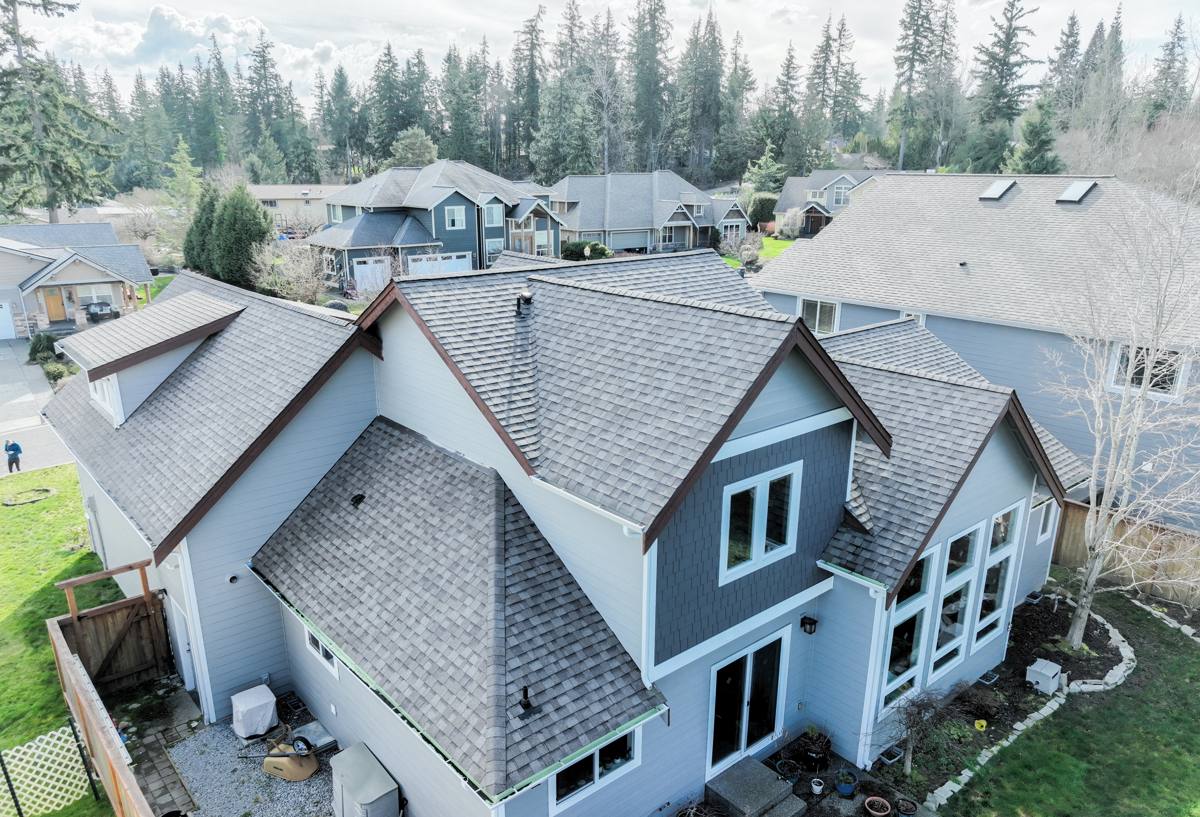
What Local Exposure Actually Does to Siding
Salt Air
Salt-laden air doesn't just sit on a wall — it gets carried by wind and settles into seams, fastener heads, and any spot where two materials meet. Over years, it accelerates corrosion on unprotected metal trim and fasteners, and it can work into the surface of materials that weren't engineered with coastal exposure in mind. Fiber cement itself doesn't corrode, but the fasteners, flashing, and trim details around it still need to be spec'd for it.
Driving Rain
Wind-driven rain doesn't fall — it's pushed. That means water finds its way behind siding at laps, corners, and penetrations far more aggressively than a calm rainstorm would. A siding system's real test isn't whether it sheds water straight down; it's whether the water-resistive barrier, flashing, and lap details behind it keep that sideways-driven water out of the wall assembly.
The Long Moss Season
Whatcom County's shoulder seasons run long and damp. Shaded walls, tree-lined lots, and north exposures stay wet longer than they dry, which is exactly the environment moss and algae need. Siding that absorbs even a little moisture holds onto that dampness and feeds the growth cycle; siding that doesn't absorb moisture starves it.
Why We Standardized on James Hardie
James Hardie fiber cement is engineered from cement, sand, and cellulose fiber — not wood, not vinyl, not a wood-plastic composite. That composition is the reason it doesn't rot, doesn't feed insects, and doesn't swell and contract with moisture the way wood-based products do. For a property near Nooksack dealing with salt air and a long wet season, that's not a marketing point — it's the specific property that keeps siding performing after ten and twenty years, not just after year one.
Hardie's ColorPlus factory-applied finish is baked on under controlled conditions, which gives it more consistent adhesion and UV resistance than field-applied paint. It also matters here for a quieter reason: a factory finish holds up better against the surface staining and mildew growth that damp climates encourage, and when it does eventually need attention, it fades more evenly instead of chalking or peeling in patches.
Hardie also builds region-specific product lines — HZ5 for colder, harsher climates and HZ10 for the Pacific Northwest's wet-but-milder profile. That's an acknowledgment from the manufacturer that siding performance is regional, which lines up with everything we see doing this work in Whatcom County: what performs in a dry inland climate isn't automatically the right spec here.
What We Won't Install Here, and Why
We don't install vinyl, LP SmartSide, cedar, primed spruce, or composite panel products like Cemplank or Allura. None of these are junk products — each has legitimate uses elsewhere. But for this climate specifically, each comes with a trade-off we're not willing to build a reputation on:
- Vinyl expands and contracts with temperature swings, can warp or distort under sustained damp-cold cycling, and its seams are a long-term entry point for wind-driven rain.
- Wood-based products (cedar, primed spruce, LP SmartSide) are organic materials in a climate built to keep them damp — that's a maintenance commitment for the life of the siding, not a one-time install.
- Other fiber cement brands may use similar raw materials but different formulations, warranty structures, and finish processes — we install what we know inside and out, backed by a manufacturer warranty we can stand behind.
We'd rather turn down a job than install something we know will need premature repair or replacement in a coastal Whatcom County climate.
What Correct Installation Involves
Fiber cement siding performs exactly as well as its installation — no better. The material has a strong track record, but that record depends entirely on details most homeowners never see once the wall is closed up.
Water Management Behind the Siding
A weather-resistive barrier, correctly lapped house wrap or building paper, and properly integrated flashing at every window, door, and penetration all have to work together before the first siding board goes up. This is the layer that actually stops wind-driven rain from reaching the sheathing — the siding itself is the second line of defense, not the only one.
Clearances and Fastening
Hardie specifies minimum clearances from grade, roofing, and decking, plus specific fastener types, spacing, and penetration depth. Skipping these isn't a cosmetic shortcut — it's the difference between siding that sheds water the way it's designed to and siding that traps moisture at the bottom edge, which is where a huge share of real-world siding failures start.
Caulking and Joint Treatment
Butt joints, trim transitions, and penetrations need the right sealant, applied correctly, at the right stage of installation. Over-caulking traps moisture just as badly as under-caulking lets it in.
Our Process for a Nooksack-Area Home
- On-site assessment — we look at sun exposure, prevailing wind direction, tree cover, and existing moisture or moss patterns on the current siding before recommending anything.
- Tear-off and sheathing inspection — old siding comes off and we check the sheathing underneath for hidden rot or moisture damage before it gets covered again.
- Water-resistive barrier and flashing — installed and integrated at every penetration, following current best practice, not just the minimum code requirement.
- Hardie panel or lap installation — following manufacturer clearance, fastening, and joint specs exactly, adjusted for the specific exposure of each elevation.
- ColorPlus finish or field-applied topcoat, depending on the product line chosen.
- Final walkthrough — checking caulking, trim, and clearances before we call the job done.
Why a Crew That Already Works This Area Matters
A siding crew that's worked around Ferndale and Nooksack already knows which elevations on a given lot take the worst of the driving rain, where moss tends to establish first, and how far the salt-air exposure typically reaches inland from open water. That's not knowledge you get from a spec sheet — it's knowledge you get from having repaired the failures that happen when those factors get ignored. It shows up in small decisions: extra attention to a north-facing wall that never gets full sun, tighter flashing detail on a corner that catches wind-driven rain, or simply not recommending a product line that looks fine on paper but doesn't hold up to this specific mix of exposure.
Cost Factors for a Nooksack-Area James Hardie Project
| Factor | Why It Affects Cost |
|---|---|
| Tear-off complexity | Multiple layers of old siding or hidden sheathing damage add labor and material |
| Home size and wall complexity | More corners, penetrations, and trim details mean more labor per square foot |
| Product line (HZ5 vs. HZ10) | Climate-matched product selection affects material cost and long-term performance |
| Finish choice | Factory ColorPlus finish vs. field-applied paint changes both cost and maintenance schedule |
| Access and site conditions | Steep lots, limited access, or extensive tree cover can add labor time |
A Homeowner's Pre-Project Checklist
- Ask which Hardie product line is being specified for your specific exposure, not just "Hardie siding" generically
- Confirm the water-resistive barrier and flashing plan before the first board goes up
- Ask how existing moisture or moss issues on your current siding will be addressed at tear-off, not just covered over
- Get manufacturer fastener and clearance specs in writing as part of the scope
- Confirm whether you're getting factory ColorPlus finish or a field-applied topcoat, and what that means for future maintenance
- Ask about the manufacturer warranty terms and whether they transfer if you sell the home
Long-Term Maintenance in This Climate
Even correctly installed fiber cement isn't a walk-away-forever product. In a climate like this, an annual rinse-down of shaded and north-facing walls helps keep moss and algae from establishing, and a periodic check of caulked joints and trim transitions catches small issues before they become water intrusion problems. That said, the maintenance burden is meaningfully lower than wood-based alternatives — there's no repainting cycle driven by rot or insect damage, and the factory finish holds its color far longer than field-applied paint typically does in this kind of sustained damp exposure.
If you're planning a siding project for a home in the Nooksack area or elsewhere around Ferndale, we're happy to walk the property, look at your specific exposure, and put together a straightforward, no-pressure estimate — just fill out the form below.