 Ferndale Exterior
 Why Siding Replacement Works Differently Near the Water
Semiahmoo sits close enough to the water that homes here take on a different kind of weather than siding built for an inland lot ever has to handle. Salt-laden air, wind-driven rain that hits walls sideways instead of falling straight down, and long stretches of gray, damp weather all add up over the years. A siding product or installation detail that holds up fine forty minutes inland can fail early out here — not because it's a bad product, but because it was never asked to do this job.
When we talk about siding replacement in this part of Whatcom County, we're not just talking about swapping old boards for new ones. We're talking about re-engineering the water and moisture management on a home so it actually matches the climate it sits in. That's the whole point of this page: what Semiahmoo homes specifically need, what a correct job looks like, and why it matters who you hire to do it.
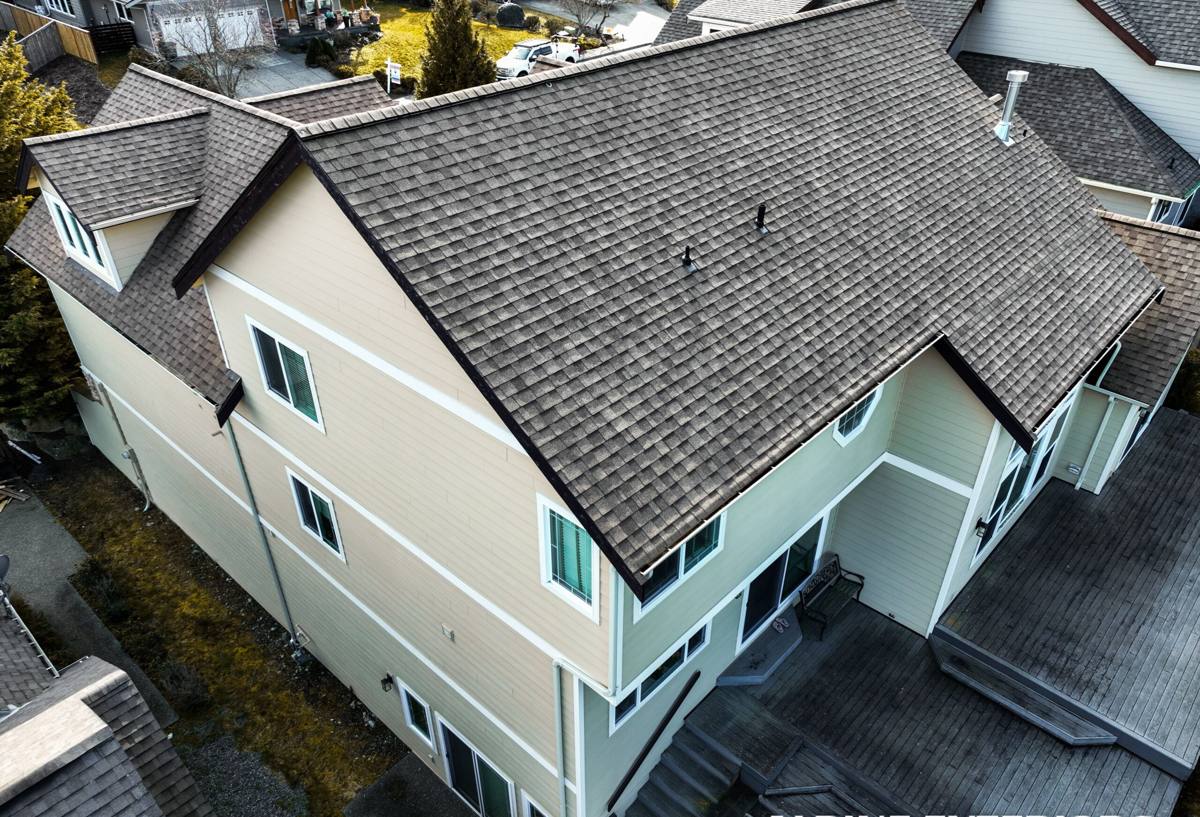
What Salt Air, Driving Rain, and Moss Actually Do to Siding
Salt Air
Airborne salt doesn't just sit on the surface — it works into seams, fastener heads, and any exposed edge of a material that isn't built to resist it. Over years, that accelerates corrosion of fasteners and trim hardware and speeds up the breakdown of coatings and caulking. Siding with a weak factory finish will chalk, fade, or lose adhesion faster near the coast than the same product would inland.
Wind-Driven Rain
Rain that comes in at an angle finds every gap a straight-down rain never would — around window trim, at butt joints, behind poorly lapped courses, at inside corners. On a coastal-exposed home, the flashing details and the way each course of siding overlaps the one below it matter more than the siding material itself. Get those wrong and water gets behind the cladding no matter how good the boards are.
Moss and Algae Season
Whatcom County's long wet season, combined with shaded exposures common on wooded or north-facing lots, gives moss and algae a long runway to establish themselves on siding. On absorbent or porous materials, that growth holds moisture against the wall longer, which compounds any existing rot or delamination issues. A material that resists moisture absorption in the first place has a real advantage here.
Signs a Semiahmoo Home Needs Siding Replacement — Not Just a Repair
Some damage is patchable. Some means the whole assembly behind the siding is compromised and patching just delays a bigger bill. Here's what tells us which situation you're in:
- Soft or spongy spots when you press on the siding, especially near the bottom courses and around window and door trim
- Visible warping, cupping, or separation at butt joints and panel seams
- Paint that won't hold — repeated peeling or bubbling within a year or two of repainting
- Persistent moss or algae staining that comes back within a season of cleaning
- Cracked or missing caulk at trim and corner boards that's let water track behind the wall
- Visible gaps or daylight at seams, especially on the side of the house that takes the worst of the wind
- Interior signs — musty smell, staining, or soft drywall on an exterior wall — that point to moisture getting through
If you're only seeing one or two of these in a small area, a repair might genuinely be the right call. When we come out for an estimate, we'll tell you honestly if replacement isn't necessary yet — there's no reason to sell a full re-side when a section repair solves the problem.
What a Correct Siding Replacement Job Actually Involves
The siding board itself is maybe a third of what determines how a job performs over time. The rest is in details that don't show up in a photo:
Tear-Off and Substrate Check
Full removal of the old siding lets us see the sheathing underneath — which, on a coastal-exposed home, is often where we find the real damage. Any rotted or compromised sheathing gets replaced before anything new goes up. Covering over a bad substrate just hides the problem under new material.
Weather-Resistive Barrier
A correctly lapped and sealed weather-resistive barrier (WRB) is the layer that actually keeps bulk water out of the wall assembly — the siding is the first line of defense, the WRB is the backup that has to work when wind-driven rain gets past it. This is installed to manufacturer spec, not just stapled up quickly.
Flashing at Every Penetration
Windows, doors, hose bibs, vents, light fixtures — every penetration through the wall is a place water can get in if it's not flashed correctly. On a home with real coastal exposure, this is where we spend extra attention, because it's also where most leaks originate.
Fastening and Clearances
James Hardie specifies exact fastener types, spacing, and minimum clearances from grade, roofing, and other surfaces. Following that spec — not just eyeballing it — is what keeps the manufacturer's warranty valid and keeps the installation performing the way the product was engineered to.
Caulking and Paint Details
Factory-primed or factory-finished siding still has field-cut edges and joints that need to be sealed correctly. This is a small step that gets rushed on low-bid jobs and is one of the first places water intrusion starts when it's skipped.
Why We Install Only James Hardie Fiber Cement
We standardized on James Hardie siding for every job we do, including here in Semiahmoo, for reasons that matter more on a coastal-exposed home than almost anywhere else in the county. It's a fiber cement product, not wood or wood-composite, so it doesn't absorb water and swell, delaminate, or feed rot the way some other claddings can once moisture gets past the surface. It's non-combustible, which matters for insurance and long-term risk. And it comes with ColorPlus Technology — a factory-applied finish baked on under controlled conditions, which holds up better against salt air and UV exposure than field-applied paint, with color-specific touch-up available instead of a full repaint down the road.
James Hardie also builds region-specific HZ product lines engineered for different climate zones, so the product going on a Whatcom County home is formulated for a wetter, more marine-influenced climate than the version sold in dry inland regions. Combined with a strong transferable warranty, that's the combination we're willing to stand behind on every home we side — including yours.
How Siding Options Compare for a Coastal Whatcom County Home
| Factor | James Hardie Fiber Cement | Vinyl | Wood / Cedar |
|---|---|---|---|
| Moisture absorption | Very low | Doesn't absorb, but seams can trap moisture behind it | High — absorbs and can swell or rot |
| Salt air resistance | Strong, factory-finished | Can become brittle and discolor over time | Vulnerable without diligent maintenance |
| Maintenance | Low — occasional wash, no repainting for years | Low, but can crack or warp and isn't repairable in sections easily | High — regular painting, sealing, and inspection |
| Fire resistance | Non-combustible | Combustible, can melt/warp near heat | Combustible |
| Typical lifespan (installed to spec) | Decades, with strong warranty backing | Long, but appearance and fasteners degrade in coastal air | Shorter without consistent upkeep |
This table reflects general, well-understood trade-offs between material categories — not a claim about any specific competitor's product. It's why fiber cement is our standard for coastal-exposed homes like yours in Semiahmoo.
Our Process, From Estimate to Finished Job
- On-site evaluation. We walk the exterior, check for the signs listed above, and look specifically at exposures facing prevailing wind and rain.
- Honest scope and estimate. You get a clear breakdown of what needs full replacement versus what can be repaired, with no pressure to over-scope the job.
- Tear-off and substrate repair. Old siding comes off, sheathing is inspected, and any damage found is repaired before new material goes on.
- WRB, flashing, and Hardie installation to spec. Every step follows manufacturer installation requirements, not shortcuts.
- Final walk-through. We go over the finished job with you before calling it done.
Why It Matters That We Already Work in Semiahmoo
A crew that's done siding replacement in Semiahmoo and around Ferndale knows which exposures tend to catch the worst of the wind-driven rain, how long moss season actually runs here, and what fastener corrosion looks like a few years into a coastal installation. That's not something you can fully account for from a general spec sheet — it comes from having worked on homes in this exact environment and seen what holds up and what doesn't. It also means we're a local call away if a question comes up after the job is finished, not a crew that drove in from out of the area for one project.
Caring for Your New Siding in a Coastal Climate
Once new Hardie siding is installed correctly, upkeep is light — but a few habits go a long way near the water:
- Rinse the exterior periodically to clear accumulated salt residue and prevent moss establishment, especially on shaded walls
- Keep gutters clear so overflow doesn't run down the siding face repeatedly
- Trim back vegetation that keeps a wall shaded and damp longer than it should be
- Inspect caulking at trim and penetrations every year or two and refresh it if it's cracking
- Address any impact damage or chips promptly using color-matched touch-up rather than letting the substrate underneath get exposed
If you're weighing a siding replacement for a home in Semiahmoo, we're glad to come take a look and give you a straight answer on what your house actually needs — no pressure, no inflated scope. Reach out for a free estimate using the form below.